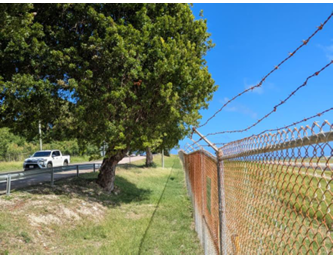
The Antigua and Barbuda Airport Authority (ABAA) will remove three Mahogany trees along the Sir George Walter Highway this Sunday, a step the authority describes as essential to aviation safety as the US$50 million airfield rehabilitation project enters its final phase.
The tree removal exercise is scheduled to begin at approximately 6:30am under the supervision of relevant agencies, including the Police Traffic Department, to ensure the uninterrupted flow of traffic along the highway.
As the airfield upgrade nears completion and aircraft prepare to utilise the full length of the runway, the trees have been identified as an obstruction to the clear line of sight required between the Air Traffic Control Tower and the western end of the airfield.
ABAA Director of Operations Joseph Samuel said the trees present a direct hazard to air traffic management. "Unobstructed visibility is essential for the safe and efficient management of aircraft operations on and around the runway," Samuel explained.
Acting Chief of Air Traffic Services Eugene Silcott reinforced that point, noting that any compromise to controller visibility constitutes a significant safety hazard. "One of the primary responsibilities of an air traffic controller is to prevent collisions between aircraft and other aircraft, vehicles, personnel, or obstacles on the maneuvering area," he said. Silcott added that controllers must also remain vigilant for the presence of wildlife within airport boundaries, making clear sightlines critical before issuing landing or departure clearances. "Safety remains, and must always remain, our highest priority," he stressed.
The ABAA said the decision was not made quickly. Over the years, the authority pursued pruning and ongoing maintenance as mitigation measures. Removing the trees was described as the last remaining option after all alternatives were carefully considered in consultation with key stakeholders and government agencies.
A comprehensive assessment was conducted by the Forestry Unit within the Ministry of Agriculture, with findings confirmed by Senior Forestry Officer Adriel Thibou. The assessment revealed evidence of termite activity and structural deterioration that has significantly weakened the trees, raising the likelihood of failure. The report also determined that the location, height, and canopy spread of the trees encroach on protected aviation safety surfaces and pose an unacceptable risk to aircraft operations, road users, airport personnel, and the travelling public — a risk compounded by their proximity to the highway and their vulnerability during adverse weather conditions.
"Their removal is necessary to eliminate unacceptable hazards, protect human life, and preserve the operational integrity of VC Bird International Airport. This approach aligns with both international aviation safety standards and local forestry best practices, reflecting a precautionary principle that prioritizes safety, visibility, and unobstructed airspace," the Forestry Unit's report concluded.
The ABAA acknowledged the sentimental value many Antiguans and Barbudans attach to Mahogany trees. In recognition of that, the authority is collaborating with the Forestry Unit and the Environmental Division to replant several trees in approved locations. The wood from the removed trees will also be repurposed into functional and commemorative features to preserve a connection to the site's natural history.
"This underscores the ABAA's unwavering commitment to environmental stewardship. While aviation safety is foremost, we also must ensure that our operations are guided by sustainable and proper environmental practices," Samuel said.