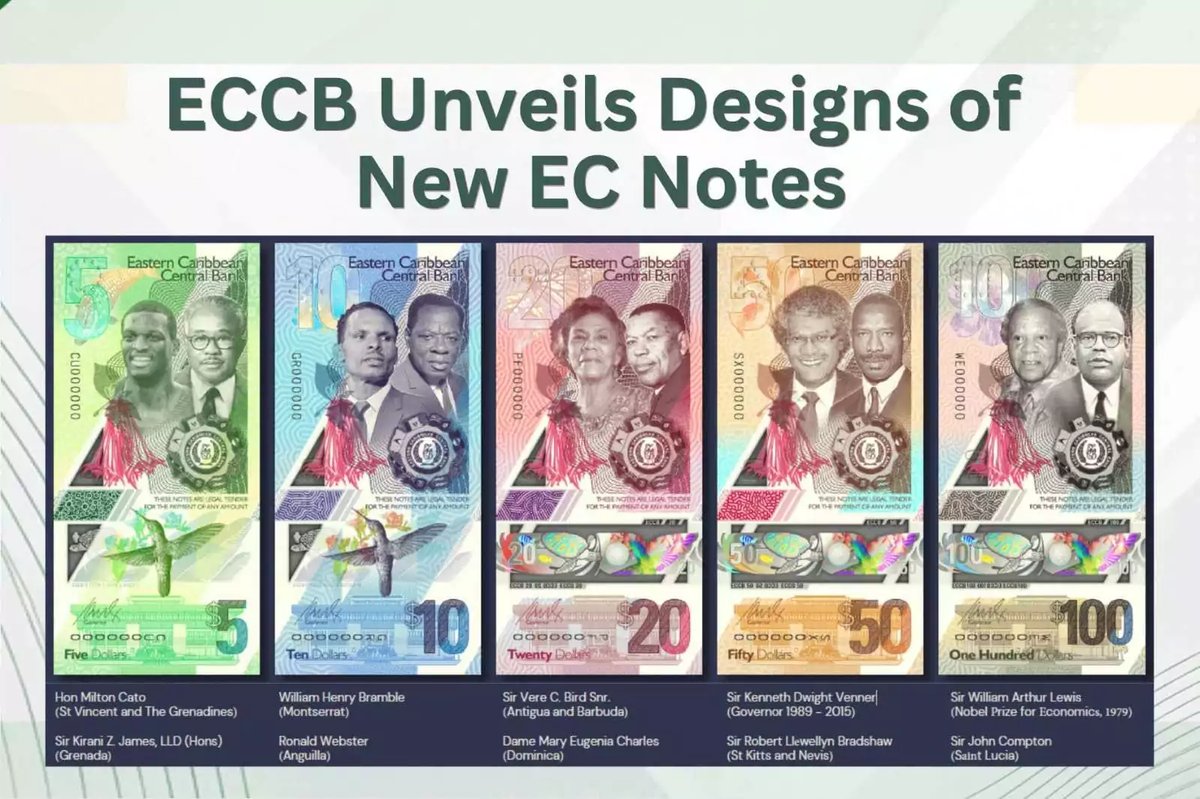
The Eastern Caribbean Central Bank (ECCB) unveiled a redesigned family of banknotes Thursday evening in Dominica, replacing the image of the late British monarch Queen Elizabeth II with ten national icons drawn from across the currency union. According to Antigua.news, the reveal marks the 50th anniversary of the EC dollar peg.
ECCB Governor Timothy N.J. Antoine said the individuals selected for the new notes reflect "the highest ideas of service, leadership, scholarship and excellence." He added that public consultation drove the decision: "The response was clear and compelling. The people called for our currency to honour our own heroes, nation builders and persons whose lives and achievements have enriched our countries and strengthened our region."
The redesigned $5 note features St Vincent and the Grenadines' first prime minister, Robert Milton Cato, recognised for his role as one of the first signatories to the ECCB agreement. Sharing the denomination is Grenada's Olympic sprint champion Sir Kirani James, whose "discipline, humility and sporting excellence have brought distinction to Grenada."
The $10 note carries Montserrat's first chief minister, William Henry Bramble, alongside Anguilla's James Ronald Webster — leader of the Anguilla Revolution and revered as "the father of the nation."
Antigua and Barbuda's founding prime minister, V.C. Bird, a founding architect of the Caribbean Free Trade Association, appears on the $20 note alongside Dominica's Mary Eugenia Charles — the Caribbean's first female prime minister and the first woman to serve on the ECCB Monetary Council.
Sir K. Dwight Venner, who served 26 years as ECCB governor — the longest tenure in the bank's history — remains on the $50 note, now joined by St Kitts and Nevis' first national hero, Sir Robert Llewellyn Bradshaw. The $100 note pairs Nobel laureate economist Sir Arthur Lewis with St Lucia's first premier and prime minister, Sir John George Melvin Compton.
Rosbert Humphrey, the ECCB's director of currency management, explained that the space previously occupied by the monarch's portrait on the front of each note has been filled with the bank's logo, encircled by the flags of the currency union's member territories.
On the reverse sides, most background images remain largely intact, with modest adjustments. St Vincent's Admiralty Bay scene on the $10 note has been replaced with Dark View Falls. Montserrat's note now features the national bird and the Heliconia flower in place of Montserrat House. The $50 note's Brimstone Hill image has been extended to include a canyon — a detail Humphrey described as significant. "Coincidentally, this signifies resilience," he said, noting its placement on the $50 note during the peg's 50th anniversary.
Coins will retain their reverse ship design, with the obverse changing from the monarch's image to the same encircled-logo design used on the banknotes, Humphrey confirmed.
The new notes will co-circulate with existing currency rather than replace it outright, Humphrey said, ensuring that everyone can continue to identify legal tender during the transition period. He added that the bank is still assessing whether a September or October 2026 launch window will hold, or whether the rollout will be pushed into 2027.