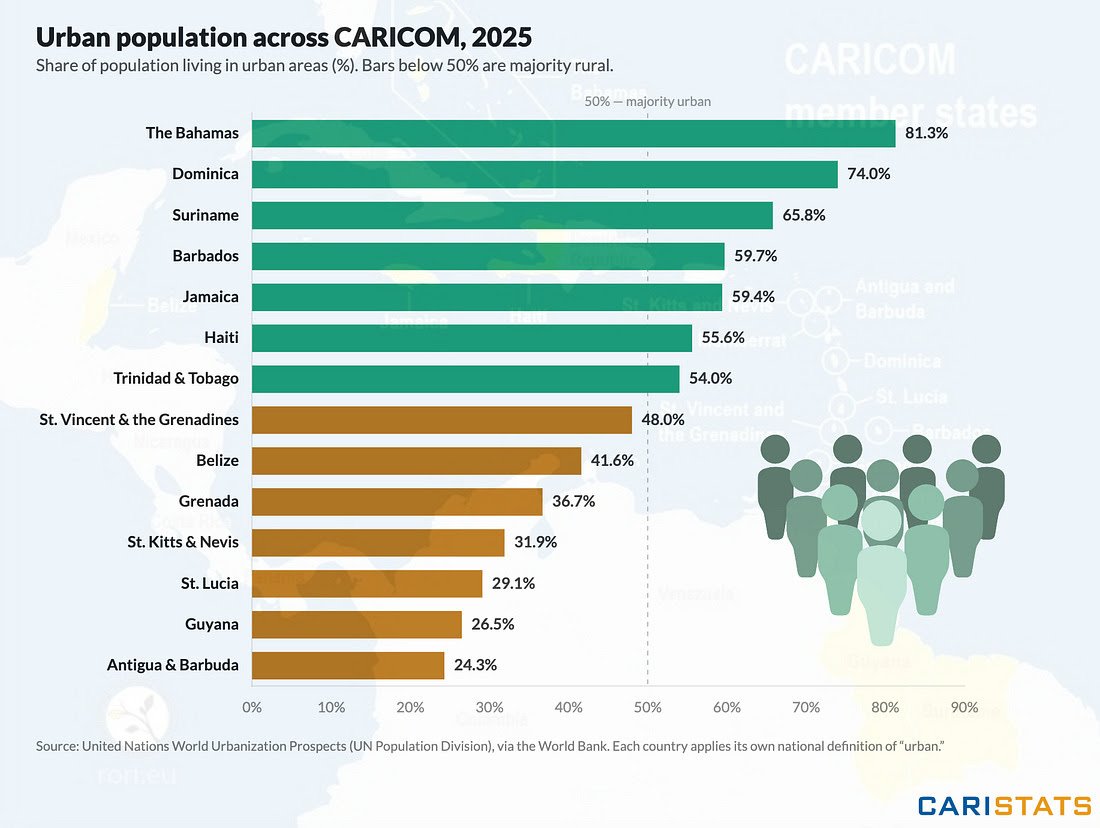
Antigua and Barbuda has the lowest proportion of urban residents among CARICOM member states, according to a new regional analysis. According to Antigua News Room, data drawn from the United Nations World Urbanization Prospects and published by CARISTAT reveals that just 24.3% of the country's population lives in areas classified as urban — the smallest share across 14 member states with available data.
The figures highlight striking variation across the Caribbean bloc. Urban population shares range from Antigua and Barbuda's 24.3% at the low end to 81.3% in The Bahamas at the high end. Dominica follows with 74% and Suriname with 65.8%, both countries where populations are concentrated in a single capital or coastal belt.
Notably, the data does not follow patterns of economic development. Several small, high-income economies register as majority rural. Saint Lucia records an urban share of 29.1%, Saint Kitts and Nevis 31.9%, and Guyana 26.5% — all clustering near the bottom of the regional range alongside Antigua and Barbuda.
Analysts point to inconsistent national definitions as a key factor driving the disparity. Each CARICOM member state classifies "urban" according to its own criteria, which may be based on settlement size, administrative designation, or the nature of local economic activity. As a result, densely settled communities on a compact island can still be counted as rural under a country's official methodology.
The practical consequence, as reported by Antigua News Room, is that the majority of people across much of the region continue to live outside the areas their own governments formally designate as urban — regardless of how built-up or populated those communities may appear on the ground.
The figures are based on 2025 estimates from the United Nations World Urbanization Prospects, compiled by the UN Population Division and accessed via the World Bank.