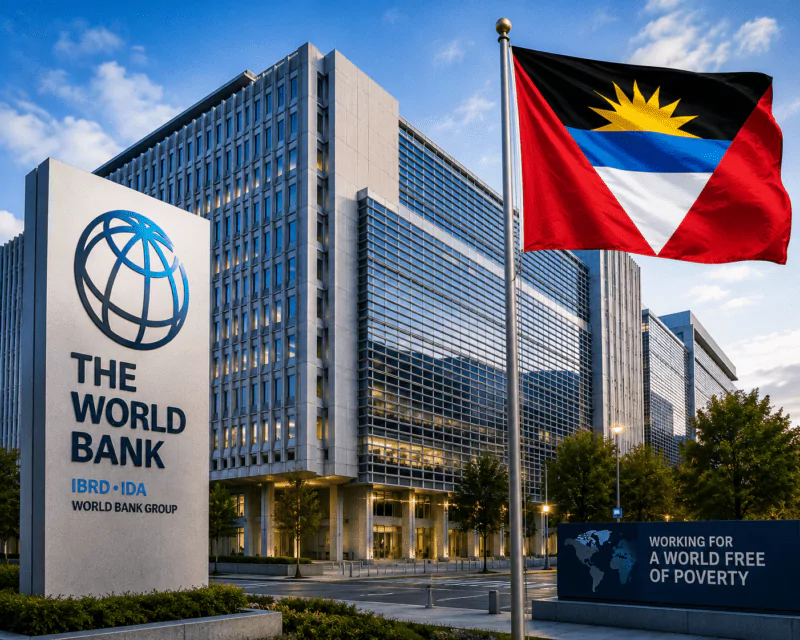
Antigua and Barbuda has been officially classified as a high-income economy by the World Bank, placing the twin-island nation among a select group of countries recognised for relatively high levels of national income. According to Antigua.news, the designation appears in the World Bank's latest Country Income Classification, released on July 1.
The classification is based on each country's Gross National Income (GNI) per capita for 2024, calculated using the World Bank's Atlas Method. To qualify as a high-income economy under the current criteria, a country must record a GNI per capita above US$14,375. Antigua and Barbuda comfortably exceeded that threshold, with its GNI per capita estimated at approximately US$21,380, according to World Bank data.
The achievement places Antigua and Barbuda among just 87 high-income economies worldwide. The country joins Caribbean neighbours including Barbados, St. Kitts and Nevis, Trinidad and Tobago, The Bahamas, and several overseas territories in that grouping.
The World Bank updates its income classifications annually on July 1, dividing economies into four categories — low, lower-middle, upper-middle, and high income. The rankings are used primarily for analytical and statistical purposes and are based solely on GNI per capita, rather than broader measures of development or income distribution.
Gross National Income measures the total income earned by a country's residents and businesses, including income received from abroad, divided by the population to determine average income per person. The World Bank applies its Atlas Method to smooth exchange-rate fluctuations and improve comparability between countries.
The latest classification reflects Antigua and Barbuda's continued economic recovery and expansion following the COVID-19 pandemic, driven by a strong rebound in tourism, construction, investment, and related economic activity.
While the high-income designation is widely regarded as an important international benchmark, economists caution that it does not necessarily mean all citizens enjoy a high standard of living or that income is evenly distributed. The classification measures average national income and does not account for inequality, cost of living, or poverty levels within a country.
Nevertheless, the World Bank's recognition marks a significant milestone for Antigua and Barbuda, underscoring the country's economic resilience and positioning it among the world's highest-income economies in the institution's latest global assessment.