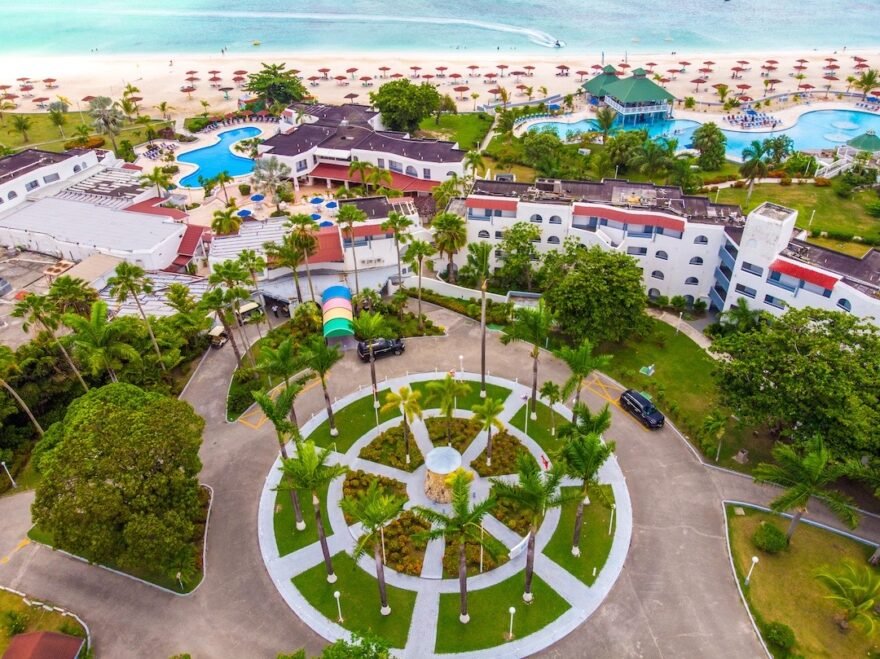
The government has scrapped plans to sell the entire Jolly Beach Resort, opting instead for a hybrid redevelopment strategy that would preserve part of the property while opening a portion to major private investment, Prime Minister Gaston Browne announced Saturday.
According to Antigua News Room, Browne revealed the revised plan during his weekly Pointe FM programme, explaining that the shift came after several international hotel brands expressed interest in acquiring the beachfront property — some proposing to demolish the existing resort entirely and build anew.
Under the new concept, the government intends to retain approximately 200 rooms at Jolly Beach while carving out around 20 acres of land for a private investor to develop a new luxury resort. "We will separate 200 rooms, break down 150, and that will help us to create 20 acres of greenfield land, which we're prepared to give a private investor to develop," Browne said.
Browne noted that both Hilton and Club Med have recently shown interest in the property. Officials from Club Med travelled to Antigua last week seeking at least 20 acres of beachfront land. "They want all of it, and they're thinking about tearing it down and building a completely new hotel. That doesn't help us," he said.
The prime minister argued that allowing a full demolition would leave Antigua without one of its largest tourism properties for several years, inflicting serious economic damage. Jolly Beach currently accommodates approximately 75,000 visitors annually, generating revenue through airport head taxes, hotel profits, and visitor spending.
"Our Airport Authority makes about $20 million a year in head taxes as a result of all those tourists," Browne said. "Then you're going to lose another $4 million or $5 million in profits. That's $25 million. Then the spending in the economy, the different things they buy when they're here, the taxi drivers and so on who are benefiting — you may be losing probably about $30 million to $35 million a year easily."
Should a full redevelopment take five years, Browne warned the cumulative economic loss could surpass EC$100 million. "If we lose over $100 million, our tourism product will fall. That's just not helpful," he said.
The government would retain ownership of approximately 67 acres of the property under the proposed plan, keeping the hotel operational while construction of a new luxury resort proceeds on the adjacent site. Browne added that the government remains interested in transferring at least a portion of Jolly Beach to the Social Security scheme, and that maintaining 200 rooms would allow the property to continue generating income throughout the redevelopment period.
The 20-acre parcel would be marketed exclusively to large international developers with the financial capacity to invest between US$150 million and US$200 million. "This is not for small individuals trying to develop a little portion of the land," Browne said. "This is for a large investor who can come in with probably about US$150 million to US$200 million."
Browne said the revised approach strikes a balance between attracting new investment and protecting employment, visitor arrivals, and public revenue. "All those factors, we have decided not to sell it," he said. "So we can save Jolly Beach."