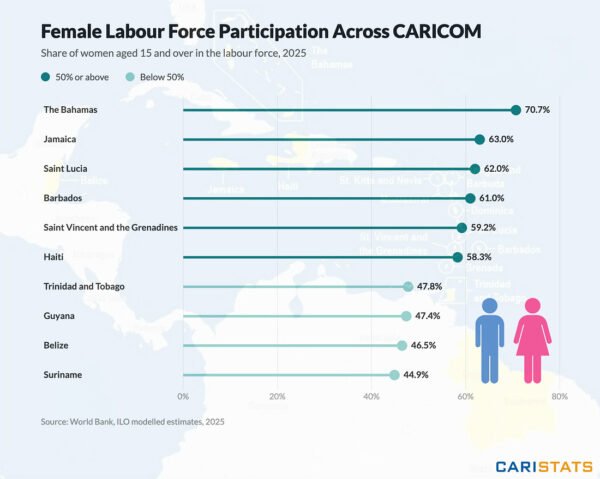
Women's participation in the labour market remains one of the most uneven economic indicators across the Caribbean. According to Antigua News Room, data from 2025 shows that the share of women aged 15 and older who were working or actively seeking work ranged from 44.9% in Suriname to 70.7% in The Bahamas — a gap of nearly 26 percentage points across the CARICOM grouping.
In practical terms, that means fewer than half of all women in Suriname are engaged in the formal labour force, while in The Bahamas the figure approaches seven in ten.
Six CARICOM member states recorded female labour force participation rates above 58%, led by The Bahamas, Jamaica and Saint Lucia. The remaining four nations clustered in the mid-to-high 40s. Guyana, near the lower end of the regional rankings, nonetheless recorded notable progress — rising to 47% from the high 30s recorded in 1990.
The gap between male and female participation rates also varies considerably across the region. In The Bahamas and Barbados, women are nearly as likely as men to be working or seeking employment. The World Bank notes that in both countries, the gender gap in labour force participation is narrower than the average recorded across the world's wealthiest economies. In Belize, by contrast, men remain significantly more likely than women to be active in the labour market.
The Bahamas stands out on both measures — posting among the highest rates of female participation in the region while simultaneously maintaining one of its smallest gender gaps.