A recent opinion piece published by Antigua News Room has reignited debate over the government's handling of the Windfall Tax, with a local business and governance professional pushing back against a proposal to extend and expand the levy.
According to Antigua News Room, Prof. C. Justin Robinson argued in a June 17, 2026 op-ed that the idea to extend and expand the Windfall Tax "deserves national consideration." A respondent — identifying themselves as someone with over 35 years of decision-making experience — agrees the matter warrants broad discussion, but takes sharp issue with how that conversation is being framed.
The central complaint is that the public is being presented with a solution before the underlying problem has been clearly defined. The author argues that sound decision-making requires first establishing the desired measurable outcome, then diagnosing why current systems are falling short, and only then evaluating possible courses of action.
"We are presented with a fix before we are even clued into the problem," the author writes, adding that the proposal to extend and expand the tax reads as a foregone conclusion rather than an open national dialogue.
The author also raises questions about Prof. Robinson's objectivity, noting — without personal criticism — that it would not be in Robinson's institutional interest to advocate for any approach that could reduce funding to the University of the West Indies, which the Windfall Tax was originally designed to support.
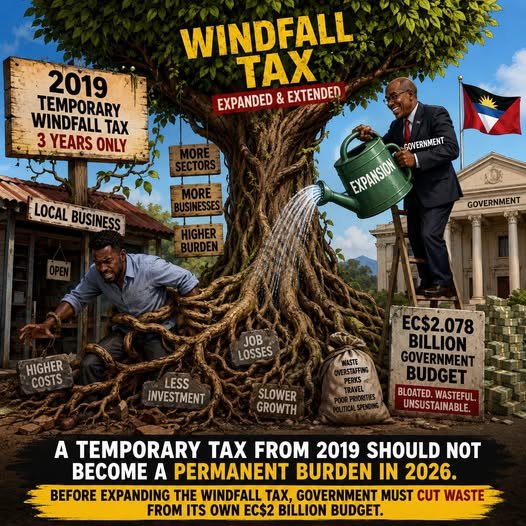
By way of background, the Windfall Tax was introduced in 2019 as a temporary three-year measure to fund the establishment of the UWI Five Islands Campus. It applies exclusively to businesses in the banking, telecommunications, insurance, and petroleum distribution sectors at a rate of 10 percent on net profit — on top of the existing 25 percent corporation tax. The author contends that the government has since repeatedly extended the tax beyond its original mandate.
The author poses nine pointed questions they say must be answered before any expansion is considered. These include: how much the current tax yields annually and how those funds are being spent; how much additional revenue the new proposals would require; what role the existing Education Levy is playing; whether funds could be reallocated from Antigua and Barbuda's recurrent and capital budget, which exceeds EC$2.0 billion; and what steps are being taken to eliminate government waste.
Further questions target the long-term sustainability of the tax, its potential to put private businesses under financial strain — particularly when they must compete with state-owned enterprises — and whether those same state-owned enterprises are meeting their own Windfall Tax obligations.
The author also raises a broader concern about quality, arguing that funding education without defining clear, measurable outcomes risks spending scarce public resources without accountability. "We do not want to merely pay for 'Education' at any cost and quality," the piece states.
On the economic impact, the author warns that widening the tax net could push up the cost of living, noting that every resident already bears an implied burden of approximately $20,000 per year from the government's combined recurrent and capital spending.
The author concludes with a call for transparency: if the extension and expansion of the Windfall Tax is to be a genuine national conversation, the public must first be given the information needed to participate meaningfully in it.
"No taxation without representation," the piece ends.