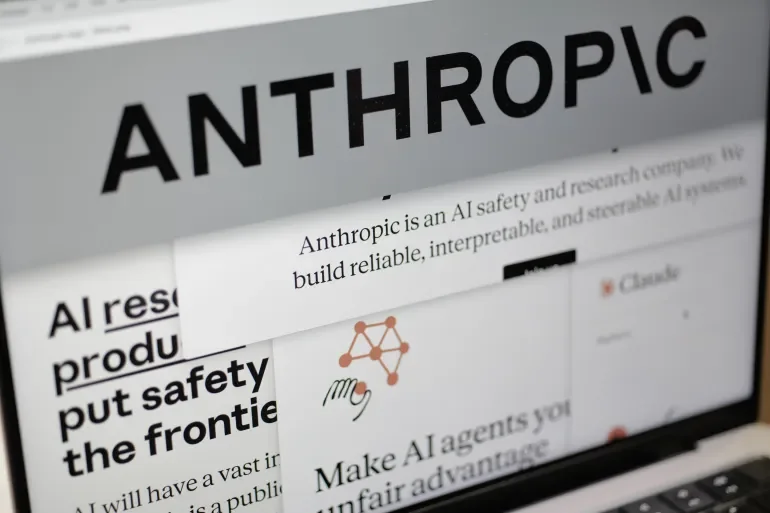
Artificial intelligence company Anthropic is urging the world's leading AI developers to establish a coordinated mechanism to pause or slow the development of advanced AI systems, warning that the technology is advancing so rapidly that humans risk losing control over it. According to Antigua News Room, the company published its position in a blog post on Thursday.
The company behind the Claude chatbot stated that as cutting-edge AI grows increasingly faster at executing tasks, "it would be good for the world to have the option to slow or temporarily pause" its development. Anthropic said its internal research institute plans to explore the issue in collaboration with others and to "take actions" to help build the systems necessary for a credible slowdown or pause, though it stopped short of offering specific details.
Rival company OpenAI took a different position in a report published on Wednesday, arguing that "democratic governments — not private companies acting alone — must ultimately determine the rules, safeguards, and accountability mechanisms." OpenAI added that "decisions about the pace of AI innovation should not be left to any one lab, company, or special interest group."
At the heart of Anthropic's concern is the accelerating speed at which AI models are completing software tasks such as coding autonomously. Based on current trends and sufficient computing power, the company warned that an AI system could eventually design and develop its own successor — a process known as "recursive self-improvement." While such a development could yield significant benefits in science and healthcare, Anthropic cautioned it "also might increase the risks of humans losing control over AI systems."
The blog post was authored by company co-founder Jack Clark and Marina Favaro, head of its research institute. They said any pause would be used to allow "societal structures and alignment research" to keep pace with AI advances. Alignment refers to the effort to ensure AI technology remains consistent with human values and intentions.
The proposed coordination framework would also allow advanced AI labs to verify that global rivals have genuinely stopped or slowed their work, guarding against a scenario where "a bad actor could use the auspices of a coordinated slowdown to jump ahead in secret." Anthropic argued that without such a global mechanism, a unilateral slowdown could simply allow the "least cautious" players to gain ground, adding pressure on companies and governments already wrestling with difficult AI safety decisions.
Anthropoc's call comes alongside a separate warning from researchers at the University of Toronto, who demonstrated how AI tools could be used to create a new type of AI "worm" capable of adapting its hacking strategy as it spreads between devices and takes over large computing networks. Lead researcher Nicolas Papernot, who notified Canadian cybersecurity authorities before releasing the findings, said the worm was developed in a laboratory using an open-source AI tool that software developers can cheaply access and modify.
"I think it's really important that people understand that it's not just the biggest, most powerful language models that pose the security concerns," Papernot said.
Papernot noted that while cyberattackers have historically targeted high-value systems — including banks, hospitals, electricity grids, water treatment facilities, and schools — the falling cost of AI-powered attacks has expanded the pool of potential targets dramatically. "That old laptop you have in your basement that you don't check on regularly doesn't seem like a very high-value target, but it can be used as a launch pad to attack these higher-value targets," he said. "Anything connected to the internet is now at risk because of how low the cost has become to mount these cyberattacks."
Papernot called for greater collaboration between companies, government agencies, and academic researchers to develop countermeasures against AI-powered hacking tools.
The push for a pause is not new. In 2023, a coalition including Elon Musk, who owns AI lab xAI, backed a non-profit Future of Life Institute campaign urging a six-month halt to AI development to allow time for safety guardrails to be established. That effort had little practical impact.
Regulation has moved slowly, particularly in the United States, where most leading AI labs are headquartered. A Trump administration executive order issued this week placed responsibility largely on the labs themselves, asking them to voluntarily submit their most capable models for government cybersecurity testing before public release.
Anthropics's warning arrives amid broader scrutiny of the company. Earlier this year, it declined to allow the US military to use its models for domestic surveillance and fully autonomous weapons, a decision that prompted government backlash and placed it on a national security blacklist set to take effect later in 2026. The company also noted that its own Mythos model sent shockwaves through industries including banking and software earlier this year due to its ability to identify vulnerabilities in existing code.
Anthropics's call for a pause comes as both it and OpenAI prepare for potential stock market listings. An IPO could value Anthropic at nearly a trillion dollars.