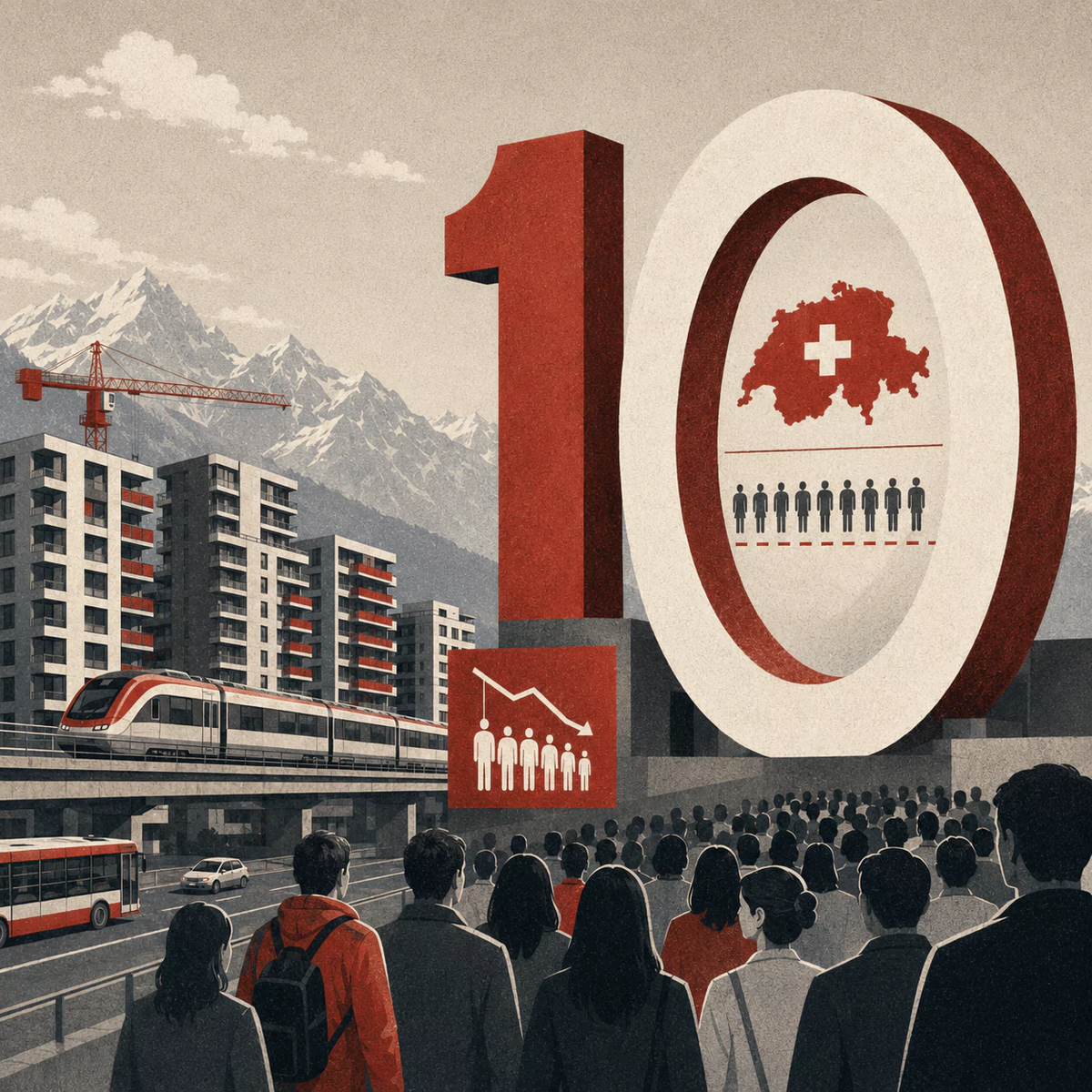
On June 14, Swiss voters will decide whether to constitutionally limit their country's population to 10 million people — a vote that, according to Antigua.news, carries consequences reaching far beyond a single demographic threshold and into the heart of Switzerland's relationship with the European Union.
The proposal, formally titled "No to a Switzerland with 10 million! — Sustainability Initiative," is backed by the right-wing Swiss People's Party, known by its German acronym SVP. It would require Switzerland's permanent resident population to remain below 10 million until 2050. Should the population exceed 9.5 million before that date, the Federal Council and parliament would be obliged to act, particularly on asylum and family reunification policy. A breach of the 10 million threshold could force Switzerland to terminate international agreements that contribute to population growth — including its free movement accord with the European Union.
That legal chain reaction is what gives the vote its weight. Free movement is not a standalone arrangement. It forms part of the Bilateral Agreements I, a package of treaties underpinning much of Switzerland's access to the EU's single market. The government has warned that terminating the free movement accord would render the other treaties in that package null and void. Switzerland's participation in the Schengen passport-free travel area and the Dublin system for allocating asylum responsibility would also be called into question.
Switzerland had approximately 9.1 million residents at the end of 2025. Since the introduction of free movement with the EU in 2002, its population has grown by around 1.7 million, driven largely by immigration. That growth has been shaped less by ideology than by labour demand. Hospitals, care homes, engineering firms, hotels and financial institutions have all relied on European workers to keep the Swiss economy functioning.
The SVP has built a potent political message from the everyday frustrations of a prosperous but crowded country: packed trains, rising rents, congested roads, shrinking green space, and a widely felt sense that the Swiss way of life is under strain. The party's core argument is direct — population growth has become a substitute for productivity, and immigration has become a hidden tax on housing, infrastructure and social cohesion.
The opposition to the initiative is unusually broad. The Federal Council, Switzerland's seven-member executive, has urged voters to reject it, warning of serious damage to EU relations and the wider economy. Cantonal governments, trade unions and employer groups have also aligned against the measure, arguing that a hard population ceiling would restrict labour supply, weaken businesses and complicate cooperation on security and migration.
For Swiss business, the stakes are structural. Switzerland is not an EU member, but it functions as a deeply integrated outsider. Its exporters, universities, pharmaceutical groups and high-tech manufacturers depend on reliable access to European workers, customers, research networks and regulatory frameworks. To them, the cap is not about headcount alone — it is about access.
The anxiety driving the initiative, however, is not easily dismissed as populism. Reuters reported this week from Knonau, a village near Zug, where residents described the pressures created by rapid construction, rising prices and stretched public services. Knonau's population has risen by almost 150 per cent since 1990 — far above the national average — making it a symbol of the growth pressures felt in Switzerland's most dynamic regions.
The initiative's weakness lies in its arithmetic. Migrants are counted as pressure on housing and infrastructure, but they are also part of the workforce that builds homes, staffs hospitals, funds pensions and sustains business competitiveness. Switzerland's underlying problem is not simply that too many people want to live there. It is that the country has been slow to build, slow to densify and slow to demonstrate how openness can be made compatible with domestic comfort.
Polling has made the outcome difficult to predict. A 20 Minuten and Tamedia survey published in late April found 52 per cent support for the initiative. A subsequent trend poll by the research institute gfs.bern, conducted for the Swiss Broadcasting Corporation — known domestically as SRG SSR — put the race at a dead heat, with 47 per cent in favour and 47 per cent opposed. The campaign has also become one of the most expensive in Switzerland's recent voting history. Swissinfo reported that supporters and opponents had combined declared budgets of 15.52 million Swiss francs by mid-May, the highest figure since mandatory budget reporting was introduced.
A yes vote would not immediately close Switzerland's borders or its economy. But it would embed a hard demographic ceiling in a political system that has long preferred managed ambiguity. It would signal to Brussels that free movement is conditional, warn companies that labour supply is subject to political rationing, and tell Swiss voters that the discomforts of growth can be resolved through constitutional arithmetic.
A no vote would not dissolve those discomforts. Housing shortages, infrastructure bottlenecks and immigration unease would remain. The harder work would start the morning after: building faster, planning more effectively, investing in transport and schools, and making the case that openness and order can coexist.
The question before Swiss voters on June 14 is ultimately not whether 10 million is too many people. It is whether a country that grew rich by combining sovereignty with market access, caution with ambition, and order with openness can still make that formula credible to its own citizens — and whether it will answer the pressures of success with planning, or with a stop sign.