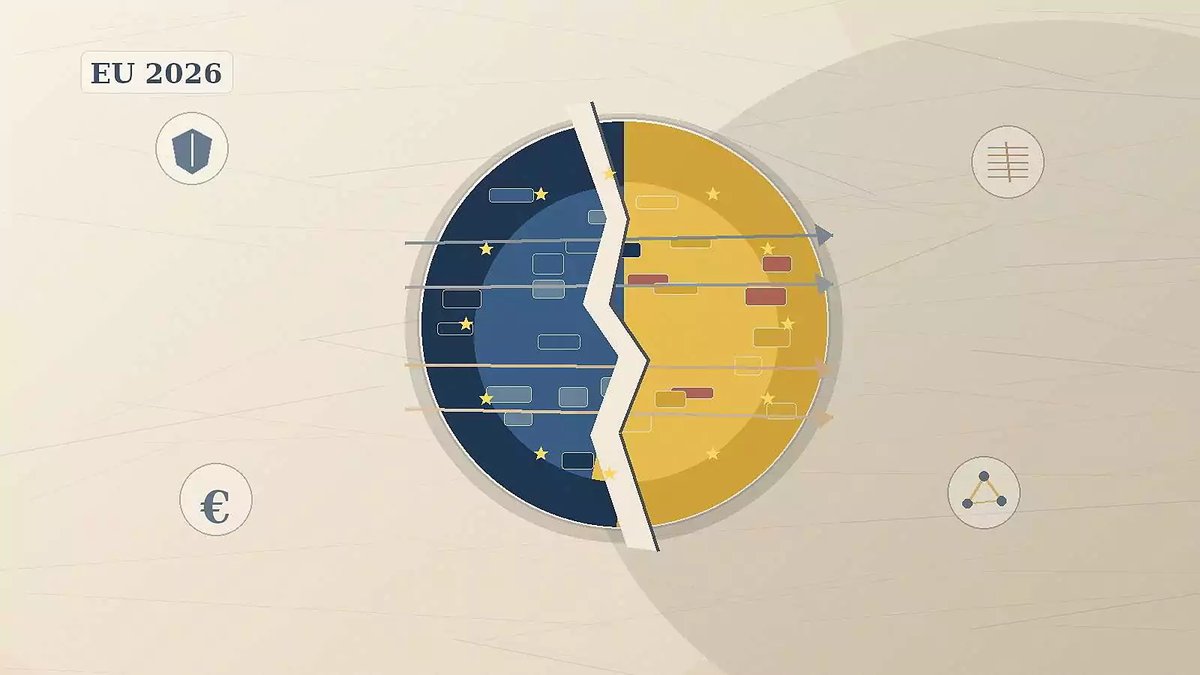
The European Union in 2026 is no longer divided simply along the familiar lines of north versus south, or creditor versus debtor. According to Antigua.news, the bloc is now split between member states that view deeper integration as a matter of survival and those that still treat national sovereignty as their most guarded asset.
Europe has long operated by a familiar crisis reflex — moving slowly, then suddenly, inventing new instruments under pressure and arguing afterward over whether those instruments represent temporary exceptions or the foundations of a more federal union. In 2026, that method is being tested simultaneously across nearly every strategic file: defence, fiscal policy, migration, enlargement and the transatlantic alliance.
The result is not the old "two-speed Europe" of eurozone insiders and opt-outs. It is something more awkward — a union that aspires to act as a geopolitical power while remaining, on its most sensitive questions, a confederation of national vetoes. The phrase circulating in European capitals — 27 armies, no unified command — is blunt but effective. It captures the central contradiction: Europe is rearming, but it is not yet integrating.
Defence: More Spending, Less Integration
The war in Ukraine and the return of hard-power geopolitics have forced the EU to revisit assumptions that stood for decades. The European Commission and the EU's foreign policy arm presented the White Paper for European Defence — Readiness 2030 in March 2025, alongside the ReArm Europe/Readiness 2030 package. The initiative was designed to create financial levers for a surge in defence investment and to close critical capability gaps, including joint procurement incentives and fiscal flexibility for defence spending.
The political economy of rearmament, however, is uneven. The eastern flank views the Russian threat as immediate and existential. Southern member states must balance defence priorities against migration pressures, debt burdens and social spending demands. Northern countries remain wary of open-ended common borrowing. NATO's European allies and Canada increased defence spending by 20 per cent in real terms in 2025, as reported by Reuters, while NATO leaders have agreed a target of 5 per cent of GDP for defence and security-related spending by 2035. Poland wants that target reached by 2030.
This dynamic has created a new internal hierarchy. Poland and the Baltic states speak in the language of urgency. France advocates strategic autonomy alongside industrial preference. Germany is spending more but remains cautious about debt and escalation. Italy and Spain support stronger European instruments yet face domestic fiscal constraints. Smaller neutral or historically non-aligned states fear being drawn into a security architecture whose rules they did not shape.
The practical challenge is industrial as much as political. Euronews has reported persistent disputes over eligibility rules in EU defence-industrial negotiations, with France pushing for stricter European preference and Poland seeking broader procurement options. Defence sovereignty, the same report noted, remains jealously guarded by national governments. More spending alone does not produce strategic power. Without common procurement, interoperable systems, shared stockpiles and credible command arrangements, the EU risks assembling a larger arsenal made up of national fragments.
Fiscal Policy: Public Goods or Permanent Liabilities?
Fiscal policy is the second major fault line. The EU's new economic governance framework, in force since April 2024, was designed to balance debt sustainability with growth-enhancing reforms and priority investments. It grants member states more ownership through medium-term fiscal plans while preserving safeguards around debt reduction and the 3 per cent deficit reference value.
That compromise is already under strain. Defence, energy security, industrial policy and demographic pressures all require significant funding. The central question is whether Europe treats these as national budget items or as European public goods requiring collective financing.
A recent IMF warning, reported by Reuters, argued that the EU will need a combination of reform, consolidation and joint borrowing to meet rising defence, energy and pension costs. The same warning noted that France, Italy and Spain are more open to joint borrowing, while Germany and several northern states remain opposed.
This is not merely a technocratic dispute. It is a struggle over the political meaning of the single market. If defence infrastructure, energy grids, critical minerals and digital networks are European necessities, then rigid national austerity rules may become strategically self-defeating. But if common debt becomes the routine answer to every shared pressure, northern creditor states fear the EU will drift into a transfer union without the democratic architecture required to sustain it.
Migration and Asylum: Solidarity Without Consensus
Migration adds a third layer of division. The Pact on Migration and Asylum, adopted in 2024, is due to enter application on 12 June 2026. It promises stronger external borders, faster procedures, clearer asylum rules and a framework balancing responsibility with solidarity.
Here again, geography and political incentives divide the bloc. Countries of first entry want solidarity to mean relocation, funding and genuine burden-sharing. Destination countries want fewer secondary movements and faster returns. Central and eastern governments frequently resist mandatory redistribution. Mediterranean states warn that without meaningful support, external border control becomes a national burden for a European-scale problem.
The compromise language — "flexible solidarity," "safe third countries," "external partnerships" — conceals sharp underlying disagreements. Some governments favour offshore processing and stronger return mechanisms. Others warn that outsourcing asylum decisions will erode legal obligations and undermine the EU's identity as a rights-based power. In practice, Europe is attempting to construct a common asylum system in the absence of a common political consensus on asylum itself.
Enlargement: Credibility Versus Governability
Enlargement is arguably the most strategic and potentially destabilising question of all. Ukraine's accession has taken on the character of a geopolitical imperative since Russia's full-scale invasion. Moldova has advanced in the process. Georgia remains part of the eastern enlargement conversation. The western Balkans have waited long enough to place the EU's credibility on the line.
The Commission's 2025 enlargement package indicated that Ukraine had completed screening and met conditions to open several negotiating clusters, while Albania was described as making significant progress. But enlargement amplifies every existing internal division. A larger union would require revisiting voting rules, the budget, cohesion policy, agricultural spending and the composition of EU institutions.
A study by the German Institute for International and Security Affairs (SWP) found that, incorporating the six western Balkan states, Ukraine, Moldova and Iceland, the EU could become a union of 35 or more members — a scale that would require fundamental reforms to decision-making processes, the European Parliament and the principle of one commissioner per member state.
This is the enlargement paradox. The EU must expand to maintain geopolitical credibility, but it must reform to remain governable. Delaying enlargement leaves vulnerable democracies in a strategic grey zone. Enlarging without institutional reform risks importing paralysis into a system already constrained by unanimity requirements.
Western Alliances: Indispensable, Less Predictable
The relationship with the United States and the broader western alliance is the final accelerating factor. Europe remains embedded in NATO and the G7, but the assumption of automatic American primacy is fading. Washington wants European allies to shoulder more of the conventional defence burden. European leaders, meanwhile, must navigate a relationship with a US partner that remains indispensable but increasingly less predictable.
The G7 still presents a united front on key diplomatic positions, though the internal dynamics of that alliance — much like those within the EU itself — reflect a moment in which the rules and assumptions of the post-Cold War order are under sustained pressure.