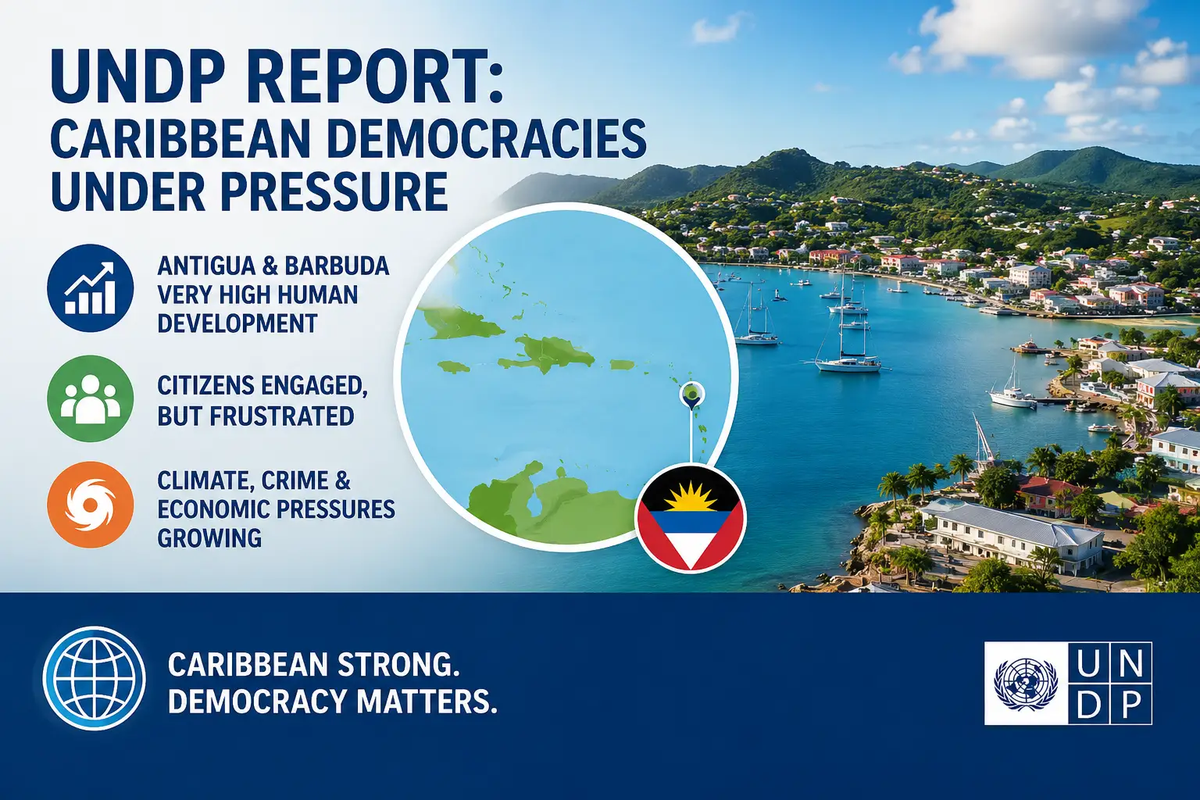
A new United Nations Development Programme report has ranked Antigua and Barbuda among the Caribbean's top-performing nations in human development, while sounding the alarm over mounting pressures on democratic governance across the region. According to Antigua News Room, the findings are contained in the Democracy and Development Report 2026, released by the UNDP.
The report assigns Antigua and Barbuda a Human Development Index score of 0.851, placing the twin-island nation in the Caribbean's "Very High Human Development" category alongside other regional states.
The report examines democratic governance and development trends across Latin America and the Caribbean, covering Antigua and Barbuda, Barbados, Jamaica, Trinidad and Tobago, St. Lucia and other CARICOM member states.
While describing the Caribbean as a region of generally stable democracies, the UNDP warns that governments are increasingly strained by rising insecurity, public dissatisfaction, economic vulnerability and climate-related pressures.
"The Caribbean does not contribute to global warming, but it does feel the effects of environmental degradation deeply," the report states. It adds that natural disasters continue to increase debt burdens and undermine development goals across the region.
The report also raises concerns over organised crime and arms trafficking, noting that many of these threats originate outside the Caribbean.
Despite these pressures, political participation remains relatively strong in many Caribbean countries. Antigua and Barbuda was specifically included in the report's parliamentary voter turnout analysis as an example of continued civic engagement.
However, the UNDP identifies growing public frustration over corruption, economic performance and the delivery of government services. The report notes that citizen engagement is increasingly channelled through civil society organisations and advocacy movements rather than traditional political structures.
The report stops short of predicting democratic collapse, but argues that Caribbean governments face increasing pressure to improve governance, strengthen institutions and respond more effectively to citizens' demands.
Regional efforts through CARICOM also receive attention, with the report highlighting initiatives focused on gender equality, youth empowerment, crime prevention and social protection.
The UNDP concludes that stronger social safety nets and sustained collaboration with international organisations will be critical to preserving democratic stability and advancing sustainable development across the Caribbean.