Dear Editor,
Every election cycle, governments promise more land and more housing. It is politically popular, emotionally appealing and, for many families, tied to the dream of finally owning something of their own. But as reported by Antigua News Room, one resident is urging the nation to confront a harder truth before that dream consumes the very resource it depends on.
Antigua and Barbuda has only a limited amount of land. Yet the dominant development model remains unchanged — one family, one house, one plot. Entire communities are being carved into thousands of small lots, roads are pushing deeper into undeveloped areas, and successive governments continue opening up more acreage for residential sales as though land scarcity is not already on the horizon.
This approach may have been workable decades ago, when the population was smaller, land was cheaper and development pressures were lower. Today, the math no longer holds.
Every new subdivision demands roads, electricity, water lines, drainage, schools and transportation access. Sprawling development is costly for taxpayers and environmentally destructive for a small island already vulnerable to climate change, flooding and water scarcity.
The long-term consequences are stark. How much land will remain in 30 or 40 years if every generation repeats the same pattern? What happens when agricultural land disappears? When green space vanishes? When young people can no longer afford land because supply has been exhausted or concentrated in private hands?
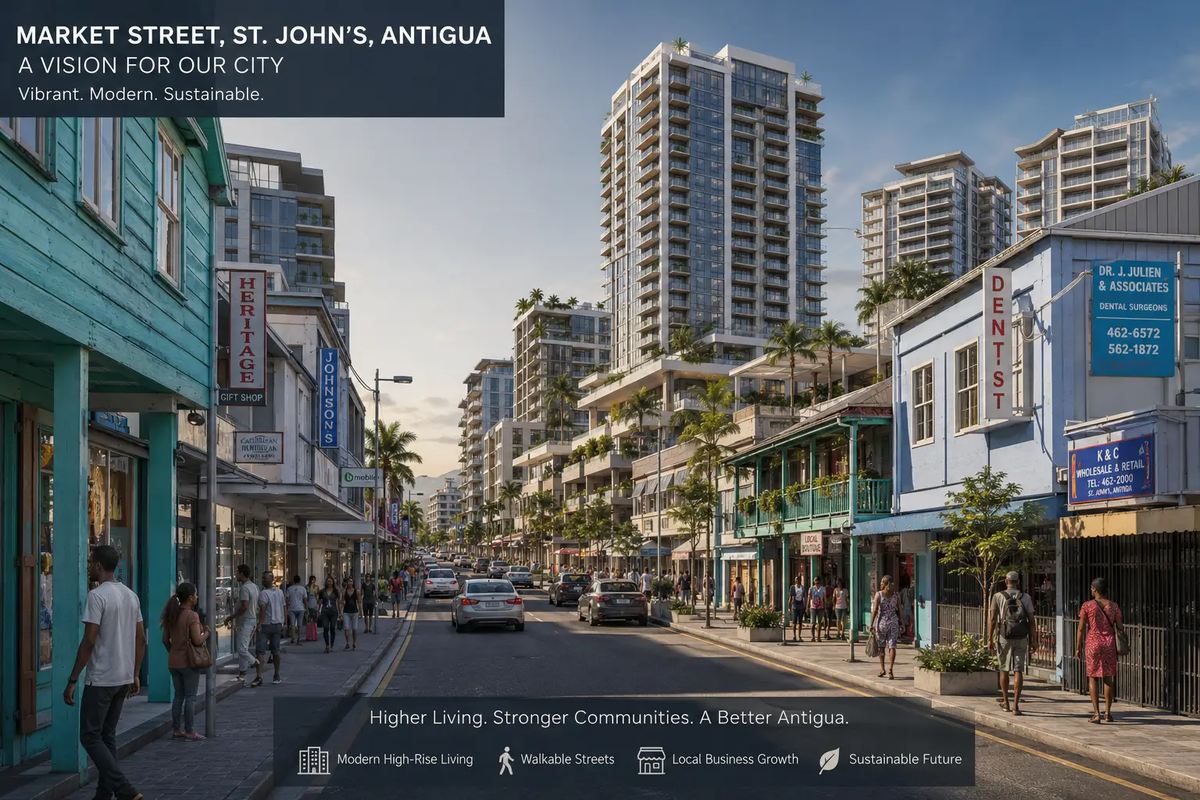
Antigua and Barbuda must begin seriously exploring higher-density housing solutions. The future cannot be endless subdivisions stretching farther into the countryside. It must include apartment buildings, townhouses, condominiums and properly planned high-rise residential developments in suitable urban areas.
For too long, many Caribbean societies have treated apartment living as inferior to detached homes. But across the world, densely populated and highly developed nations have accepted that vertical living is necessary where land is limited.
A well-designed apartment or condominium can deliver affordable housing while preserving large amounts of land. Shared infrastructure is more efficient. Public transportation becomes easier to support. Utilities are cheaper to extend. More people can live closer to jobs, schools and services, rather than pushing urban sprawl ever outward.
This is not an argument against homeownership. It is an argument for sustainability and realism. The dream of owning a home should not become the nightmare of exhausting an island's land supply.
Antigua and Barbuda is a small state. Small states cannot sustain large-country land policies indefinitely. The conversation may be uncomfortable, but it is necessary — because if the current pace of land consumption continues without changing how the nation builds, future generations may inherit an island where land ownership is no longer attainable at all.
Marcus Jeffers