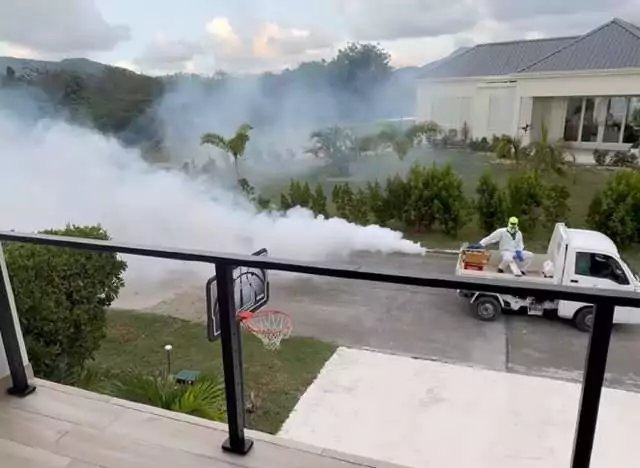
Mosquito fogging operations in parts of Jolly Harbour have been temporarily suspended following a High Court hearing, as a legal dispute between a homeowner and a developer continues to unfold. According to Antigua.news, the halt came after proceedings on May 5, 2026, before Madam Justice Birnie Stephenson.
The matter involves freeholder Cyprian Kowalczyk and Caribbean Developments (Antigua) Limited (CDAL). Kowalczyk filed his application on April 14, 2026, with the case first set down for April 28 — a notably swift turnaround for a contested civil matter. He said the hearing was later rescheduled to May 5 at approximately one hour's notice.
Kowalczyk, who is representing himself, raised several procedural concerns during the hearing. He stated that while he was permitted to address the bench, he was not allowed to sit at counsel's table and instead had to use spare chairs in the well of the court to hold his materials, laptop, and microphone. He argued this arrangement is difficult to reconcile with Rule 1.1 of the Eastern Caribbean Supreme Court Civil Procedure Rules 2023, which requires that cases be dealt with justly and that parties be placed, as far as possible, on equal footing. He said the arrangement placed him at a structural disadvantage against a defendant with full legal representation.
Kowalczyk also stated that several fellow Jolly Harbour freeholders who attended the hearing in support of his case were not admitted to the courtroom. He said the judge indicated the matter was being heard in chambers. While Section 15(9) of the Constitution of Antigua and Barbuda provides that proceedings should ordinarily be held in public, Section 15(10) permits certain interlocutory matters to be heard in chambers. Kowalczyk questioned whether the chambers designation alone justified the exclusion of other freeholders directly affected by the same fogging programme.
Concerns were also raised during the hearing about both the volume of materials submitted and the nature of the evidence presented. Kowalczyk said he filed approximately a dozen peer-reviewed scientific studies and a similar number of legal authorities, many running between 20 and 30 pages. He described this as a challenge inherent to self-represented litigants — submitting too little material risks criticism that a case has not been properly made out, while submitting extensive documentation may draw objections about volume.
Among the evidence presented was a photograph exhibited to an affidavit sworn by his wife, showing swelling around their eleven-year-old daughter's eyes on April 28, 2026, taken approximately one day after a fogging event. Kowalczyk said the court questioned why no medical expert report had been filed and raised the possibility that the image could have been generated by artificial intelligence, despite his wife having sworn under oath that she took the photograph. He maintained that expert medical reports are not required at the interim stage of proceedings and noted that an official audio recording of the hearing exists as the authoritative record.
In his substantive submissions, Kowalczyk framed the central issue as whether one freeholder may release a chemical mist from its land that drifts onto another freeholder's property, interfering with that owner's use and enjoyment of their home and their natural right of way to the public road. He argued that the common law does not permit such interference. He also cited a United States court decision in which similar relief — including a buffer zone preventing a truck-mounted ultra-low-volume mosquito fogger from operating near a private home — was granted on comparable facts, arguing the relief he seeks is neither new nor unprecedented.
Addressing concerns raised from the bench about mosquitoes as a public nuisance and disease vector, Kowalczyk acknowledged having contracted dengue fever himself. However, he argued that scientific studies submitted to the court indicate that high-frequency adulticide fogging does not effectively reduce mosquito populations and may worsen the problem by eliminating natural predators and promoting chemical resistance. He pointed to alternative control methods — including larviciding with Bacillus thuringiensis israelensis (Bti), source reduction, and biological control — noting that his application does not seek to restrain any of these approaches.
On health and safety grounds, Kowalczyk noted that the manufacturer's label for the chemical product Zenivex E20 limits applications to no more than 25 per site per year. He stated that more than 36 spray events had already taken place in the area by the time of the hearing, exceeding the recommended annual limit with several months still remaining in the year. He said this threshold is based on safety risk assessments by the United States Environmental Protection Agency designed to protect vulnerable populations, including toddlers. He also noted that fogging frequently occurs in areas where residents, including mothers with young children, are present.
On the question of legal authority, Kowalczyk argued that no contract, statute, or regulatory licence permits CDAL to release chemical aerosol onto his registered freehold land. He challenged the characterisation of Jolly Harbour as a managed community, describing it instead as a "scheme of development" in which individual buyers hold independent registered titles. He added that while CDAL continues to demand payments related to his property, those matters are the subject of separate legal proceedings and form no part of the current application.
The court also examined whether pre-action efforts had been made to resolve the dispute. Kowalczyk stated that correspondence presented to the court shows CDAL's attorneys have not responded to him since May 2025, despite written objections sent in January, March, and April 2026 requesting that fogging in the vicinity of his home be stopped.
Following submissions, the court ordered a temporary halt to mosquito fogging near Kowalczyk's property. The matter is scheduled to return before the court on June 4, 2026, when the terms and duration of any continuing relief are expected to be considered.
The proceedings are ongoing.