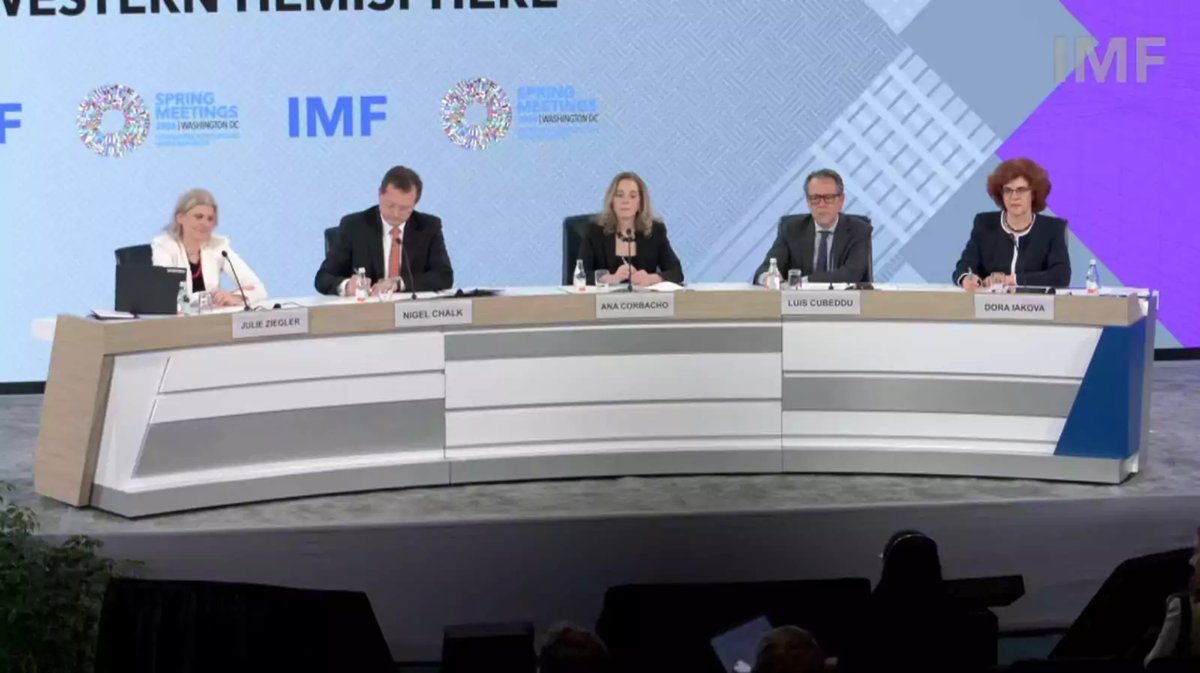
The International Monetary Fund has identified tourism-dependent Caribbean economies — including Antigua and Barbuda — as the most vulnerable group in the Western Hemisphere to the economic fallout from the ongoing Middle East war. According to Antigua.news, IMF Western Hemisphere Department Director Nigel Chalk delivered the warning Thursday during the fund's press briefing for the April 2026 Regional Economic Outlook, held as part of the IMF's Spring Meetings.
"We are very concerned that tourism-dependent Caribbean economies are likely to be the hardest hit," Chalk said. "Their debt is high, their fiscal space is small, and they're quite large net energy importers, even despite investments that have been made in these countries in shifting towards renewables."
The IMF's April 2026 Regional Briefing identifies the tourism-dependent Caribbean subgroup — which includes Antigua and Barbuda, Barbados, Grenada, St. Kitts and Nevis, St. Lucia, Dominica, and St. Vincent and the Grenadines, among others — as carrying a net oil import burden of negative 7.3 percent of GDP. That figure represents the heaviest energy import exposure of any grouping in the hemisphere.
The subgroup's 2026 real GDP growth projection has been revised down by 1.1 percentage points from the fund's October 2025 forecast. Growth is now expected at just 0.9 percent for the year, before partially recovering to 2.5 percent in 2027.
Chalk also flagged uncertainty surrounding the tourism sector itself, a critical revenue source for the subregion. "We also don't know what the potential impact of this war and the shifts in energy prices may have on flights and on tourism, and so that's another thing we're keeping an eye on," he said.
The IMF director noted that the hemisphere had entered 2026 on relatively solid footing before the conflict introduced new pressures. "For most countries, growth was close to potential, output gaps were largely closed, and inflation was at target," Chalk said, adding that the region had adapted to shifts in US tariff policy more effectively than earlier forecasts had anticipated.
On the question of fiscal response, Chalk urged Caribbean governments to exercise restraint when it comes to energy subsidies. While acknowledging that several countries already have mechanisms to smooth energy price increases and limit immediate pass-through to consumers, he cautioned strongly against making such arrangements permanent.
"What we don't want is for countries to permanently increase subsidies to energy," he said. "Those subsidies are untargeted. They benefit the rich more than they benefit the poor."
Chalk warned that the volatility of oil markets makes broad subsidy commitments especially dangerous for small island states. "You can start that process maybe with oil prices at 90, but you don't know what oil prices will be three months from now," he said. "So, the size of the subsidies you may be creating over time could be quite large and quite unpredictable."
Instead, the IMF's position is that fiscal support should be targeted directly at those most affected. "We do think that fiscal support can be provided, but it should be used judiciously, and it should be focused on the vulnerable families, farmers, and businesses that are most affected by this shock," Chalk said.
The IMF projects end-of-period inflation for the tourism-dependent Caribbean will rise to 3.0 percent in 2026, up from 2.4 percent in 2025. Across the broader Latin America and Caribbean region, end-of-period inflation for 2026 has been revised upward by 2.4 percentage points relative to the October 2025 forecast, with the region now projected at 6.6 percent.