Households in Antigua and Barbuda are paying a smaller share of their healthcare costs out-of-pocket than most Caribbean nations, though the figure still exceeds the global average, according to Antigua News Room.
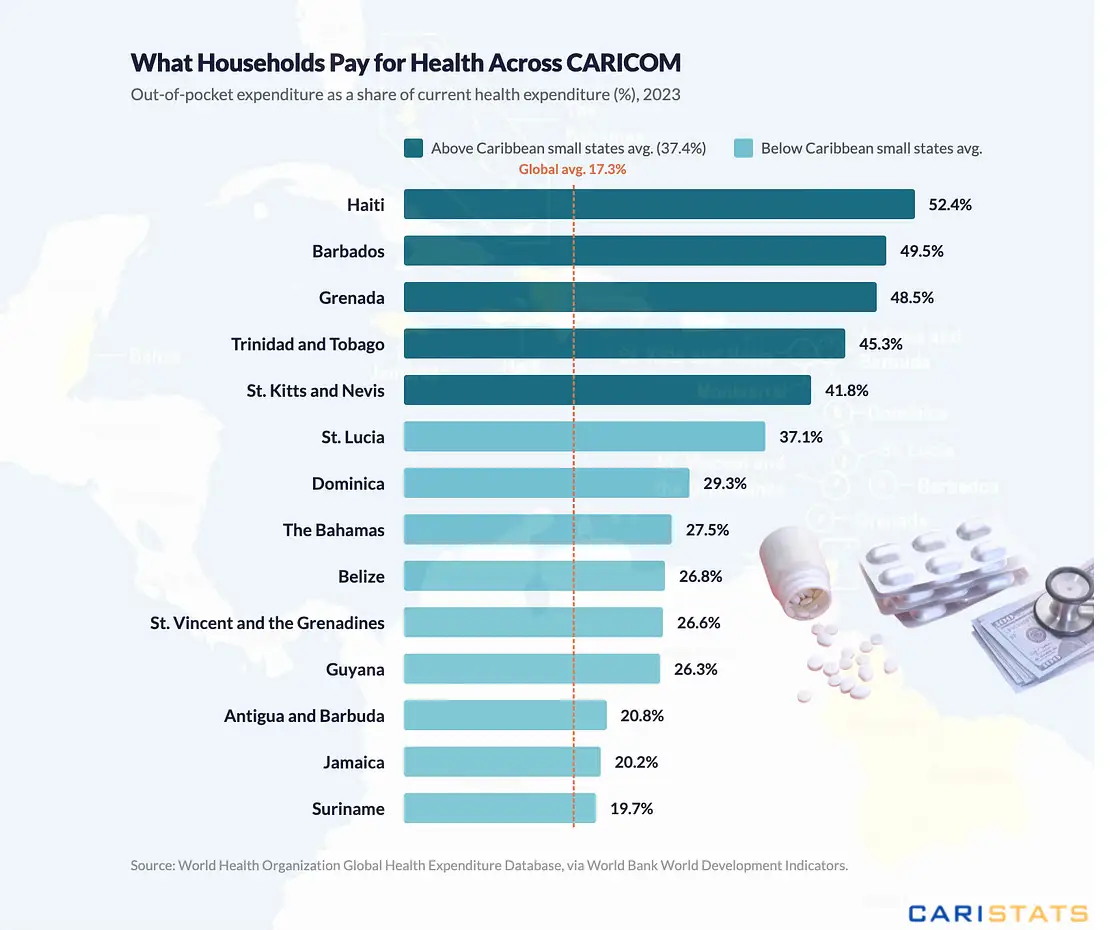
Regional data compiled by CARISTATS show that out-of-pocket (OOP) spending — direct payments for services not covered by public healthcare or insurance — accounts for 20.8% of total health expenditure in Antigua and Barbuda. While this places the country among the lowest in the Caribbean, it remains above the global average of 17.3%.
Across the broader CARICOM region, households typically bear a significantly heavier burden. In most member states, OOP spending exceeds a quarter of total health costs, reflecting gaps in insurance coverage and widespread reliance on private healthcare providers.
The highest levels are recorded in Haiti, where households pay 52.4% of healthcare costs directly. Barbados follows at 49.5%, with Grenada close behind at 48.5%. Analysts note that Barbados' figure is particularly striking given its status as a high-income country with a universal public health system, suggesting that many patients continue to seek private care and pay out of pocket.
Antigua and Barbuda's comparatively lower share places it closer to Jamaica, at 20.2%, and Suriname, at 19.7% — both countries similarly near the global benchmark.
The data, drawn from the World Health Organization Global Health Expenditure Database and published via the World Bank, indicate that how healthcare systems are financed and organised plays a greater role in determining household costs than national income levels alone.
As reported by Antigua News Room, researchers say the findings highlight persistent challenges across the Caribbean, where limited insurance coverage and uneven access to public services continue to push costs onto individuals — even in countries that perform relatively well by regional standards.