By Yves Ephraim
General elections, like the end of a school year, mark the moment when politicians must face their report cards. They are not permitted to grade themselves. That task belongs to the electorate.
Most people navigate their academic lives through a gauntlet of quizzes, mid-term exams, the 11-plus, CXC assessments and beyond. At every stage, independent teachers determined the grades. Report cards kept an honest score, whether students liked the results or not. A poor report card meant being held back — and everyone noticed.
Elections serve the same function. Rather than viewing them simply as a contest between candidates seeking power, they are better understood as a formal assessment of the incumbent administration. Challengers offer alternatives, but they cannot be meaningfully evaluated until they have had a turn at the helm. It is not comparing apples to apples otherwise.
With that framework in mind, the following represents an attempt to construct a 12-year report card for the current administration across three broad areas.
BASIC FUNCTIONS OF GOVERNMENT
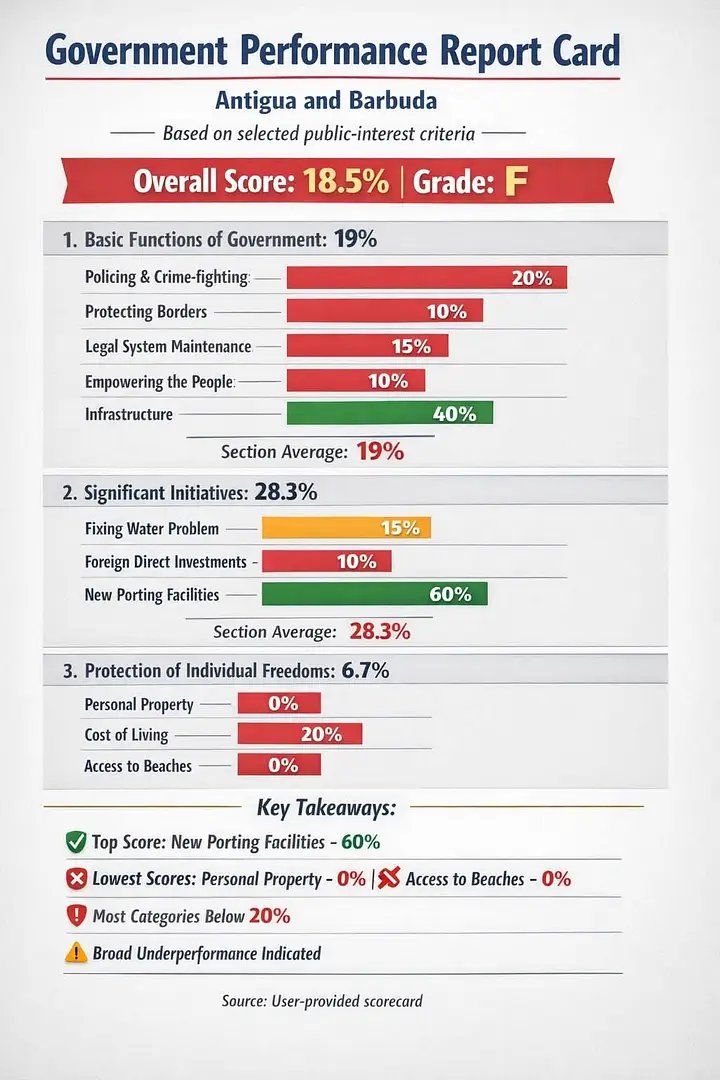
The weighting applied here is: Policing and Crime-fighting (20%), Protecting Borders (10%), Maintenance of the Legal System (15%), Empowering the People (10%), and Infrastructure (40%).
On policing, the force lacks independence and remains unable to solve most non-obvious crimes. It appears powerless to curb robberies and is grossly under-resourced in both equipment and expertise.
Border security was thrown into sharp relief by the Antigua Airways saga, which exposed significant vulnerabilities — both incoming and outgoing. The Cameroonian refugees demonstrated this clearly. Even after being granted permission to remain in Antigua and Barbuda, they were able to slip out of the country as easily as they had slipped in. It is difficult to assess how much of the nation's gun crime and criminal activity is enabled by these porous borders.
The legal system continues to languish, chronically under-resourced.
Empowering citizens means more than distributing handouts or subsistence-level employment. True empowerment teaches people to fish rather than simply handing them one. Dependency, visibly widespread, has only deepened — and is especially evident during this election cycle.
On infrastructure, years of neglect give the impression that current construction activity is driven primarily by two factors: the approaching election and the upcoming CHOGM summit. The persistent failure to address road drainage engineering is telling. Drainage is being ignored because there is no time, or no will, to do the job properly.
SIGNIFICANT INITIATIVES
The weighting here is: Fixing the Water Problem (15%), Foreign Direct Investment (10%), and New Port Facilities (60%).
Prior to 2014, approximately 40 percent of APUA's water production was reportedly lost through a leaking distribution network. Sound engineering logic would dictate that the priority should have been repairing the distribution system first — the equivalent of a baker plugging a hole in the mixing bowl before baking more dough. Instead, the government opted to brute-force production through multiple expensive reverse osmosis plants, bypassing the distribution problem entirely.
If a household requires 100 gallons of water daily, but 40 percent is lost in transit, APUA must pump 167 gallons to deliver those 100. That is 67 gallons wasted — every day. The outcome of this approach: water shortages persist, and the national debt has grown.
Signature foreign investment projects, including YIDA and several others, never got off the ground.
The new facility at St. John's Harbour, however, earns a passing grade.
PROTECTION OF INDIVIDUAL FREEDOMS
The weighting here is: Personal Property (0%), Cost of Living (20%), and Access to Beaches (0%).
Since national independence in 1981, no administration carries a comparable record of widespread violations of individual property rights. From Booby Alley to Barbuda, the pattern has been consistent.
This administration also became the only one in the nation's history to coerce citizens into receiving an injection of a then-experimental substance against their will — a stark departure from the civil liberties that independence was meant to enshrine.
On the cost of living, the government's recent temporary reduction of tariffs on certain food items revealed just how significantly taxation drives prices. Strawberries that once retailed for $35.00 dropped to under $15.00 for the same quantity almost immediately. This suggests that further relief is not only possible but achievable — and that reducing the size of government could be a meaningful starting point.