A dispute between a Jolly Harbour freehold property owner and Caribbean Developments (Antigua) Limited (CDAL) is raising serious questions about the limits of developer authority, the rights of independent freeholders, and the safety of a routine mosquito control programme operating within the community.
According to Antigua.news, Cyprian Kowalczyk, who holds freehold title to his Jolly Harbour property, has challenged what he describes as extra-contractual payment demands imposed by CDAL for services he says he never agreed to receive. The dispute has since broadened into a conflict over environmental management practices, centred on a chemical mosquito fogging programme conducted throughout the development.
Jolly Harbour operates under a structure in which CDAL, as master parcel owner, sold individual plots to buyers who each received independent freehold titles. Kowalczyk contends that the development is not governed by condominium by-laws or homeowner association agreements that would legally bind residents to a developer-managed system. Despite this, he alleges that CDAL continues to collect maintenance charges and unilaterally dictate services as though the community functions as a managed complex. He further claims that residents who have requested formal service agreements for utilities including water, electricity, and pest control have received no contracts in response.
The conflict escalated when Kowalczyk formally objected to CDAL's ongoing chemical fogging programme, requesting that spraying cease near his home over concerns about his family's health. He alleges that CDAL has continued the programme regardless.
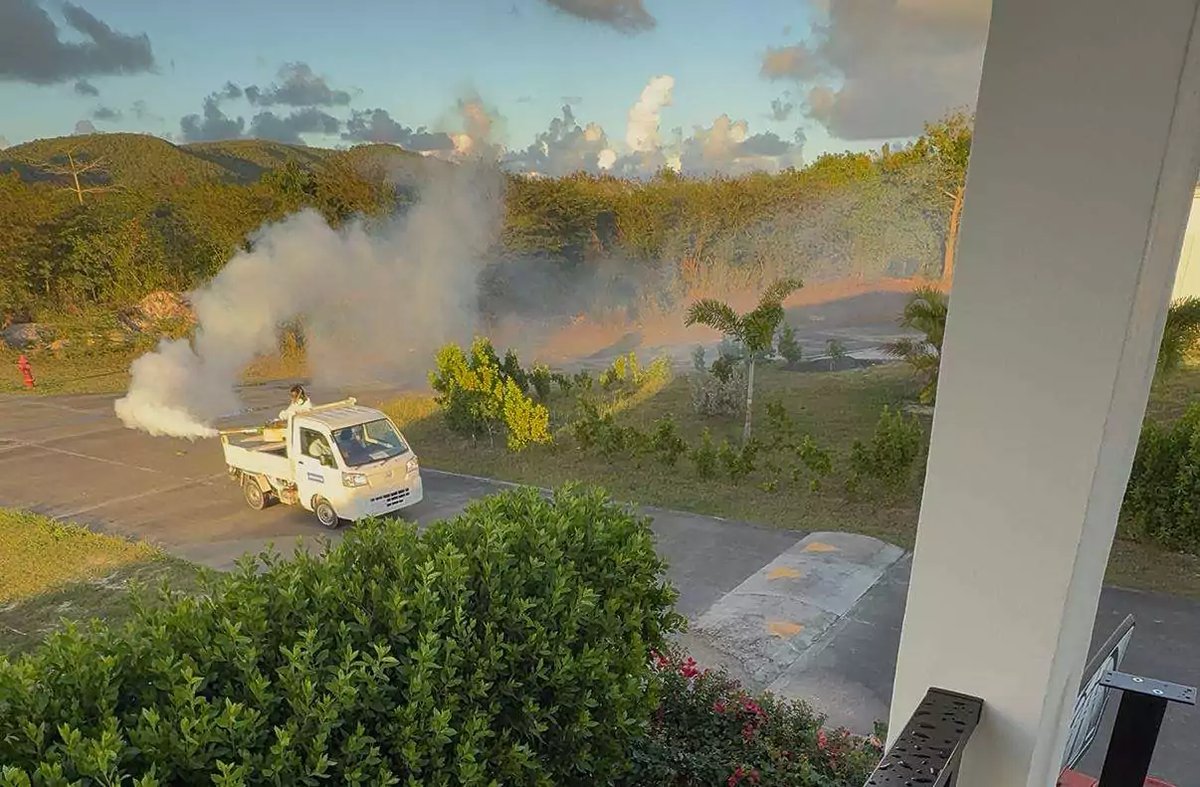
The fogging operation uses Zenivex E20, a synthetic pyrethroid diluted with mineral oil. As reported by Antigua.news, Kowalczyk states that spraying typically takes place around 5:30 p.m., when residents are commonly outdoors and homes are ventilated. He claims that easterly trade winds averaging 20 km/h carry a visible oily mist into homes, across patios, and onto private property.
Kowalczyk reports that the spraying has left an oily residue on solar panels and air conditioning units, and has been linked to health concerns within his household. These include his 11-year-old daughter's diagnosed atopic dermatitis, his own severe dry eye syndrome, and ongoing irritation he attributes to chemical exposure.
He has cited peer-reviewed research outlining potential health risks associated with the fogging mixture. Among the concerns raised is chronic pulmonary damage: the fogging equipment produces droplets smaller than 60 microns, which can be inhaled deep into lung tissue. Mineral oil, which the body cannot metabolise, may accumulate in the lungs and potentially lead to Exogenous Lipoid Pneumonia, a risk he says is heightened for children and the elderly.
Kowalczyk has also pointed to cancer risk classifications, noting that the International Agency for Research on Cancer (IARC) designates untreated and mildly treated mineral oils as Group 1 human carcinogens. He argues that the programme's estimated frequency of 104 applications per year far exceeds occupational safety standards. He additionally claims the mixture contains nearly 80 percent isopropyl myristate, a compound used in pharmaceuticals to enhance skin absorption, which he says disrupts the skin's protective barrier and may worsen conditions such as eczema and dermatitis.
Rather than adjusting the programme, Kowalczyk says CDAL has advised residents to close their windows and doors or temporarily leave their homes during fogging periods — a measure he calculates would require him to vacate his residence for more than 200 hours per year.
CDAL has reportedly defended continuing the programme by warning that suspending spraying in specific areas could create a so-called mosquito sanctuary, posing a risk to the broader community. Kowalczyk disputes this, citing official data indicating no arboviral disease transmission in Antigua and Barbuda in early 2026 and only 11 dengue cases recorded in 2025. He also referenced guidance from the World Health Organization, the Pan American Health Organization, and the U.S. Centers for Disease Control and Prevention, all of which classify ultra-low-volume adulticiding as an emergency response measure rather than routine preventative practice.
The dispute has prompted a formal regulatory inquiry. Kowalczyk has submitted a request to the Pesticides and Toxic Chemicals Control Board, backed by more than a dozen residents and additional overseas property owners, seeking confirmation of whether CDAL holds a valid pest control operator licence. Under the Pesticides and Toxic Chemicals Act 2008, conducting extermination for reward without such a licence constitutes a criminal offence.
Further compliance concerns have been raised regarding the manufacturer's guidelines for Zenivex E20. Kowalczyk states that the product label restricts application to no more than 25 times per site annually, well below the programme's estimated 104 annual applications in Jolly Harbour. The label also cautions against use when wind speeds exceed 10 mph — conditions he argues may be frequently surpassed by Antigua's prevailing trade winds, increasing the risk of chemical drift onto non-target properties.
Kowalczyk has also questioned the programme's effectiveness, citing a 2023 study published in the Journal of Medical Entomology that reportedly found the product ineffective at reducing mosquito populations, and a 2021 meta-analysis in Ecology Letters suggesting that such chemical interventions can trigger pest resurgence by eliminating natural predators. He notes that once diluted with mineral oil, the fogging mixture is approximately 98 percent oil carrier by volume, a composition he says reduces solar panel energy output and diminishes air conditioning efficiency by trapping dust in coated systems.
Kowalczyk has made clear he is not seeking to end mosquito control efforts in Jolly Harbour. Instead, he is calling for alternative approaches, including Bti larviciding, source reduction strategies, and the establishment of buffer zones around private residences.
The dispute has drawn wider attention to governance questions within Jolly Harbour, specifically whether a developer can impose environmental practices and maintenance charges on independent freeholders without their consent, formal contracts, or adherence to established safety standards. The matter remains under review by the relevant authorities.