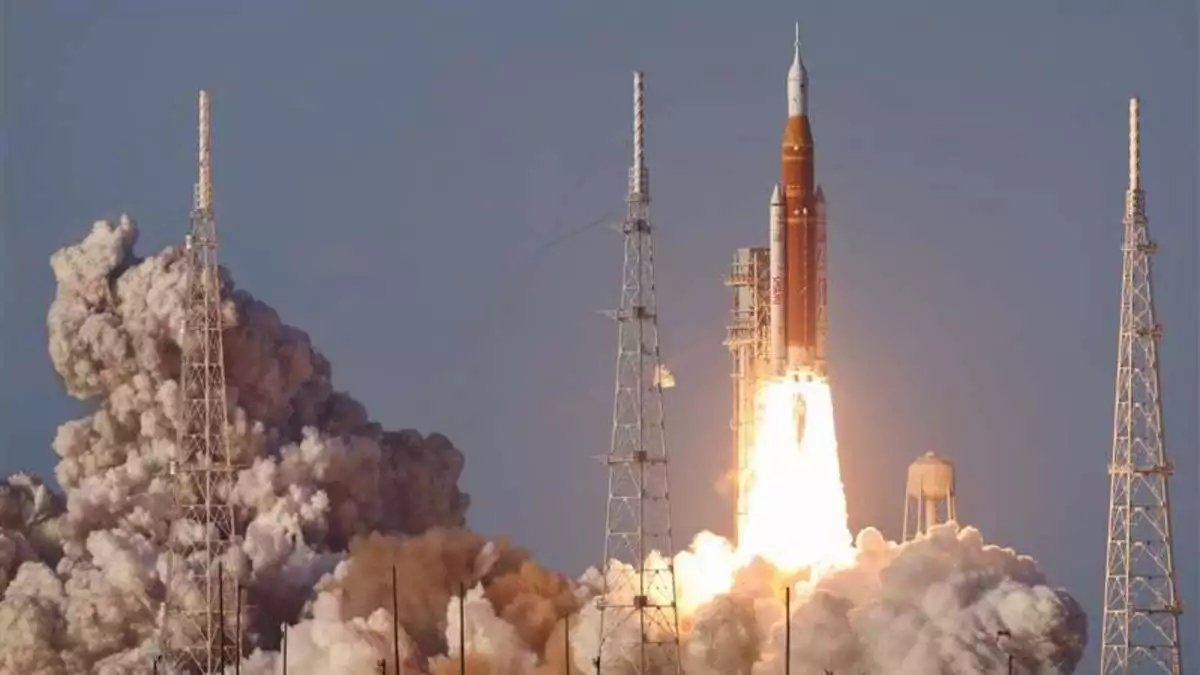
NASA's Artemis II rocket lifted off from the Florida coast at 18:35 CDT on April 1, sending a crew of four astronauts on a mission to circle the far side of the Moon. According to Antigua.news, technicians at Kennedy Space Center erupted in cheers as the enormous spacecraft rose into the sky amid a sheet of brilliant white flame that temporarily engulfed the entire launch pad.
A second round of cheers followed at one minute and ten seconds into the launch — the point of maximum aerodynamic pressure, when engineers know that even minor structural weaknesses can prove catastrophic.
The launch had not been without tension. In the hour preceding liftoff, controllers raised concerns about the abort system, which allows NASA scientists to eject the astronauts and destroy the rocket in the event of a malfunction. Separately, sensors in the waste-management system were producing unexpected readings. Both issues were resolved in time, and the four crew members were able to deliver pre-launch messages during the final ten-minute countdown.
The crew consists of retired Navy Captain and Commander Reid Wiseman, Pilot Victor Glover, Mission Specialist Christina Koch, and Fighter Pilot Jeremy Hansen.
Observers tracked key milestones throughout the ascent, including the separation of the twin solid rocket boosters after propelling the craft beyond 10,000 miles per hour. The astronauts officially entered orbit upon crossing the Kármán line — the recognised boundary between Earth's atmosphere and outer space.
The crew is now travelling toward a point approximately 6,400 miles (10,299 km) beyond the far side of the Moon — the side that permanently faces away from Earth — marking the first time humans have ventured to that distance. The journey will surpass the record for the farthest distance humans have ever travelled from Earth, previously set by Apollo 13.
The lunar flyby is expected on April 6. The crew is scheduled to return to Earth with a splashdown in the Pacific Ocean at approximately 0006 UTC on April 11.
Looking further ahead, NASA has set its sights on Mars, with ambitions to send humans there by the 2030s — a timeline many observers consider challenging given the significant technological hurdles that remain.