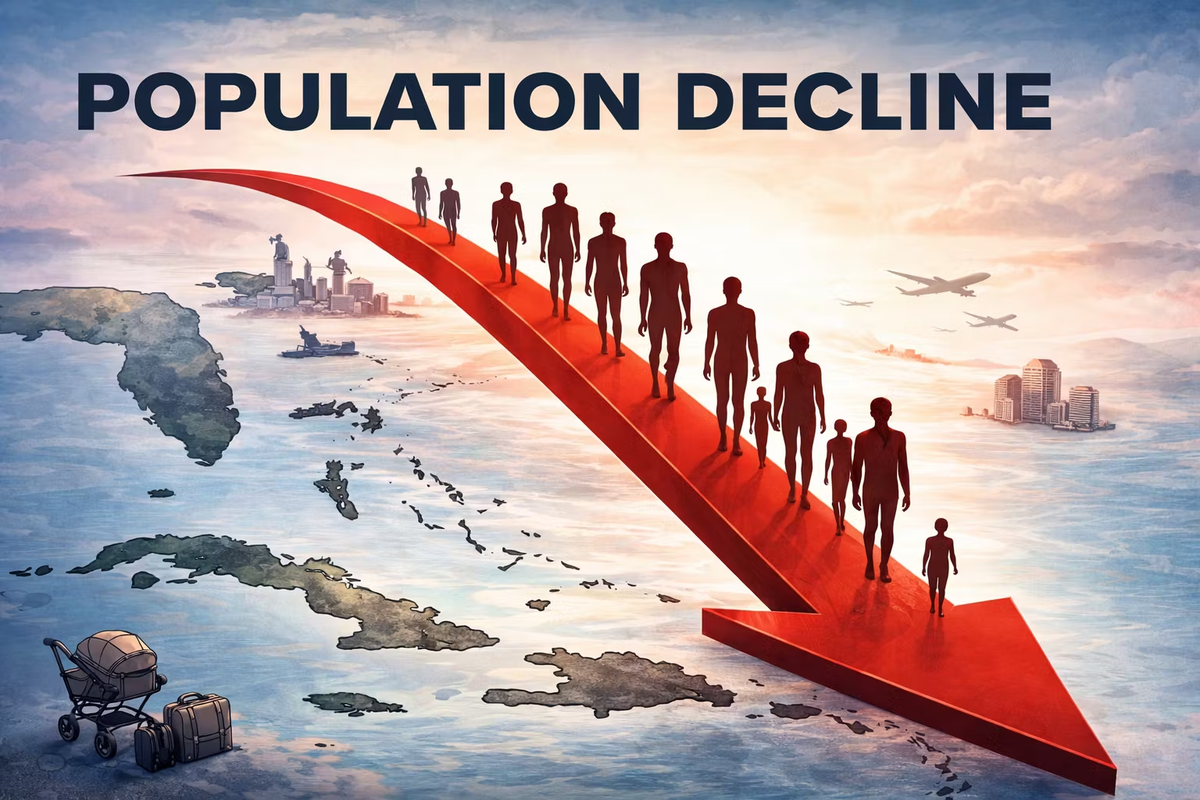
Shrinking populations across the Eastern Caribbean are emerging as a significant threat to long-term economic growth, with the Governor of the Eastern Caribbean Central Bank (ECCB) warning that the region cannot expand its economies without confronting the issue head-on.
According to Antigua News Room, Dr. Timothy N.J. Antoine made the remarks at the launch of the ECCB's 2026–2031 strategic plan, where he revealed that six of the eight countries within the Eastern Caribbean Currency Union are experiencing either stagnant or declining populations. He described the trend as a serious structural constraint on development.
Dr. Antoine questioned how economies can grow, generate demand, and sustain businesses if the number of consumers continues to fall. "How do you grow and double the size of an economy with a falling population?" he asked, noting that declining populations reduce consumption, limit business opportunities, and weaken long-term economic prospects.
The population challenge forms part of a broader set of structural issues identified by the ECCB, including low productivity, limited access to credit, and high dependence on imports. The bank says all of these must be addressed under its "Big Push" strategy for regional transformation.
In outlining potential solutions, Dr. Antoine called for a more deliberate approach to population growth, including actively encouraging members of the Caribbean diaspora to return home and contribute to national development. He said improvements to healthcare systems and digital connectivity will be critical to attracting returning nationals, particularly those seeking to work remotely while living in the region.
"We are going to have to get our people to come back home," he said, pointing to the large number of Caribbean nationals currently living abroad.
Dr. Antoine also raised the prospect of targeted immigration, acknowledging the sensitivity of the topic while arguing that carefully managed inflows of skilled workers could help fill gaps in small economies. He noted that some countries in the region, including Antigua and Barbuda, have already benefited from inward migration, which has supported both economic activity and population growth.
The focus, he said, should be on attracting individuals with skills that are in short supply, with appropriate safeguards in place. "We actually want people with skills," Dr. Antoine said, adding that even a small number of skilled workers can make a meaningful impact in small island economies.
Dr. Antoine stressed that tackling population decline will require open, balanced discussions and coordinated policy responses from governments across the region. He tied the demographic issue directly to broader economic goals, including raising productivity, expanding business activity, and achieving sustainable growth under the ECCB's new strategic plan.
The remarks reflect a growing recognition among regional policymakers that demographic trends are not merely a social concern, but a central factor shaping the Caribbean's economic future.