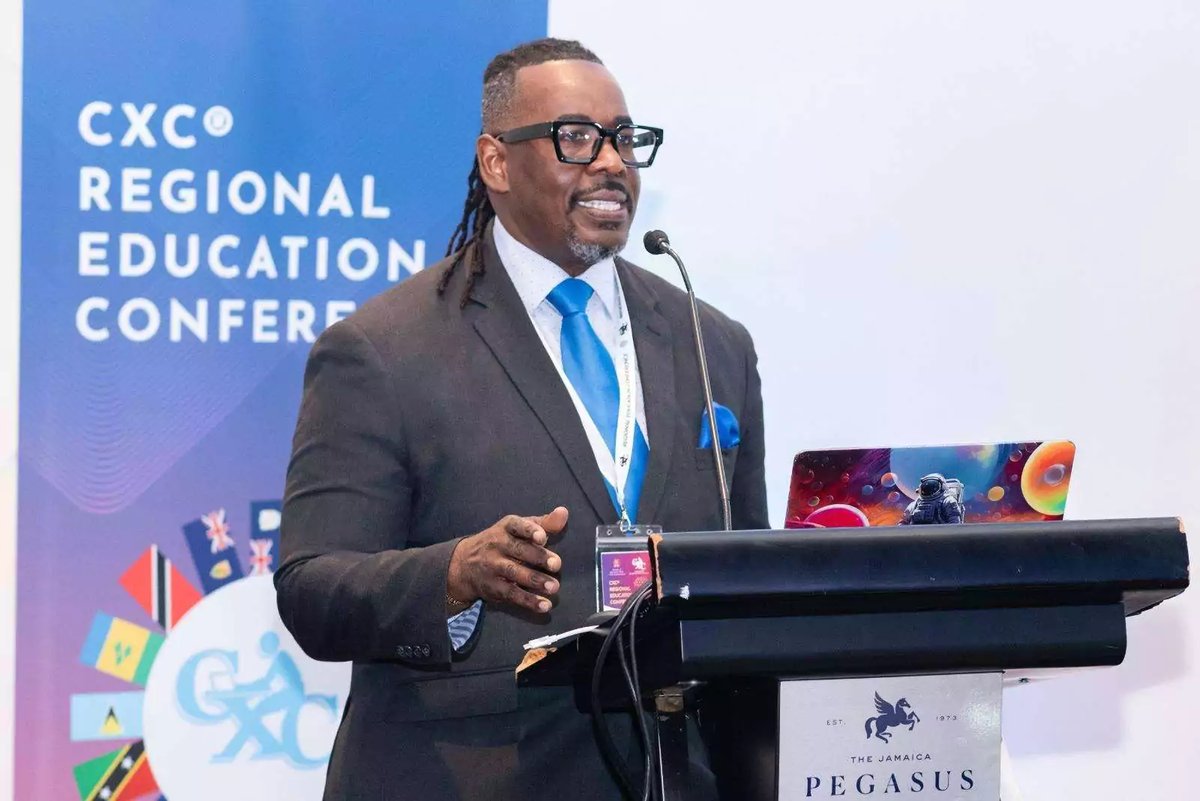
The Caribbean Examinations Council (CXC) has opened its inaugural Regional Education Conference in Jamaica, uniting more than 350 delegates and 13 ministers of education from across the region to confront growing demands for digital transformation in Caribbean schools. According to Antigua.news, the conference draws participants from 27 countries, including Malta, Canada, the United Kingdom, the United States, and the Netherlands.
The four-day gathering, themed "Navigating the Digital Age: Rethinking Learning, Teaching, and Assessment," is being held at the Jamaica Pegasus Hotel. Originally scheduled for October 2025, the conference was postponed following the impact of Hurricane Melissa on Jamaica.
CXC Registrar and CEO Dr Wayne Wesley told delegates that Caribbean education systems are already operating in a world defined by artificial intelligence and digital technology, and that the pace of change demands an entirely new approach.
"We must, as an education community, be in a perpetual state of transformation," he said. "We must remain agile to prepare our students to take on what this new world is going to be."
Dr Wesley pointed to the recent rollout of fully electronic and hybrid examinations during CXC's January 2026 cycle across 17 Caribbean states, involving more than 10,000 candidates. "The results were clear. Students across the Caribbean are ready for examinations that are electronic," he said.
Dr Marcia Potter, Deputy Chair of CXC, told delegates the conference's theme was both timely and necessary. "Artificial intelligence, automation, data analytics, and digital platforms are reshaping every sector of society, and education is no exception," she said. Potter urged participants to move beyond mere adaptation. "The future of learning is not something that will simply happen to us. It is something we must design together."
Delivering the opening address, Jamaica's Minister of Education, Skills, Youth and Information, Senator Dr Dana Morris-Dixon, said the central challenge for Caribbean education leaders is not whether artificial intelligence will enter schools, but how it is managed. "The question is whether we as leaders have clear frameworks for its responsible use," she said. "Whether we will build digital literacy, not just digital exposure."
The minister outlined several initiatives underway in Jamaica, including the imminent launch of a Jamaica Learning Assistant — described as a 24-7 AI-powered academic tool trained on the national curriculum and adapted to be culturally relevant, including the ability to respond in Patois. "When this is launched, every child in Jamaica will have access to this," Morris-Dixon said. "It doesn't replace a teacher. What it does is give you additional tools at home that you can engage with the lessons in the way that you learn."
Morris-Dixon also cautioned that inclusion must remain central to any digital strategy, noting that children with disabilities are two and a half times more likely to be out of school than their peers. She said AI tools must be deployed with a rights-based approach.
Opening keynote speaker Professor Paloma Mohammed-Martin, Vice-Chancellor of the University of Guyana, told delegates the region is experiencing a complete paradigm shift — not simply a change in tools or methods. "Nothing is staying still," she said. "We have moving frontiers."
Professor Mohammed-Martin called on every government ministry in the region to immediately establish dedicated units focused on futures thinking, warning that the pace of technological change is too rapid to be addressed through voluntary or after-hours efforts. "We need to establish really quickly focal points or offices or units for futurist work immediately in every single government ministry and agency in this region," she said. "It has to be resourced."
She also raised concerns about the absence of young people from the conference proceedings, arguing that meaningful planning cannot take place without the voices of those being planned for.
Over the remaining days, the conference will examine sub-themes including generative AI in teaching and learning, literacy and numeracy standards, flexible education pathways, and technology-enhanced assessment.