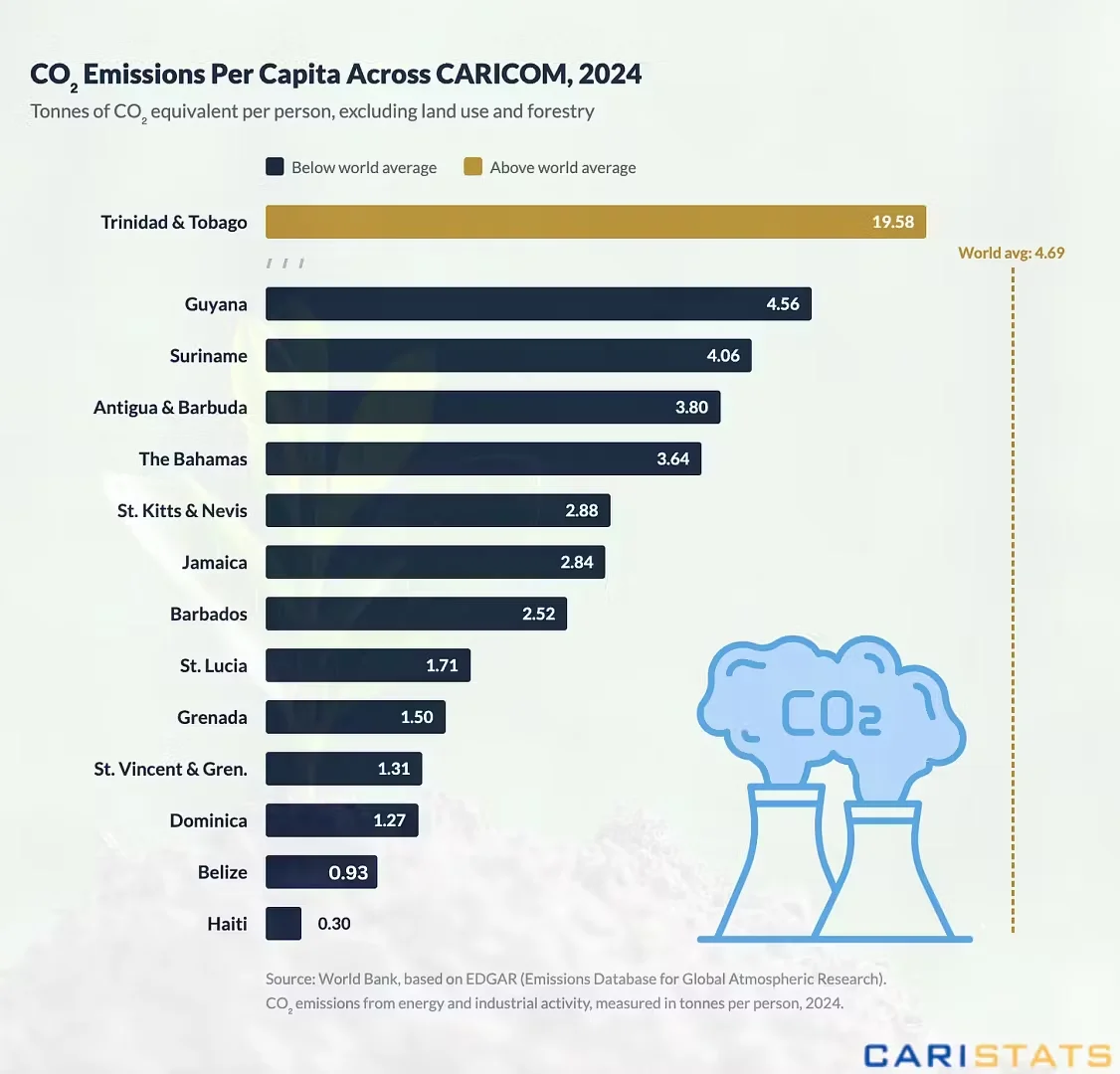
Thirteen of CARICOM's 14 member states emitted less carbon dioxide per person than the global average of 4.69 tonnes in 2024, according to Antigua News Room, citing the latest data from the Emissions Database for Global Atmospheric Research (EDGAR).
The sole exception is Trinidad and Tobago, whose petrochemical-driven economy produces 19.58 tonnes of CO₂ per capita — more than four times the world average. Even so, that figure has fallen by 28% since 2015, reflecting declining output from the country's energy sector.
At the other end of the spectrum, Belize and Haiti recorded per capita emissions of just 0.93 and 0.30 tonnes respectively, a fraction of global norms. Dominica, Grenada, St. Vincent and the Grenadines, and St. Lucia all emit fewer than 2 tonnes per person — less than half the global average.
Guyana stands out as the region's most significant mover in the opposite direction. Its per capita emissions have surged 67% since 2015, climbing from 2.73 to 4.56 tonnes, a rise that tracks the rapid expansion of the country's offshore oil sector.
As reported by Antigua News Room, the figures underscore a stark and familiar imbalance: the Caribbean nations contributing least to global emissions remain among the most exposed to climate change's consequences.
Data is sourced from the World Bank, based on EDGAR CO₂ emissions figures covering energy and industrial activity, measured in tonnes per person, for 2024.