BY YVES R. EPHRAIM
Months after Antigua and Barbuda's independence in 1981, government officials visited my fifth-form class in search of young citizens willing to commit to nation building. According to Antigua News Room, the opinion piece below represents one citizen's account of decades of civic commitment and growing disillusionment with successive government policies.
We were told our country needed us — that we should remain and help build our newly independent nation. Even then, brain drain was a serious concern. I struggle today to identify even a handful of former classmates who still call Antigua and Barbuda home.
The officials offered guaranteed engineering scholarships to those willing to work for APUA and Public Works. At least three classmates applied, were awarded scholarships, pursued undergraduate engineering degrees, and went on to become senior leaders within those institutions. I, however, was not interested in public sector work and declined. My passion was electronics, and my sights were set on one of two local private sector firms that offered training in that field.
Nevertheless, I was committed to this nation. As the firstborn of a struggling single mother with an absent father, my options were limited — yet I vowed to remain and contribute. Antigua and Barbuda, I believed, would one day show the world that its sons and daughters could rival the brightest minds anywhere.
Over the years, as I built my skills and expertise, I was presented with more than a few opportunities to settle abroad permanently. Some told me I was wasting my talent by staying. I chose to remain, pushing through what I describe as self-inflicted policy barriers, holding onto the belief that meaningful change would come within my lifetime.
Today, I am grateful for the opportunity to contribute through job creation and mentoring young people who are themselves driven to make an impact. Antigua and Barbuda has faced challenges throughout its 44 years of independence and will likely continue to do so. I do not expect a utopia. What I do expect is to be valued by my government in the same measure that my government expects commitment from me. I consider that a fair exchange.
It was the COVID-19 pandemic that compelled me to speak publicly.
By that point, I had begun to feel that the government did not genuinely value its people. I began voicing those concerns on social media as early as 2020. I was driven to speak out by what I saw as dystopian treatment of the population — most significantly, the government's vaccine mandate, which threatened public servants with job loss if they refused the jab. In my view, that was a crime against humanity.
One of my own employees developed a permanent side effect after voluntarily following her government's strong encouragement to be vaccinated. For the sake of the tourism industry, the government pursued an 80% vaccination target using what many now argue was an experimental drug — one that ultimately did not prevent transmission of the virus. In the aftermath of COVID-19, evidence is mounting that the intervention caused more harm than good. For me, the greater fear was never the virus itself, but a government willing to strip away fundamental freedoms under the guise of public safety.
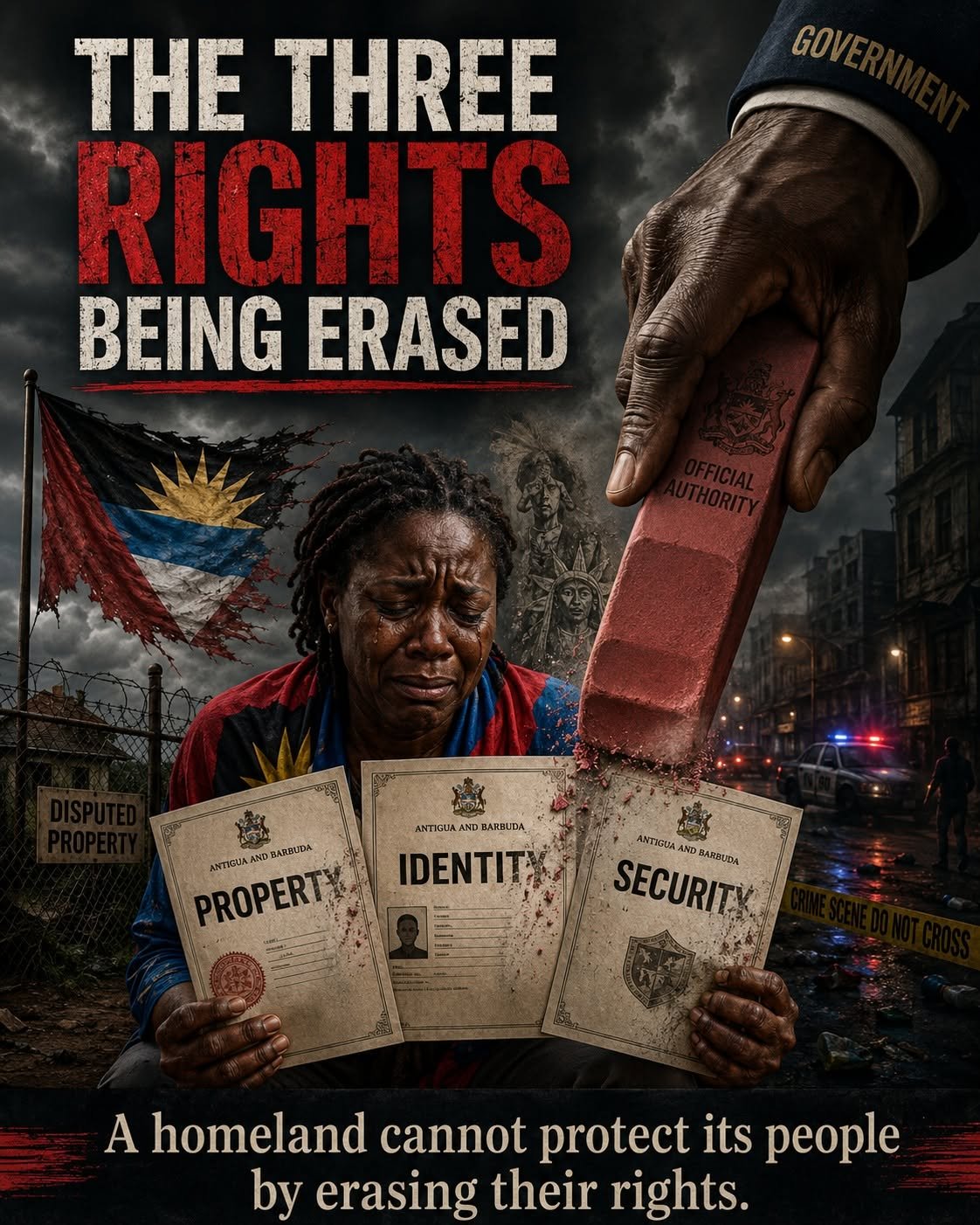
Since the pandemic, I have witnessed a series of government policies that I believe are steadily transforming this nation into what I can only describe as a neo-plantation — eroding the identity, property rights, and livelihoods of Antiguans and Barbudans. The following are among the most significant concerns:
1. A degradation of the country's telecommunications infrastructure, including the confiscation of spectrum rights from Digicel and Flow, and some of the highest bandwidth prices in the region.
2. The loss of access to the northeastern corridor of the country to a special economic zone, surrendered without a performance clause or meaningful economic benefits for citizens.
3. The marginalisation of Barbudans and the confiscation of their lands to facilitate giveaways to wealthy foreign investors.
4. Legislative amendments that make it significantly easier for the government to seize private property.
5. The forced acquisition of the Alpha Nero superyacht, which thrust Antigua and Barbuda into the international spotlight and represents a substantial contingent financial liability for the country.
6. A water crisis that was promised to be resolved within 14 days — yet nearly 14 years and hundreds of millions of dollars later, officials are only now acknowledging that aging pipes were the core problem all along, a fact that was widely known from the outset.
7. No previous government administration in the country's history has demonstrated such an appetite for the appropriation of private property, which appears to have become default policy.
8. The loss of US visa access for both travel and education — despite prior assurances from officials that such an outcome was impossible given the strength of the country's diplomatic team. This development has had serious consequences for citizens who require access to US medical facilities.
9. A rising tide of violent crime facing an under-resourced police force. Vehicle tire theft has reached epidemic levels with no sign of abatement — a reality I recently encountered firsthand.
10. An under-resourced justice system producing recent judgements that are eroding public confidence in the rule of law.
11. A demonstrated willingness to accept third-country nationals, including deportees from other jurisdictions, in a manner that many believe is contrary to the national interest and potentially destabilising.
12. The announced intention to make Spanish an official language within 30 days of winning the last election, alongside the creation of a dedicated desk in the Prime Minister's office specifically for nationals of the Dominican Republic — an arrangement that appears to exclude Spanish-speaking residents from other nations such as Cuba and Venezuela.
13. A proposed expansion of the Windfall Tax to capture more local businesses and drive up costs for already-struggling households — a move that would effectively nullify recent minimum wage increases.
14. The prioritisation of amnesty for undocumented immigrants at a time when longstanding civic needs remain unaddressed.
15. Government interest in redirecting $50 million in unclaimed bank deposits toward another airline venture, despite the failed track record of Antigua Airways and ongoing questions surrounding the new LIAT arrangement — funds that could instead be directed to the hospital, used to ease the burden of the Windfall Tax, or deployed to strengthen the police force.
As a born citizen of Antigua and Barbuda who has dedicated his working life to contributing meaningfully to this country, I no longer feel that my government is committed to providing the enabling environment that guarantees my right to private property, my national identity, or my ability to thrive safely in my own homeland. That is why I refuse to remain quiet.