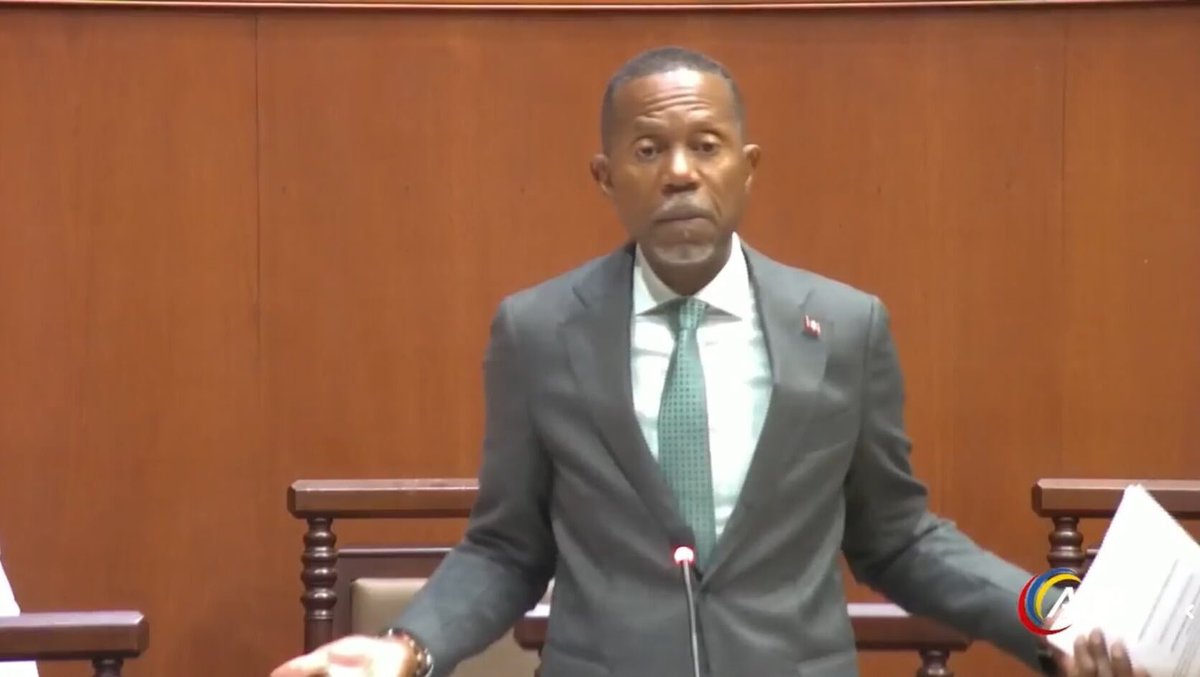
Barbuda Member of Parliament Trevor Walker argued Tuesday that Antigua and Barbuda is negotiating from a position of weakness with the United States over the possible transfer of third-country nationals, warning that the country lacks meaningful leverage given existing American visa restrictions.
According to Antigua News Room, Walker made the remarks during parliamentary debate on a resolution setting out the principles to guide negotiations with Washington, where he repeatedly challenged Prime Minister Gaston Browne's approach to the talks.
"I want Antiguans and Barbudans to hear me. Antigua and Barbuda don't have no cards," Walker said. "You have no cards."
Walker acknowledged that negotiation remains the appropriate course but pressed the government on what concessions it intends to seek in return for cooperating with the United States. "If that's what the government is going to do, then what are the reciprocal arrangements that's being sought by Antigua and Barbuda?" he asked, adding that he did not consider the question unreasonable.
He urged that the matter not be treated as a partisan issue, warning that any resulting agreement would affect all citizens. "This matter ought not to be partisan and political because it will affect all of us," Walker said.
Central to Walker's argument was the country's current standing with the United States. He noted that Antiguans are presently limited to 30-day visits to the US, and recounted a recent personal experience in which an American immigration officer reminded him of the restriction despite his plan to stay only four days.
Walker called on the Prime Minister to explain how Antigua and Barbuda arrived at what he described as one of its most difficult periods in relations with Washington. "The Prime Minister of this country has an obligation … to let Antiguans and Barbudans understand why Antigua and Barbuda at this time is placed in a position where things are almost at the highest element of hardship when it comes to United States travel restrictions," he said.
Drawing a contrast with an earlier era, Walker pointed to the mid-2000s, when then-US Secretary of State Condoleezza Rice commended Antigua and Barbuda for legislation promoting accountability and transparency. He questioned whether the current deterioration in relations stemmed from concerns surrounding the country's Citizenship by Investment Programme and said the public deserved a full explanation if that were the case.
Walker also directed criticism at regional leaders, arguing that CARICOM has failed to develop a unified position on the issue. He contended that small states would carry far greater bargaining power if they negotiated collectively, and called on both the Organisation of Eastern Caribbean States and the wider CARICOM community to adopt a common stance. "These guys cannot sit down and come up with a common position so that this issue can be dealt with," he said.
The Barbuda representative further demanded broader public consultation before any agreement is finalised, arguing that organisations including the Bar Association, the Chamber of Commerce and civil society groups should have been engaged to build national consensus. He said greater transparency was essential for the public to understand the full implications of any arrangement.
Closing his contribution, Walker stressed that any deal struck with the United States must safeguard the country's economic interests and preserve citizens' ability to travel, study and conduct business abroad. "Our access to the United States, to do business, to go to school … and also the whole question of our economic survival, which is tourism, all those things must be taken into consideration," he said.