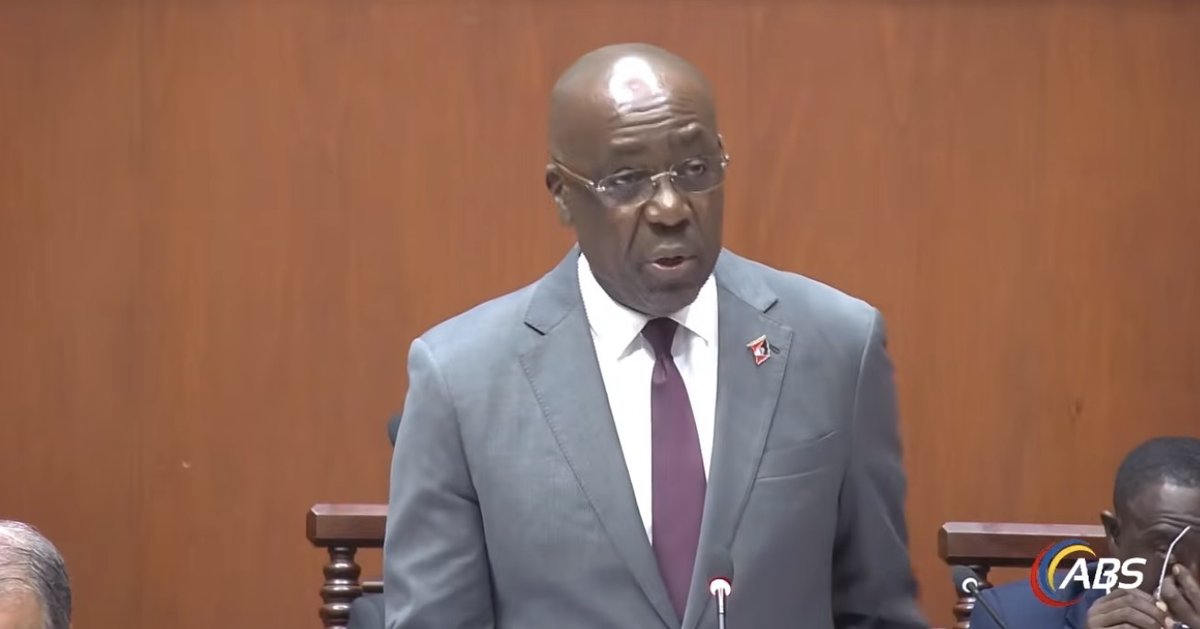
Foreign Affairs Minister E.P. Chet Greene on Tuesday defended the government's negotiations with the United States over the possible transfer of third-country nationals, telling Parliament that Antigua and Barbuda engaged Washington to protect its sovereignty — not surrender it.
According to Antigua News Room, Greene was contributing to debate on a government resolution outlining the principles that will guide any future agreement with the United States. He argued that the administration had a responsibility to hear Washington's proposal before determining whether it served the country's interests.
"We engage because responsible governments do," Greene said. "They do not make important decisions in ignorance. They do not refuse to listen before they know what is being proposed. And they do not confuse engagement with agreement."
The foreign minister said the issue extended well beyond immigration policy, describing it as a test of how a small independent state responds when a powerful ally puts forward proposals that raise serious questions about sovereignty, national security and the nation's future.
"This debate is not simply about immigration. Neither is it about the United States of America. It's about something fundamentally much bigger. It's about how Antigua and Barbuda, as a small independent nation, responds when a close and powerful neighbour and friend asks something that raises serious questions for our own sovereignty, our laws, our security and our future," Greene said.
Greene urged lawmakers to treat the matter as a national issue rather than a partisan one, insisting that questions involving sovereignty and foreign policy transcend political parties.
"When questions arise that touch the sovereignty of our country, our immigration policy, international obligations and the welfare of our people, our first duty is not to any political party. It must be to Antigua and Barbuda," he said.
The minister affirmed that Antigua and Barbuda remained a sovereign nation regardless of its size, and rejected any suggestion that negotiations had compromised the country's independence.
"We are a sovereign nation," Greene declared. "Small in size, equal in dignity. Our flag carries exactly the same worth and legal standing in the community of nations as does the flag of any larger state."
At the same time, Greene acknowledged the realities facing small states, noting that governments must recognise differences in economic and political influence while carefully guarding national interests.
"The responsibility of government is not to complain about that reality. It is to navigate it wisely," he said. "That means protecting our sovereignty without isolating ourselves, maintaining our friendships without compromising our principles, working with our partners without surrendering our judgment."
Greene also pushed back against criticism that the government should have publicly rejected the U.S. proposal from the outset, arguing that diplomacy is conducted through negotiation, not political rhetoric.
"Leadership is not measured by how loudly a government speaks. It is measured by how well it protects the interests of its people," he said. "We listened, we examined every proposal, we took legal advice, we consulted officials, we assessed the implications, and when we concluded that important parts of the proposal were not in Antigua and Barbuda's best interest, we simply rejected them."
Greene said the government negotiated under five non-negotiable principles that remained unchanged throughout discussions with the United States: rejecting any standing transfer programme; preserving Antigua and Barbuda's sovereign discretion over every proposed case; protecting the country from legal, financial and security risks; ensuring taxpayers would not bear the cost of another country's immigration policy; and requiring reciprocal benefits from any arrangement.
He also moved to dispel what he described as misconceptions surrounding the memorandum of understanding signed with the United States in December 2025.
"The memorandum did not commit Antigua and Barbuda to receive a single person. It did not establish a programme. It did not create a legal obligation," Greene said, stressing that the document is non-binding and preserves the country's right to decide each case individually.
Greene said the government rejected the original U.S. operating procedures because they failed to satisfy the principles established by Cabinet. The proposals, he said, contemplated transfers of individuals under expedited removal procedures, allowed for up to 10 transfers each month and did not adequately resolve questions surrounding legal liability or financial responsibility.
Rather than walking away from discussions, Greene said the government submitted its own counterproposals, insisting on stronger protections for Antigua and Barbuda.
"We did not simply criticise. We did not simply complain. We put forward our own proposals," he said. "We said instead, if this matter is to go any further, these are the conditions that must protect Antigua and Barbuda."
Greene praised Ambassador to the United States Sir Ronald Sanders for leading negotiations in Washington under the direction of Prime Minister Gaston Browne, saying Sanders carefully reviewed each proposal, identified legal and security concerns and consistently defended the country's interests in discussions with senior U.S. officials.
"He did not yield where the national interest required firmness," Greene said.
Among the changes the government demanded during negotiations, Greene outlined: limiting consideration to individuals with final removal orders; excluding persons with criminal records beyond immigration offences; barring unaccompanied minors and applicants with pending asylum claims; requiring complete documentation before any decision is made; and ensuring the United States assumes all financial obligations in writing prior to any transfer.
The government also rejected a U.S. proposal allowing up to 10 monthly transfers. Instead, Antigua and Barbuda proposed that no more than 10 individuals be considered during the entire 2026 calendar year, with any continuation subject to a full review.
Greene said those changes demonstrated that the government had negotiated from a position of principle rather than capitulation.
"We changed the framework. We set safeguards. We narrowed the categories. We reduced the numbers. We insisted upon complete information. We insisted upon complete funding," he said. "That is not capitulation. That is negotiation. That is the essence, the true form, of diplomacy."
Concluding his remarks, Greene said Antigua and Barbuda values its longstanding relationship with the United States but would never place its sovereignty on the table.
"Antigua and Barbuda's sovereignty is not negotiable. It never has been. It never will be," he said. "Our friendships are valuable and will be cherished, but genuine friendship is built on mutual respect."