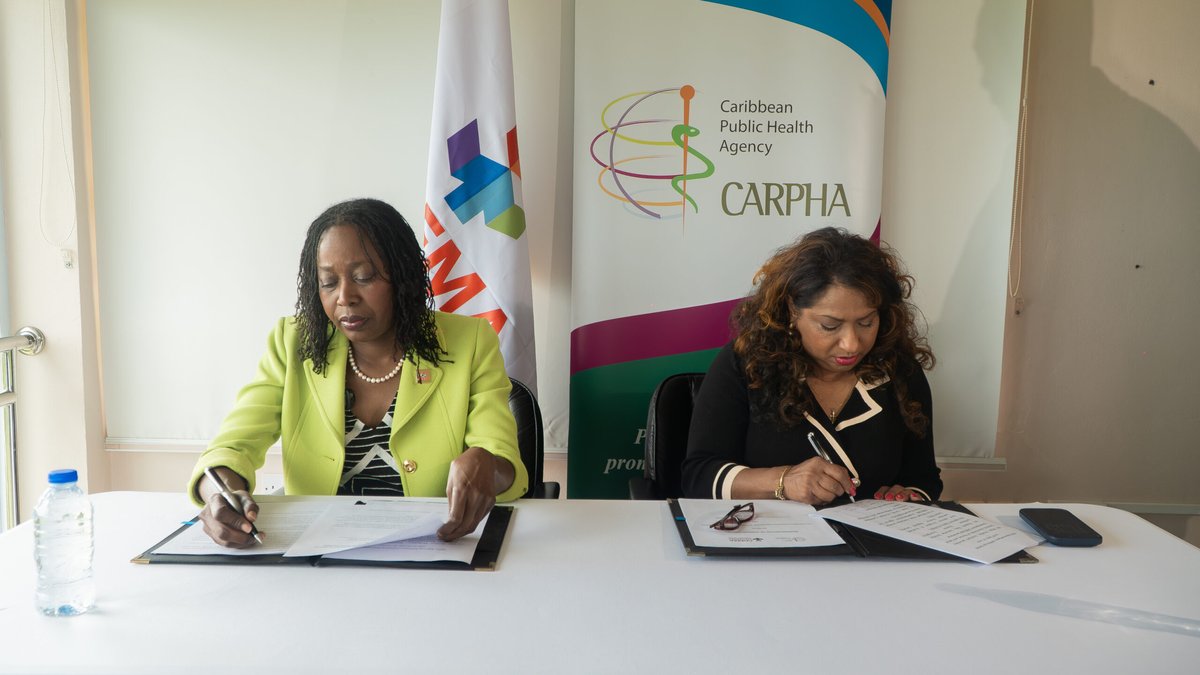
Two of the Caribbean's leading regional agencies have renewed their commitment to joint action on disasters and public health emergencies, signing a Memorandum of Understanding (MOU) on July 6th, 2026. According to Antigua News Room, the Caribbean Disaster Emergency Management Agency (CDEMA) and the Caribbean Public Health Agency (CARPHA) formalised the renewed partnership to enhance coordinated action in preventing, preparing for, responding to, and recovering from disasters and public health crises across the region.
The two CARICOM institutions have worked together for many years, supporting member states through hurricanes, disease outbreaks, and other emergencies. Through CDEMA's Regional Response Mechanism (RRM), CARPHA has contributed technical public health expertise during regional emergencies, delivering disease surveillance, laboratory services, health assessments, risk communication, environmental health interventions, and emergency response planning.
Recent examples of this collaboration include the regional responses to Hurricane Melissa in 2025 and Hurricane Beryl in 2024. Following the devastating impacts of those storms across several Caribbean countries, CARPHA supported the health response as part of the CDEMA-led RRM by deploying technical experts to conduct rapid needs assessments, evaluate shelters and health facilities, strengthen disease surveillance, and advise national health authorities.
CDEMA Executive Director Elizabeth Riley underscored the urgency behind the renewed agreement. "The Caribbean's risk landscape is changing rapidly. Climate change, increasingly intense weather events, public health emergencies, and other emerging threats demand that we move beyond traditional approaches and strengthen collaboration across sectors. This MOU between CDEMA and CARPHA reflects our shared recognition that resilience can only be achieved through integrated action and strong regional partnerships."
CARPHA Executive Director Dr. Lisa Indar emphasised the inseparable link between public health and disaster management. "Health and disaster management are inseparable. This MOU brings together CARPHA's public health expertise and CDEMA's disaster coordination leadership to strengthen regional preparedness, build more resilient health systems, and better protect the people of the Caribbean from increasingly complex threats."
CARICOM Assistant Secretary-General Alison Drayton also addressed the signing ceremony, framing the agreement within the broader regional agenda. "The collaboration between CARPHA and CDEMA therefore represents a practical expression of the Community's commitment to building resilience through cooperation. By combining CARPHA's technical leadership in health security with CDEMA's expertise in disaster mitigation and emergency management, we are strengthening the regional architecture that protects Caribbean people before, during, and after crises."
Under the MOU, the two agencies will deepen coordination during regional emergencies, promote the protection of affected populations, and integrate health considerations into regional disaster planning and response. The agreement also supports the application of shared standards and best practices, alongside joint capacity-building initiatives through training, simulation exercises, technical exchanges, and knowledge sharing.
The partnership will further strengthen joint planning, resource mobilisation, and operational coordination, positioning the Caribbean to better anticipate and respond to emerging threats while reinforcing regional health security and disaster resilience.
As the region continues to face increasingly complex and interconnected risks, the strengthened CARPHA–CDEMA partnership is intended to improve emergency coordination, protect vulnerable populations, and further embed public health within disaster risk management frameworks. Officials described the MOU as an important step toward a safer, healthier, and more resilient Caribbean.