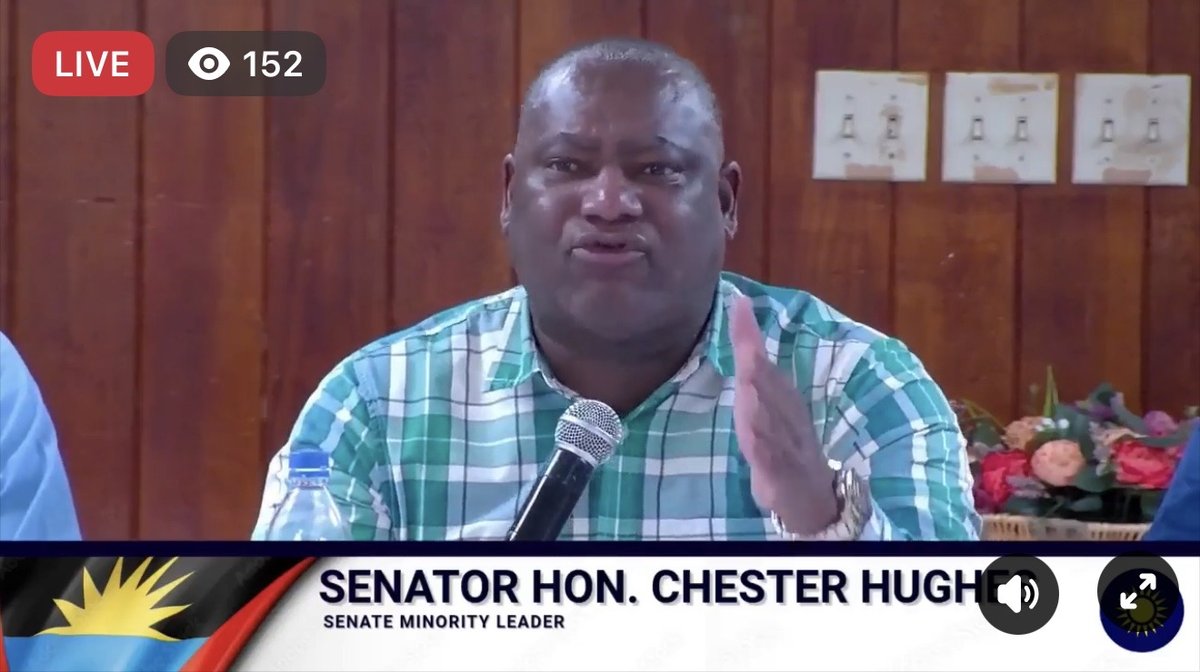
United Progressive Party Senator Chester Hughes has accused the Gaston Browne administration of accepting rather than negotiating the proposed third-country deportee arrangement with the United States, alleging that Antigua and Barbuda was handed terms rather than offered a seat at the table.
Hughes made the remarks at a UPP town hall meeting addressing the government's White Paper on the arrangement, rejecting the administration's framing of the process as a negotiation.
"The government of Antigua and Barbuda negotiated a MOU, and up to this day have not come to this country and said anything to its nationals," Hughes said. "This MOU, I believe, was given to them. No negotiations. They're making it sound fancy. America did not negotiate with any of these governments. America told them, 'You're going to take these persons.' And that's it."
Hughes also took aim at what he described as shifting statements from Prime Minister Browne regarding the number of deportees Antigua and Barbuda would accept under the agreement.
"He is playing fanciful with words," Hughes said. "First, 'I'm not taking more than 10.' Then recently, 'I'll accept 16.'" He further claimed the Prime Minister indicated the country would accept however many individuals arrived on any given flight from the United States.
The senator pressed the government on several unanswered practical questions surrounding the proposal, chief among them where transferred migrants would be housed upon arrival.
"Where are these people going to stay?" Hughes asked, questioning whether they would be placed in communities, government housing, or some other arrangement.
Hughes also criticised the administration for signing the Memorandum of Understanding before consulting the public, noting that the White Paper was only released after the agreement had already been formalised. "The government of Antigua and Barbuda negotiated a MOU and up to this day have not come to this country and said anything to its nationals," he reiterated.
Broadening his criticism to the regional level, Hughes argued that Caribbean governments should have adopted a unified position in response to the United States rather than acting independently. "And then you're hearing the Prime Minister saying that the region should have been acting as one," he said. "We have a group of arrogant leaders who are leading this Caribbean that are not about people, but about themselves."
Hughes called on Parliament to use the upcoming White Paper debate to press the government for answers and hold it accountable for its handling of the agreement.