Antigua and Barbuda recorded one of the lowest levels of air pollution in the Caribbean in 2023, according to Antigua News Room, though the country — along with every other CARICOM member — still exceeds the World Health Organization's recommended air quality guideline.
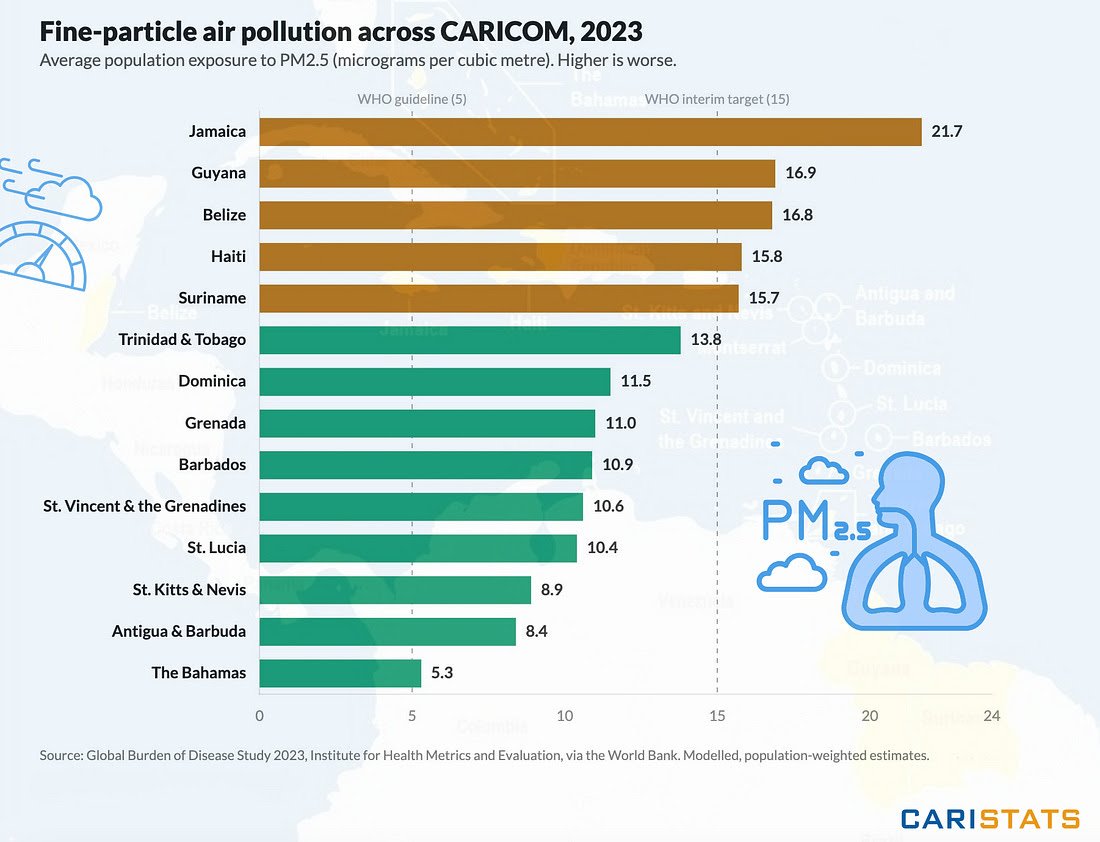
Data from the Global Burden of Disease study, produced by the Institute for Health Metrics and Evaluation, measures average population exposure to PM2.5 — fine airborne particles small enough to penetrate the lungs and enter the bloodstream. Across the 14 CARICOM members for which data is available, 2023 exposure levels ranged from 5.3 micrograms per cubic metre in The Bahamas to 21.7 in Jamaica.
As reported by Antigua News Room, geography appears to be a stronger determinant of air quality than income. Antigua and Barbuda registered 8.4 micrograms per cubic metre, placing it among the region's cleanest, alongside The Bahamas and Saint Kitts and Nevis at 8.9. These small, ocean-surrounded islands benefit from consistent trade winds that disperse airborne particulates before they can accumulate.
In contrast, larger land masses and mainland economies recorded significantly higher readings. Guyana topped that group at 16.9 micrograms per cubic metre, followed by Belize at 16.8 and Suriname at 15.7. Agricultural burning, land clearing and industrial activity are cited as key contributors to elevated pollution levels in those countries. The remaining island nations fell broadly in the middle of the regional range.
By global standards, CARICOM's figures remain moderate. The world's most heavily polluted countries record concentrations exceeding 60 micrograms per cubic metre. Nevertheless, no CARICOM nation meets the WHO's guideline of 5 micrograms per cubic metre — a threshold that currently eludes much of the world.
Note: Figures represent PM2.5 mean annual exposure estimates for 2023, drawn from the Global Burden of Disease Study 2023, Institute for Health Metrics and Evaluation, via the World Bank. Data are modelled, population-weighted estimates.