OPINION | By Yves R. Ephraim
After absorbing the initial shock of Antigua and Barbuda's offer to accept ten deportees from the United States, this writer decided to take a closer, more analytical look at the government's stated position on Washington's deportee transfer proposal. According to Antigua News Room, which has been following this developing story, the government's handling of the matter has raised serious questions among citizens and observers alike.
The conclusion reached is an uncomfortable one: the government has either executed a brilliant diplomatic manoeuvre, or it has exposed this nation to profound and lasting harm.
The first major concern is transparency. The signing of the Memorandum of Understanding appears to carry with it a de facto gag order, preventing the government from sharing the full document with the Antiguan and Barbudan public. This matter of acute national concern was conducted under a cloak of secrecy. Had another country not brought it to light, citizens may never have learned of it at all. The fact that no government official has yet produced the actual MOU text only deepens that unease.
The central question remains unanswered: why did Antigua and Barbuda need to negotiate with the United States on this issue at all? What leverage did Washington hold that made the request impossible to decline? No satisfactory answer has been offered publicly. While a degree of discretion in high-level diplomatic negotiations is understandable, the manner in which public disclosure was eventually handled obliterated what little credibility the government had remaining on this file.
The public is justified in its alarm. What the government is openly conceding — questions of sovereignty and national security — are not minor matters.
For the sake of clarity, the Antigua and Barbuda government's stated position includes the following: a willingness to engage the United States in a spirit of friendship and cooperation; a refusal to accept an ongoing monthly deportee transfer programme; consideration of proposed cases only on a case-by-case basis and at the government's complete sovereign discretion; a cap of no more than ten persons in 2026, and only if conditions are satisfied in writing; a requirement that eligibility, documentation, funding, settlement responsibility, legal status, and return arrangements all be secured in advance; a reserved right to refuse any proposed individual, reject improperly documented arrivals, and suspend any arrangement at its own judgement; and a stipulation that no international organisation or third party will be engaged until substantive terms are settled to the government's satisfaction. These conditions remain in force unless Parliament resolves otherwise.
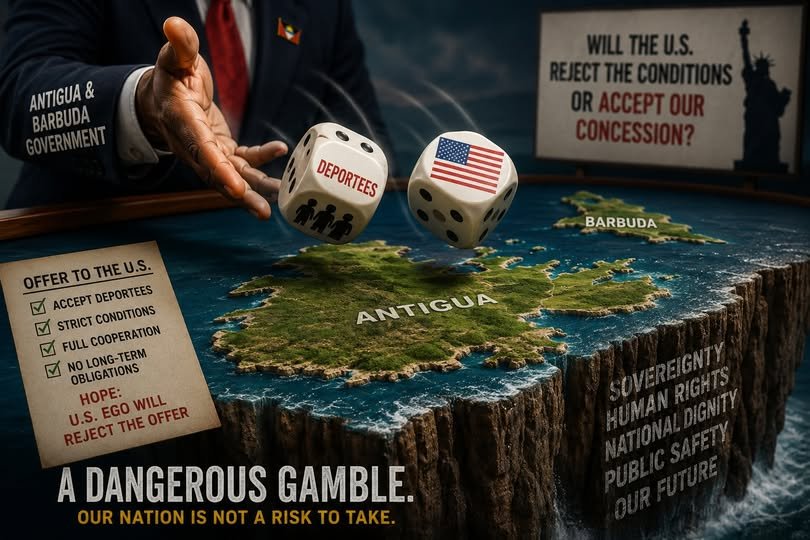
Analysing this position carefully, it appears the government is attempting to maintain a functional working relationship with Washington while simultaneously engineering a diplomatic stalemate. The strategy seems designed to give the appearance of cooperation — publicly signalling a willingness to accept deportees — while attaching conditions so stringent that they would be politically unacceptable to the current US administration.
Those conditions would effectively require Washington to reinstate visa access, abandon any automatic or unlimited transfer process, submit each deportee for individual vetting and approval by Antigua and Barbuda, and exclude third-party international organisations from the arrangement entirely.
The entire strategy rests on a single assumption: that the ego of the United States government would never permit it to be seen yielding to the demands of a small Caribbean nation, nor subjecting its deportation decisions to scrutiny and approval from Bridgetown or St. John's. The theory holds that the US will walk away from the terms rather than accept them, leaving Antigua and Barbuda in a defensible position — cooperative in appearance, immovable in practice.
Admittedly, having had to progressively extract information from the government on so serious a national issue has not inspired confidence in this analysis being wrong.
If the ego theory holds, it is a shrewd move. It would create a deadlock that endures until the current US administration changes — and based on observable patterns in that administration's conduct, such a theory is not implausible.
However, if the gamble fails — if Washington calls the bluff and accepts the conditions — then Antigua and Barbuda cannot retreat from its public offer. The government would be bound by the very terms it put forward.
The deepest concern here is not with the strategy itself, but with the government's willingness to experiment unilaterally with the lives and security of the people of Antigua and Barbuda, without their knowledge or consent.
Whether this analysis has identified a deliberate and calculated strategy, or simply a fortuitous accident of diplomacy, remains to be seen. A successful stalemate would represent the best achievable outcome under the circumstances. But if the calculation proves wrong, the consequences would be akin to a compulsive gambler pledging the family home — and losing it — leaving his wife and children with nowhere to go.