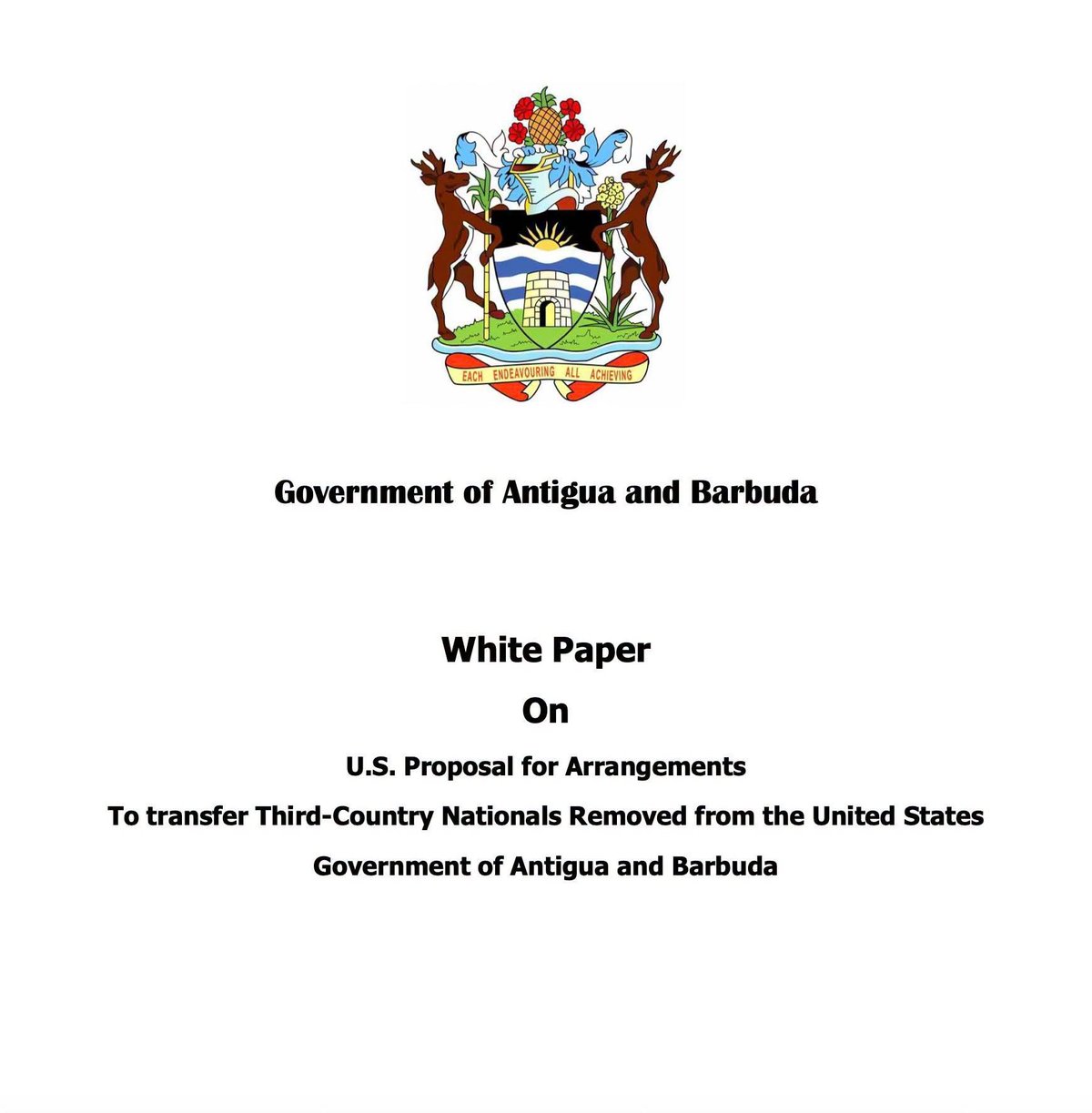
The Government of Antigua and Barbuda has issued a sharp rebuttal to The Observer online, accusing the publication of political partisanship and deliberate distortion in its coverage of the Government's White Paper on United States proposals regarding third-country nationals.
The Observer's opinion piece, posted on July 3, 2026, was presented as a sober warning to the public. The Government flatly rejects that characterisation. Its purpose, the Government argues, was not to foster clear national thinking on a serious issue, but to manufacture suspicion, inflame public anxiety, and recast responsible diplomacy as political scandal.
At the heart of the Government's objection is what it describes as the Observer's central deception — framing the Government's willingness to engage the United States in diplomatic discussion as a surrender of principle. The Government dismisses that characterisation entirely. Small states, it argues, protect themselves not by refusing to examine requests from important partners, but by engaging carefully, stating their limits plainly, and insisting on terms that preserve sovereignty, law, and national interest.
The White Paper itself, the Government contends, demonstrates the opposite of capitulation. The Memorandum of Understanding signed in December 2025 was expressly non-binding. It created no automatic or continuing arrangement for the reception of third-country nationals, and Antigua and Barbuda retained complete discretion to consider or refuse any proposed case.
The Observer suggested the Government misled the public by not announcing every stage of a sensitive diplomatic exchange while it was still unfolding. The Government rejects this. Diplomacy is not theatre, it states, and negotiation is not surrender. Governments are expected to engage, test proposals, reject unacceptable terms, and refine their positions before placing matters formally before Parliament and the people. That process has now been completed through the White Paper.
The Government points to the White Paper itself as proof of transparency. It sets out the background, the risks, the defects in United States drafts, the Government's own concerns, and the conditions under which any cooperation could be contemplated. A Government intent on concealment, the rebuttal states, does not publish a White Paper and table it in Parliament. The Government also notes that no other country that has signed an agreement to accept third-country nationals has taken the matter to its parliament.
On the question of the figure of ten — the number of individuals proposed for 2026 — the Government accuses the Observer of reducing a complex policy question to arithmetic. The figure is not a concession to pressure. It forms part of a tightly limited counter-proposal, subject to strict conditions, full prior documentation, full prior funding, a right of refusal in every case, and a review in 2027. To present that as throwing open the gates, the Government states, is not analysis. It is propaganda.
The Government also pushes back on the Observer's treatment of legal risks — including concerns about non-refoulement, asylum, statelessness, legal limbo, and indefinite support obligations. Far from being revelations against the Government, these are concerns the Government itself identified and published in the White Paper. It is precisely because these risks are real that the Government has refused any standing programme and insisted on strict eligibility conditions, clear legal status, full funding, and full return responsibility.
Addressing the Observer's list of pointed questions about housing, employment, monitoring, ministerial responsibility, and contingency planning, the Government notes that these are not unreasonable questions. But rather than undermining the Government's position, they reinforce it. They are precisely why the Government has approached the matter with the caution it has.
The Government also defends its decision to table the matter in Parliament, rejecting the Observer's suggestion that the House risks becoming a rubber stamp. Parliament is exactly where the matter belongs, the Government states. It is placing before the House the White Paper, the principles, the risks, and the terms on which any cooperation could be considered. That, it argues, is how constitutional government works.
The suggestion that town hall meetings should have preceded parliamentary consideration is also dismissed. Public discussion is important, and the publication of the White Paper ensures it can now take place on the basis of fact rather than rumour. But Parliament remains the nation's highest representative forum. When a matter engages sovereignty, immigration policy, public finance, national security, and international obligations, parliamentary consideration is not avoidance of the people — it is respect for the institutions through which the people govern themselves.
The Government closes by restating its fundamental position. It has not said Antigua and Barbuda should become a destination for other states' deportees. It has said the opposite. Antigua and Barbuda is a small country with limited land, limited resources, and limited absorptive capacity. The organised reception of non-nationals cannot become a standing expectation unless arrangements are devised that do not impose unbearable weight on small countries.
The White Paper does not surrender sovereignty, the Government concludes. It exercises it. It does not conceal risk. It identifies it. It does not evade scrutiny. It invites it. And it does not say yes — it says that if any cooperation is to be contemplated at all, it must be lawful, limited, fully funded, and carefully controlled.