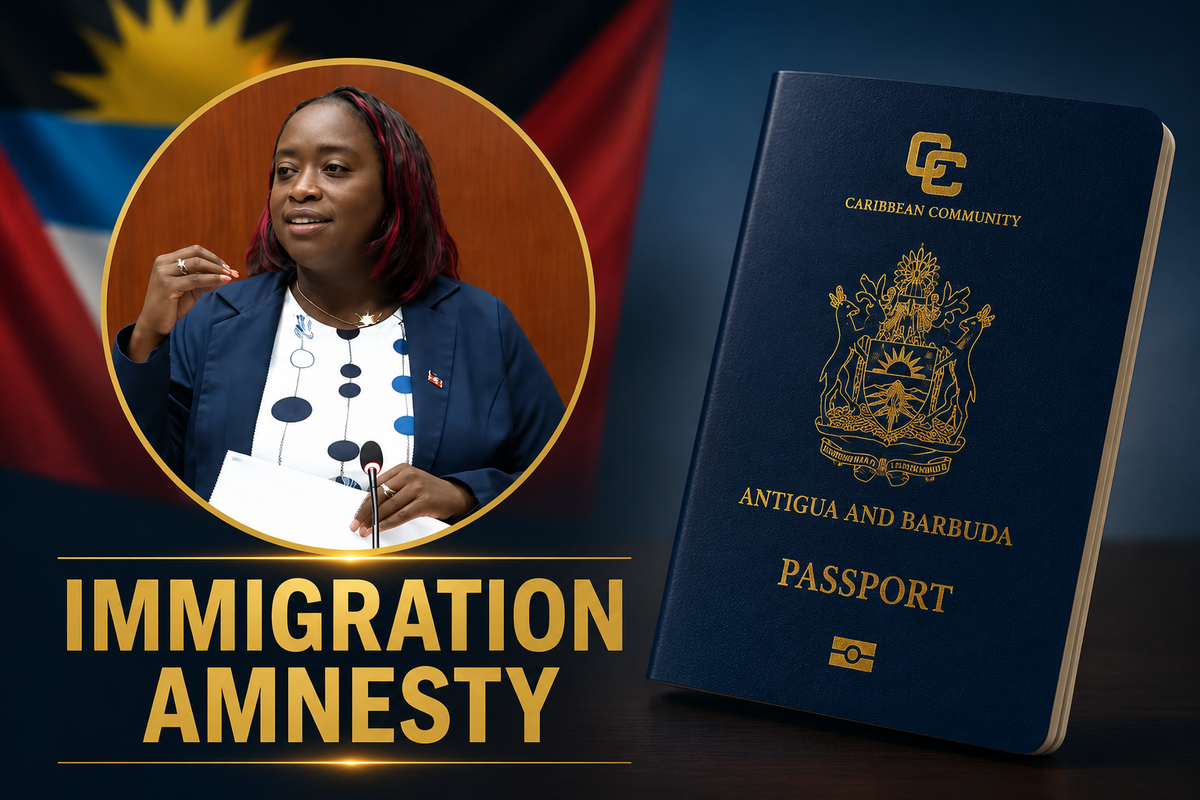
Senate Leader of Government Business Shenella Govia defended the Immigration and Passport (Amendment) Bill 2026 on Monday, arguing that the legislation strikes a careful balance between compassion and national security. According to Antigua News Room, the bill offers a structured pathway for long-term undocumented residents to regularize their status while maintaining strict eligibility requirements.
Speaking during debate in the Upper House, Govia rejected suggestions that the amnesty amounted to an unrestricted pardon. She told senators the bill was designed to uphold the rule of law while addressing the realities faced by people who have lived in Antigua and Barbuda for years without legal status.
"This bill seeks to amend the Immigration and Passport Act of 2014 to provide a structured and time-bound amnesty for persons who have long resided among us but remain outside the legal framework," Govia said.
Under the legislation, individuals who have lived in Antigua and Barbuda as undocumented immigrants for at least four years — or who narrowly missed qualifying for citizenship due to a lapse in residency — may apply to regularize their status. Applicants must submit police certificates from every country in which they have lived, pay a prescribed EC$650 fee and undergo scrutiny by the Immigration Department before being considered.
Govia said those requirements demonstrate that the government is extending opportunity while preserving accountability.
"This ensures that while we extend mercy as a country, we also uphold the rule of law and accountability," she said.
The bill also contains explicit safeguards to protect national security. Individuals who pose a security threat, provide false information, are subject to deportation orders or are wanted under international warrants are ineligible for amnesty.
"Amnesty is not a loophole," Govia said. "It is a carefully guarded doorway to lawful belonging."
Govia added that the legislation introduces a standardized application form to ensure transparency, fairness and accountability throughout the process. "Every applicant is treated fairly. Every application is documented and every decision is accountable," she told the Senate.
She argued the bill reaches beyond immigration administration, addressing the lives of people who have become embedded in the country's social fabric.
"It is about regularizing lives," Govia said. "It's about ensuring that families who have contributed significantly to our economy, our culture and our communities are given a fair chance to stand on solid legal ground."
Many people who initially came to Antigua and Barbuda seeking opportunity have since become integral members of society, she noted. Regularizing their status, she argued, would strengthen families, stabilize the workforce and reinforce the country's values of fairness and inclusion.
Govia was clear, however, that the amnesty carries conditions. "Amnesty is not unconditional. It is a covenant between the state and the individual," she said, adding that applicants would be expected to obey the country's laws and accept the responsibilities that accompany legal status.
The Immigration and Passport (Amendment) Bill 2026 was subsequently approved by the Senate, clearing the way for the government to implement a two-month amnesty programme beginning July 1 for eligible undocumented residents seeking to regularize their immigration status.