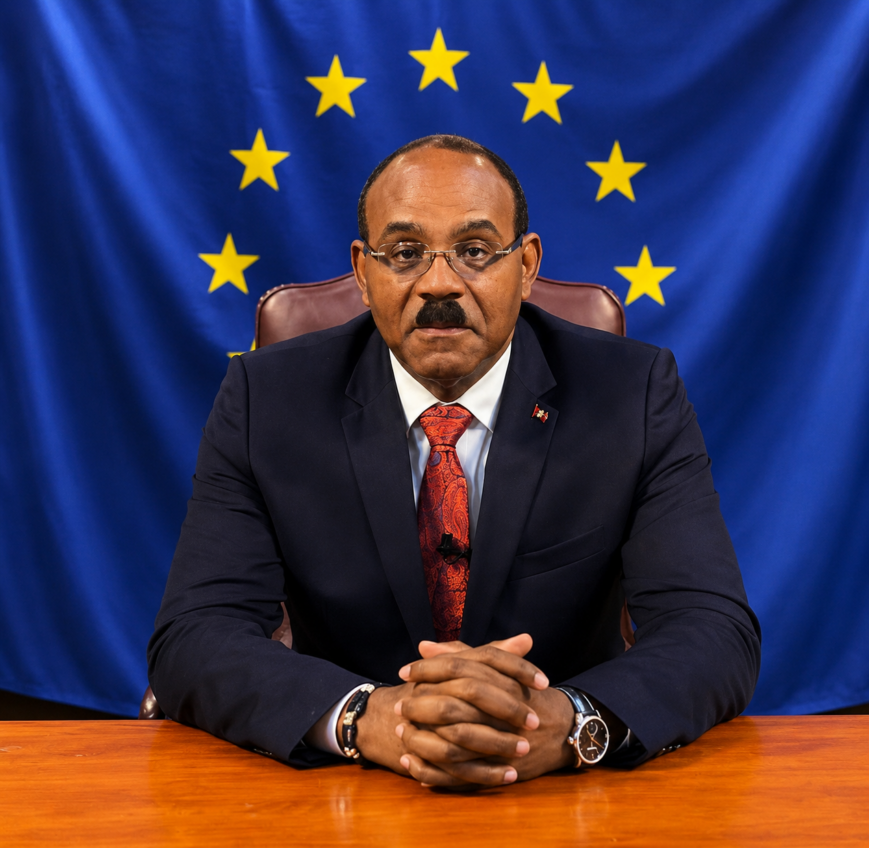
Antigua and Barbuda is mounting a high-level diplomatic push to preserve its visa-free access to the European Union, as the bloc moves closer to penalising countries that operate citizenship by investment programmes. Prime Minister Gaston Browne outlined the government's strategy on Saturday, according to Antigua News Room.
Browne said the government has not abandoned hope of convincing European officials to reverse course on proposals that could strip Antigua and Barbuda of visa-free travel privileges before the year is out.
"The European Union has threatened that they could withdraw their visa-free access, potentially by the end of the year. We don't know for sure they will, but we're trying to have a high-level engagement with them to see if we can actually get them to reconsider," Browne said during his weekly Pointe FM programme.
The prime minister argued that the EU's security concerns surrounding investment migration programmes can be addressed through enhanced measures rather than the removal of visa-free travel. Central to that argument is a proposal to introduce an electronic travel authorisation system for citizens of countries operating such programmes.
"We have the view that an electronic travel authorization should be sufficient," Browne said. "We think that it's a sensible thing to do to maintain the good relations that we've had over the years and not to throw the baby out with the bath water."
Browne said Antigua and Barbuda has already taken steps to strengthen its Citizenship by Investment Programme and stands ready to adopt any additional safeguards European authorities may require. He noted that biometrics remains the one outstanding issue yet to be resolved.
"We have said to them, 'You run investment immigration programmes; any initiative that you have in place, we'll put in place,'" he said.
The prime minister pushed back firmly against characterisations of Antigua and Barbuda's programme as a meaningful security risk, acknowledging that no immigration system is entirely without vulnerability while insisting the country's programme does not pose a significant threat.
"We are pretty sure that we have strengthened our programme and that it does not represent any significant risk to any country," Browne said. "We do accept that you have the residual risk in which from time to time you may end up with one or two crooks. Nothing is foolproof."
Browne also drew attention to similar challenges faced by investor immigration programmes in larger nations, arguing that Antigua and Barbuda is being unfairly singled out.
"Even the EB-5 programme in the United States, they've had a lot of crooks. The one in Canada too. But they keep pointing fingers at us as though they are not fallible and as though their programmes have not attracted crooks too," he said.
The prime minister emphasised that Antigua and Barbuda's programme operates with independence and integrity, noting that he has never personally overturned a rejection issued by the Citizenship by Investment Unit.
"I've never once overturned any case that was actually rejected by the CIU. We have allowed the unit and the board to operate independently," Browne said. "In the case of Antigua and Barbuda, our programme is run with integrity."
The government says it will continue engaging European officials in pursuit of a resolution that preserves the longstanding travel arrangement.