Two powerful earthquakes struck Venezuela's northern coast within 40 seconds of each other on Wednesday, killing at least 164 people and injuring 971 more in the strongest seismic event to hit the country in more than a century.
A magnitude 7.2 foreshock struck near San Felipe, the capital of Yaracuy state, just after 6:04 p.m. ET. It was immediately followed by a larger 7.5 magnitude quake centred approximately 23 kilometres southeast of Yumare, also in Yaracuy state. The tremors were felt across Venezuela and in neighbouring Colombia, hundreds of kilometres from the epicentre.
Authorities fear the true death toll and extent of the damage remain significantly higher than confirmed figures. Venezuela has declared a state of emergency as first responders deploy nationwide and international assistance begins to arrive.
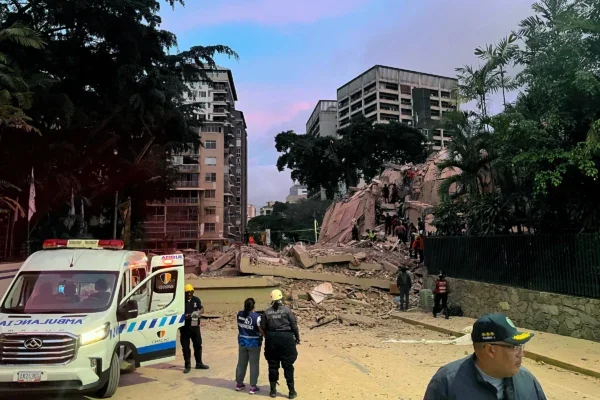
Acting President Delcy Rodriguez, who assumed the role following the capture of President Nicolás Maduro by US forces earlier this year, announced the toll in a video message early Thursday morning. She noted the sharp overnight increase in casualties as a sign of the disaster's scale. Dozens of buildings have collapsed, with the coastal state of La Guaira declared a disaster zone and identified as the hardest-hit region.
"We are currently engaged in arduous rescue operations to save as many lives as God allows. This is truly a tragedy," Rodriguez said.
The earthquake struck on a public holiday, meaning many residents were at home or attending public events. Videos geolocated by CNN showed terrified residents evacuating damaged buildings and gathering in the streets. One Caracas resident described the scene as "like a horror movie."
Another Caracas resident, Martha Añez, recounted being trapped inside her apartment building and calling for help from her balcony. "We couldn't get out; there was hammering from one side and kicking from the other," she said, describing the moment rescuers broke through her door. Three floors of her building, she said, are "totally and absolutely wrecked."
In La Guaira, a large waterfront hotel in the city of Macuto was reduced to rubble. In the town of Catia La Mar, multiple buildings collapsed and high-rises sustained severe damage. The US Geological Survey issued two separate red alerts through its PAGER system for the back-to-back quakes, warning of probable "high casualties and extensive damage" and noting that most structures in the region are vulnerable to seismic shaking.
Internet connectivity dropped sharply across Venezuela after the quakes damaged power and telecommunications infrastructure, internet watchdog NetBlocks reported.
The government has established a high-level task force to oversee search and rescue operations and announced an initial $200 million fund for rebuilding. Simón Bolívar Airport near Caracas has been temporarily closed after sustaining damage. School classes are suspended nationwide for one week, and rail services and non-essential activities have been cancelled. Nationwide prayers across all religions were scheduled for 7 p.m. local time.
Security forces have been deployed across the country, and the Ministry of Communication and Information confirmed that direct gas supplies to certain buildings have been cut off as a precautionary measure while authorities assess structural damage.
International assistance is already being mobilised. Rodriguez said Venezuela expects to receive rescue teams from the United States after President Donald Trump voiced his support. Teams are also being sent from the Dominican Republic, France, El Salvador, Mexico, and Qatar. China, Brazil, and several Caribbean nations have offered humanitarian aid.
The disaster compounds an already dire situation in Venezuela, which remains mired in political and financial crisis and continues to struggle with an economy ravaged by years of hyperinflation.
The situation is ongoing and authorities expect the death toll to rise further as rescue operations continue.