"If we do not stop the money flow, we will not stop the gangs."
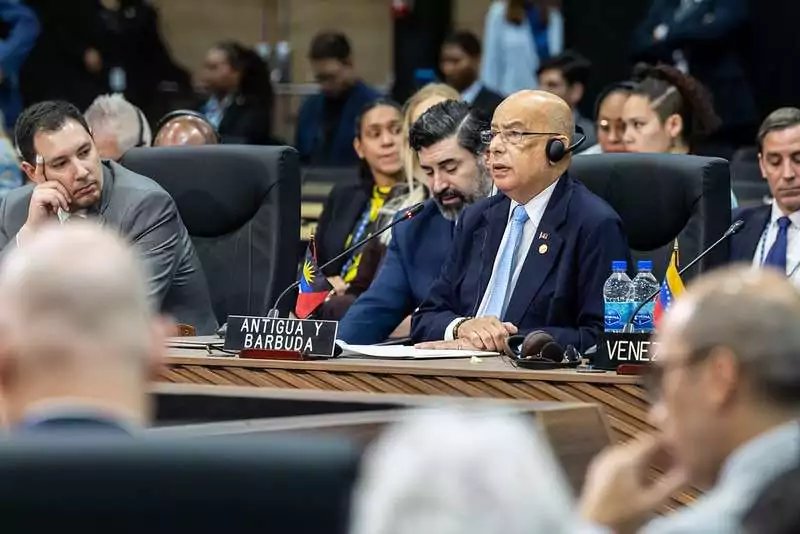
That stark warning came from Sir Ronald Sanders, Antigua and Barbuda's Ambassador to the United States and the Organisation of American States, speaking at the 56th OAS General Assembly in Panama City. According to Antigua.news, Sir Ronald declared that Antigua and Barbuda fully supports the United Nations Authorised Gang Suppression Force and all efforts to restore public order in Haiti.
The General Assembly convened under the theme 'Firm Multilateralism in Defence of Democracy, Hemispheric Security and Stability in the Americas,' with member states taking up a range of pressing issues — among them the financial health of the OAS itself, the independence of its Secretary General, and the deepening security crisis in Haiti.
"Antigua and Barbuda comes to this General Assembly with hope," Sir Ronald told delegates, framing that hope in the country's conviction that the organisation, despite its challenges, remains essential to the hemisphere.
OAS Secretary General Albert Ramdin has made Haiti a central priority since taking office, having first addressed the crisis in Antigua last year and subsequently publishing a Roadmap for Stability and Peace. Sir Ronald welcomed that direction but pressed member states to confront what he described as the deeper structural forces sustaining Haiti's gangs.
"We must disrupt drug trafficking, illicit financial flows, and money laundering that emanates from Haiti," Sanders said. "We must identify, sanction, and prosecute those who finance and support gang activity wherever they operate, inside or outside of Haiti."
Sir Ronald also called for greater investment in maritime surveillance, coastal monitoring, and border security, arguing that the movement of weapons, ammunition, drugs, and criminal actors into and out of Haiti must be disrupted if the gangs are to be weakened. He framed the crisis not as an isolated national problem but as a test for the hemisphere as a whole, urging the international community — and the countries of the Americas in particular — to act in a coordinated manner against the transnational criminal networks operating there.
Sir Ronald then turned his attention to the OAS's own finances, warning that the organisation's regular fund is under significant strain and that its reserves, designed to cushion against unforeseen shocks, have been depleted. He told delegates that the approved budget ceiling for 2027 stands at 95.6 million US dollars — lower in real terms than the organisation's budget fifteen years ago — and that the proposed 2027 programme budget fails to address 16.7 million US dollars in unfunded and underfunded needs identified by the General Secretariat.
"Antigua and Barbuda supported this budget to ensure continuity of operations, but not because the budget resolved the organisation's structural financial challenges," he said. He added that chronic underfunding carries real consequences for anti-corruption and security programmes, climate resilience initiatives, technical cooperation, and human rights mechanisms.
Sir Ronald also addressed the independence of the OAS Secretary General and the international civil service, describing it as a fundamental principle of the OAS Charter and essential to the organisation's ability to serve all member states impartially. He acknowledged that accountability is equally important, but stressed it must be exercised through established mechanisms and in accordance with the Charter — not through the unilateral preferences of any single government.
In closing, Sir Ronald said Antigua and Barbuda values the OAS and believes it can deliver more for the peoples of the Americas, but that doing so requires an organisation that is consensus-driven, adequately financed, accountable, modern, and responsive.
"Antigua and Barbuda chooses an OAS that is strong, independent, properly resourced, and representative of all of the peoples of the Americas, whose states choose to be part of this common endeavour," he said.