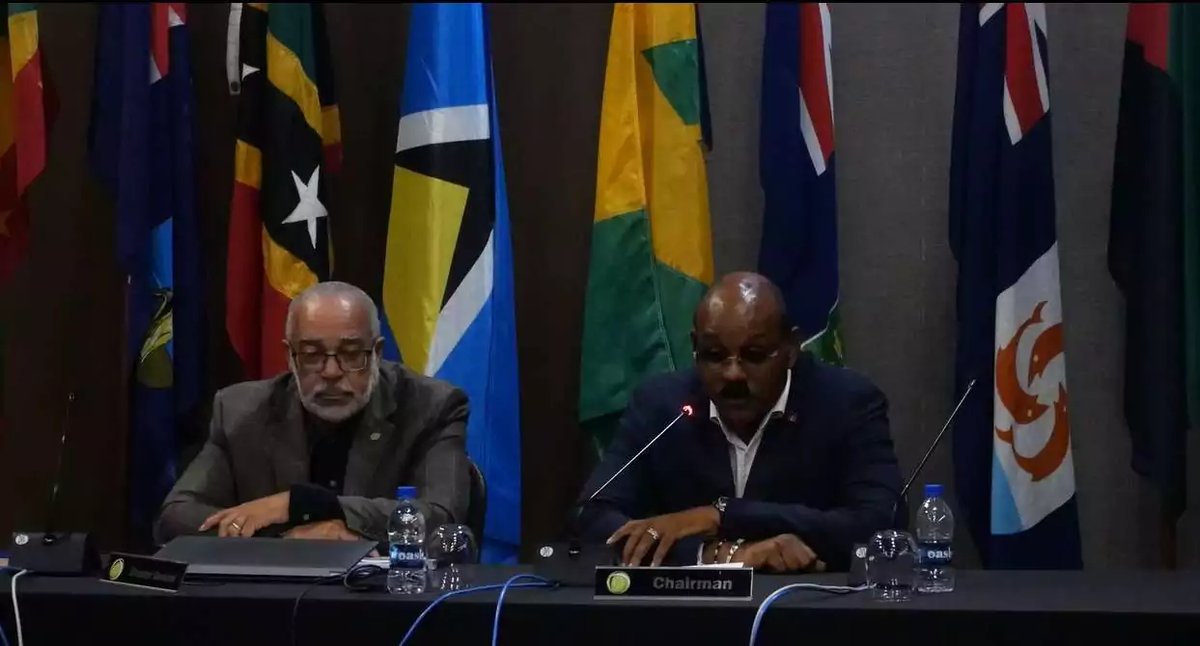
OECS heads of government are seeking high-level talks with European Union officials before the end of this year, aiming to avert a potential suspension of visa-free Schengen access linked to citizenship by investment programmes across the sub-region.
According to Antigua.news, the issue was raised during the 78th meeting of the OECS Authority, held in Antigua and Barbuda, with Chairman and Prime Minister Gaston Browne briefing media on the outcome of the leaders' deliberations.
"We also have discussions about the CIP, and the fact that there has been a threat by the European Union that they could discontinue visa-free access, that is, the Schengen visa-free access," Prime Minister Browne said.
Among the alternatives under consideration is the introduction of an Electronic Travel Authorisation system — a measure that would fall short of a full suspension of visa-free access, which the EU has raised as a possibility. "Possibly to introduce an ETA, Electronic Travel Authorisation, rather than suspending visa-free access," Browne said, adding that regional heads want to secure high-level discussions with European officials before any decision is reached.
The push for EU engagement coincides with efforts to formally establish a regional regulatory body that Browne has long championed as the appropriate response to European concerns. At the opening ceremony of the 78th meeting, OECS Director General Didacus Jules announced that Antigua and Barbuda had taken a further legal step toward formalising that body.
"We are in the final stages of establishing an independent regulatory authority to hold our citizenship by investment programmes to the highest standards," Jules told the gathering. "I am proud to announce that Antigua and Barbuda has today deposited its instrument of accession to this guarantee of integrity."
The Eastern Caribbean Citizenship by Investment Regulatory Authority — known as ECCIRA — was established by Prime Minister Browne alongside leaders from Dominica, Grenada, Saint Kitts and Nevis, and Saint Lucia, following a series of consultations involving government officials, CIP agents, regulators, international observers and members of the public in 2025. All five states signed the formal agreement in September 2025, with enabling legislation — the Eastern Caribbean Citizenship by Investment Regulatory Authority Agreement Act — passed in October 2025. All five participating states completed ratification by early 2026, with the authority now moving toward full operations from its headquarters in Grenada.
Browne has consistently argued that a unified regional regulator gives Caribbean governments stronger standing in disputes with international partners than each country defending its own programme individually.
"I think the assumption is that countries will hide any deficiencies in their programs," Browne said. "If we have an independent regulator, which could even involve individuals from, let's say, the United States, Canada, Europe, to serve in that commission, then I think it will give added impetus, or let's say we provide greater confidence in our program and to assure international partners that our programs are well regulated."
ECCIRA's mandate includes centralised vetting, standardised due diligence conducted through the CARICOM Implementation Agency for Crime and Security, biometric data collection, and annual compliance reporting across all five participating jurisdictions.
The authority's establishment has already drawn positive notice internationally. US Treasury officials cited its creation as a sign of regional good faith at the fourth US-Caribbean Roundtable on citizenship by investment, held in Antigua and Barbuda in December 2025, crediting the OECS states' regulatory push as evidence of stronger governance over the sector.
Browne underscored the economic stakes involved, describing CIP revenues as a critical funding source for several member states beyond traditional tax streams. "They are a very important source of non-cash revenue for the respective countries," he said. "And without any compensatory income, clearly, it will result in some significant displacements in our respective countries, especially those countries that are heavily reliant on CIP revenues."
The EU has intensified its scrutiny of Caribbean citizenship by investment programmes in recent years, citing concerns over due-diligence standards, security vetting, and the potential for visa-free Schengen travel to be exploited. That scrutiny sharpened further after the European Court of Justice struck down Malta's investor citizenship scheme in April 2025.