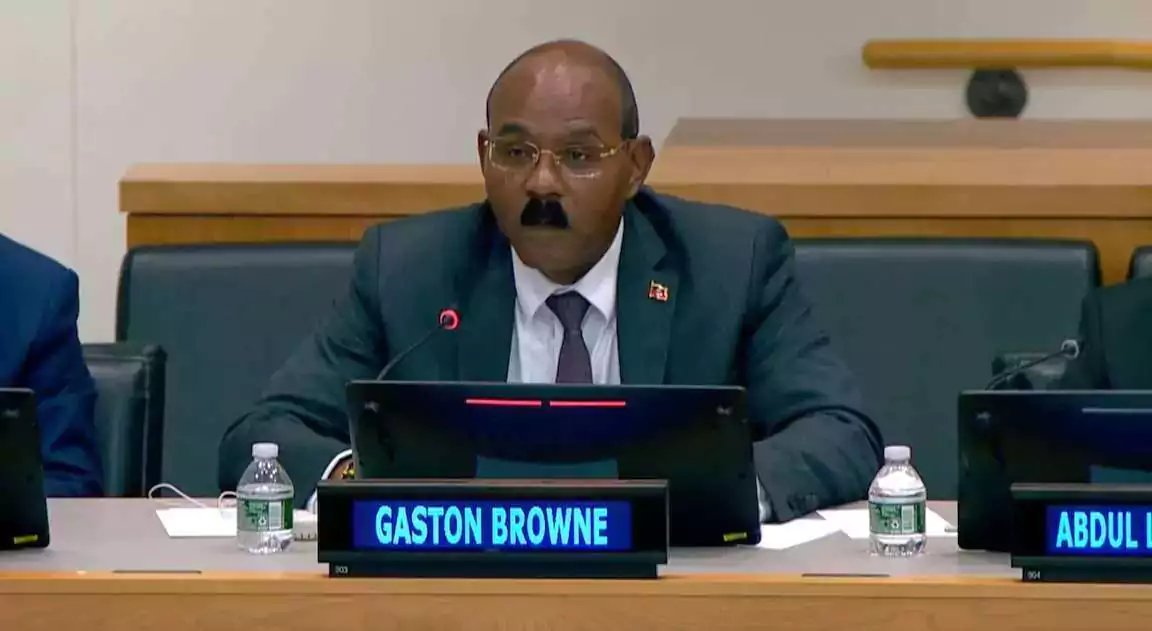
Prime Minister Gaston Browne has issued an urgent call for the immediate implementation of the Multidimensional Vulnerability Index (MVI), warning that Small Island Developing States (SIDS) can no longer afford delays in accessing fair development financing.
According to Antigua.news, Browne made the appeal at the High-Level Retreat on Operationalizing the Multidimensional Vulnerability Index at United Nations Headquarters. He argued that while the challenges facing island nations have intensified, international financing systems continue to rely on outdated measures that fail to reflect their true vulnerabilities.
Browne, who served as co-chair of the UN Secretary-General's High-Level Panel on the MVI, said the tool was developed to correct longstanding inequities created by using Gross Domestic Product (GDP) alone to determine access to concessional financing.
"The world has changed dramatically, but the rules governing access to development finance have not," Browne told delegates.
Although the United Nations formally adopted the MVI in 2024, it has yet to be integrated into the global financial system. Browne said this delay continues to disadvantage countries like Antigua and Barbuda, which remain highly vulnerable to external shocks despite being classified as middle-income economies.
The retreat was co-hosted by Antigua and Barbuda, Portugal, the United Nations Office of the High Representative for the Least Developed Countries, Landlocked Developing Countries and Small Island Developing States, and the United Nations Department of Economic and Social Affairs. It brought together governments, international financial institutions, UN agencies and development partners to discuss practical steps toward implementation.
Browne pointed to the region's energy challenges as a clear example of why the MVI is urgently needed. He noted that nine Caribbean countries generate more than 80 percent of their electricity from imported fossil fuels, while five depend on imports for more than 90 percent of their energy needs.
"Electricity consumers across our sub-region pay some of the highest tariffs in the world, frequently approaching twice the average of developed countries. This is not because we are inefficient, but because we are trapped," he said.
The Prime Minister noted that Caribbean nations remain exposed to fluctuations in global oil prices, citing the impacts of the COVID-19 pandemic, the war in Ukraine and ongoing tensions involving Iran.
"When global oil prices spike, our vulnerable countries absorb the full shock. We simply have no buffers," he said.
While renewable energy offers a path to greater resilience, Browne argued that many island states cannot secure affordable financing to build the infrastructure needed to transition away from fossil fuels.
"Because we are classified as middle-income countries based on GDP per capita, we are routinely denied the concessional access that our actual vulnerability demands," he stated.
Drawing on Antigua and Barbuda's own experience, Browne said the country has repeatedly been forced to rebuild after natural disasters using commercial loans while larger nations accessed financing at significantly lower rates.
"We have been told we are too prosperous to qualify for support, even as we were told in the same breath that our debt was unsustainable and our infrastructure inadequate," he said.
Browne urged international institutions — including the World Bank, International Monetary Fund, vertical climate funds and OECD financing frameworks — to formally incorporate the MVI into their eligibility and financing decisions.
"Make vulnerability visible in spreadsheets, in eligibility criteria, in boardrooms, and in budgets," Browne declared.
He also encouraged countries and development partners to utilize the MVI's Vulnerability and Resilience Country Profiles to guide investment and development planning. St. Kitts and Nevis has already been selected as one of the first countries to pilot the initiative, signaling growing momentum toward practical implementation.
Browne closed by calling on the international community to move beyond pledges and deliver on commitments made to vulnerable nations.
"The world made promises in Antigua and Barbuda. It made promises in Doha. It made promises in Seville, in New York, and in Baku. The time for promises has passed. The time for delivery is now," he said.