In a June 5, 2026 Daily Observer column, Ambassador Sir Ronald Sanders laid out the Antigua and Barbuda government's case for unilaterally declaring Spanish the country's second official language. It marked the first time any detailed rationale has been offered to the public on the matter.
A decision of this magnitude should have been presented to the population before the last elections, so that the government could rightfully claim a clear mandate to proceed with what remains an ill-considered idea.
Sir Ronald wrote: "The decision by the Government of Antigua and Barbuda… to make Spanish the country's second official language may prove to be one of those [significant] ideas."
The use of the word "may" is telling. That qualifier is a subliminal admission that the idea could just as easily prove insignificant — or worse, dangerous and irreversible.
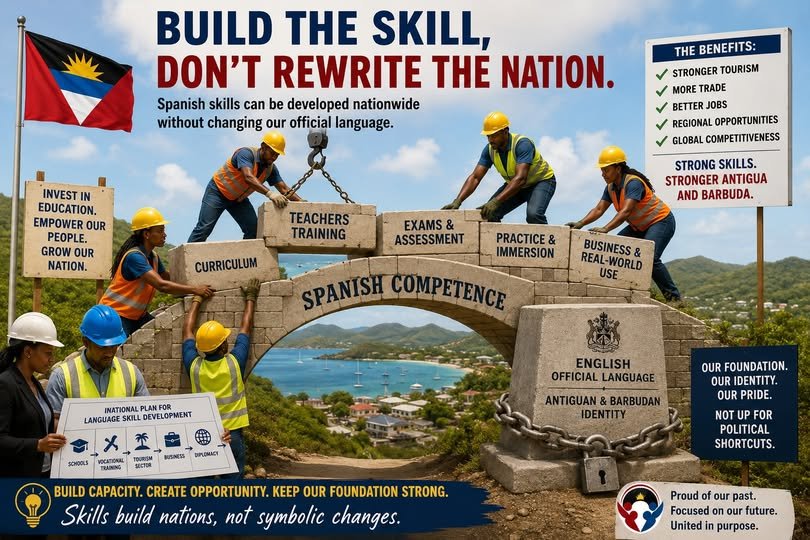
Sir Ronald's article fails to demonstrate how not declaring Spanish an official language specifically prevents Antigua and Barbuda from pursuing any of the benefits he enumerated. Acquiring the skills to speak Spanish has absolutely nothing to do with granting the language official status.
Miami, Florida already enjoys all of the advantages Sir Ronald described, and more — yet English remains its only official language. The question must be asked: how has Miami achieved what we aspire to without making Spanish an official language?
All of the outcomes Sir Ronald cited are achievable without such a declaration. Indeed, many were already in motion before the government's announcement. Our Dominican brothers and sisters were already integrating well into Antiguan society long before this decision was made.
Sir Ronald's article acknowledged as much: "Over many years, Antigua and Barbuda has become home to a substantial Spanish-speaking community, particularly from the Dominican Republic. Many have worked, invested, raised families, and become part of the country's social and economic life. Their children and grandchildren are citizens by birth, while others seek citizenship after years of lawful residence and contribution to national development."
That statement is an open admission that integration has been underway for some time. So what, precisely, is the problem the government is trying to solve?
Just as Miami integrated naturally, Antigua and Barbuda would have done the same without government intervention. Does the government believe that declaring Spanish an official language will cause everyone to speak it overnight? Integration is always a gradual process. A formal declaration will not accelerate it.
Without interference, the integration process would have organically produced a bilingual society on its own terms. Furthermore, the benefits Sir Ronald points to are not guaranteed simply by elevating Spanish to official status.
What does Antigua and Barbuda's tourism product specifically offer that will attract Latin American visitors in large numbers? The apparent assumption — unsubstantiated — is that a formal declaration will trigger an immediate flood of Latin American arrivals. It will not. The benefits outlined cannot be achieved overnight, nor even within twelve months.
The immediate, tangible effect of declaring Spanish an official language appears to be little more than an enthusiastic response from the Latin American delegation to the OAS. It is worth recalling that there was also enthusiasm when Boggy Peak was renamed Mount Obama. The material gains from that gesture remain elusive.
Support for promoting the learning of Spanish remains firm. But that support does not extend to doing so at the expense of the identity of the Antiguan and Barbudan people. It is disingenuous to suggest that making Spanish an official language and leveraging the skills of the Dominican community are inextricably linked. They are not.
The public has still not been told the real reason behind this move. Until that explanation is forthcoming, the concerns surrounding this decision will not go away.