By Daven Joseph
Over the past two weeks, Antigua and Barbuda buried two of its great public servants — and honoured them differently. That disparity deserves a national conversation.
The first was Mr. Philbert "Phil" "Sammy" Mason, the country's senior meteorologist for 34 years. He was the voice every Antiguan waited for when a storm formed. During Hurricane Hugo in 1989 and Hurricane Luis in 1995, his forecasts and his insistence on early warnings helped the country avoid catastrophic loss of life. He retired not so quietly. He died quietly. He received no official funeral.
I knew Phil well. We both studied at the University of the West Indies, and from those days until the end of his life, we remained close friends. I witnessed his discipline firsthand. In September 1995, as Luis approached, I visited the Met Office. The building was shaking. Phil stood at a table covered in maps, phones ringing, ABS Radio on hold, two junior officers at his side. He looked up and said, "Daven you need to go home now, we have six hours to get people out of low lying and flood prone areas." He was right. His warning got them out. His service was not political. It was national.
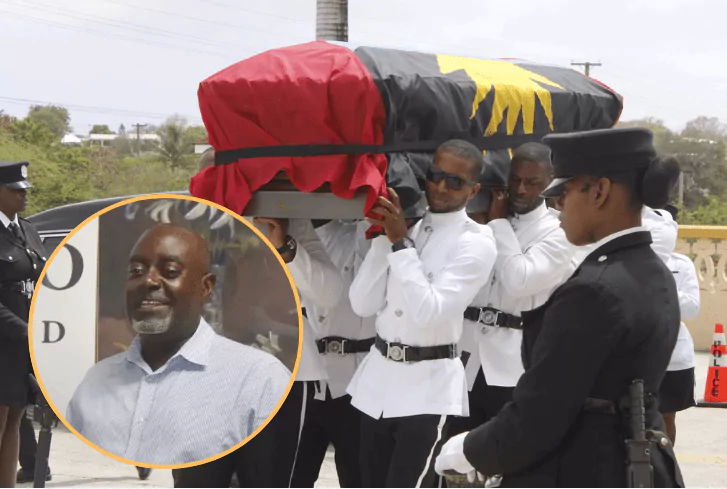
Days later, Antigua buried Dr. Cuthrin "Cuttring" Lake, former Medical Director of Holberton Hospital, the predecessor to the Sir Lester Bird Medical Centre. A surgeon and administrator, Dr. Lake served during some of the country's most challenging years — when medical specialists were scarce, equipment was old, and the hospital was chronically underfunded. He stayed. He trained young doctors. He operated through blackouts. The State accorded him an official funeral, with police outriders, a Defence Force presence, and the flag at half-mast.
Even before I met Dr. Lake personally, his reputation preceded him. I was introduced to him in 1996 through our mutual friend, the late Sir Frederick Ballantyne, former Governor-General of St. Vincent and the Grenadines, who had come to Antigua for medical treatment with Dr. Lake as his physician. From that day until Dr. Lake's passing, we greeted each other with warmth and mutual respect. I admired his humility. He never sought the spotlight. He sought results.
Both men saved Antiguan lives. Both shaped our national development. That they were buried within days of each other and honoured differently by the State exposes a gap in our protocols — one we should close now, with compassion and clarity.
STATE FUNERAL VS. OFFICIAL FUNERAL: WHAT IS FAIR?
Antigua and Barbuda currently has no published statute defining these honours. The country operates by convention, inherited from Westminster practice but never codified.
A State Funeral is reserved for sitting Heads of State, Prime Ministers, and Governors-General. It involves full military honours, lying-in-state at Parliament or Government House, and a period of national mourning.
An Official Funeral is broader and less defined. It is granted by Cabinet, typically to sitting or former parliamentarians, ministers, and speakers. Occasionally it has been extended to distinguished citizens outside politics — doctors, artists, sportsmen. The State covers costs and provides police and Defence Force participation. But there is no written list of who qualifies.
The absence of a written policy is the core problem. In Britain, the Earl Marshal and the College of Arms advise on ceremonial matters. Canada has published guidelines. Barbados' Cabinet Office issued a National Honours Protocol in 2018. Antigua and Barbuda has none. When Cabinet decides, it decides alone, and the public cannot see the reasoning.
Because the criteria are unwritten, decisions look ad hoc. When two national heroes are buried in the same fortnight and treated differently, it sends a confusing message to their families and to the wider public. It tells Met Office staff that their work is valued less than a minister's. It tells nurses at Sir Lester Bird Medical Centre that their former chief is honoured, but the man who warned the island to evacuate is not.
If Dr. Lake is deserving of an official funeral — and he most certainly was — then Mr. Philbert Mason, whose warnings saved lives during both Hugo and Luis, is equally deserving. Fairness demands a system, not selective goodwill. I am certain that both men, modest as they were, would have agreed. Both believed in service over ceremony. But both would have wanted the same rules applied to everyone.
To both families, to Dr. Lake's colleagues from Holberton, and to the Met Office staff who served alongside Phil: you have my deepest sympathy and my unqualified respect for their legacies. My call for reform takes nothing from either man's honour. It asks that we build a framework that would have honoured both automatically, without controversy.
This matters because nations are built on memory. When we honour Dr. Cuthrin Lake, we tell every young doctor that their sleepless nights at Sir Lester Bird Medical Centre mattered — that stitching a wound at 3 a.m. during a hurricane will be remembered. When we overlook Phil Mason, buried in the same two weeks, we tell every meteorologist, nurse, teacher, and coast guard officer that even heroic public service may go unacknowledged by the State.
That is a dangerous message for a small island nation. Antigua and Barbuda depends on public servants who go beyond their job descriptions — the nurse who stays through the storm, the Met officer who doesn't sleep, the fire officer who runs into the building. If the State honours only political office, it diminishes the meaning of service itself.
We are a small country. Our heroes are not distant figures. They are our classmates, our neighbours. They drove us to hospital. They told us when to board up. They taught our children. They flew the medevac. A transparent system ensures we see them all.
Let us thank Dr. Cuthrin Lake properly, without apology. He earned that funeral. Let us also ensure that the next Philbert Mason is recognised while his wife, his children, and his colleagues can still hear it. Gratitude delayed is gratitude denied.
Our heroes deserve a system that is fair, transparent, and worthy of them. The time to build it is now. The Government and the Opposition should work together, publish draft criteria, and pass a National Honours and Funerals Policy expeditiously. Let the next hero be honoured by established protocol — without fear or favour.
The views expressed are those of the author and not the Government of Antigua and Barbuda.
Daven Joseph is a businessman, the country's Development Commissioner, former parliamentarian, former senator, and current Ambassador.