By Yves R. Ephraim
According to Antigua News Room, a pointed opinion piece published this week draws a striking historical parallel between the displacement of Native Americans and what the author describes as an accelerating erosion of Antiguan and Barbudan identity, culture, and land rights.
The author opens with the history of America's Indigenous peoples — once dominant across the North American continent, now largely confined to reservations marked by drug addiction, unemployment, political corruption, failing schools, crime, and cultural loss. The so-called "Trail of Tears" of the 1830s, in which thousands of Native Americans were forcibly marched from their homelands during brutal winter conditions under President Andrew Jackson, serves as the piece's central cautionary metaphor.
"It has been said that to ignore history is to set yourself up to repeat it," the author writes. "Unfortunately, in our case it is not so much that we have forgotten history than it is that we have not taken the time to examine history."
The author argues that Antiguans and Barbudans are now outnumbered in their own homeland and outlines several developments he characterises as signs of cultural decline.
Among them: the removal of Barbudans from their communal lands; the displacement of residents in communities such as Villa, Boobey Alley, and Point, whom he says are being relocated under the banner of community development and replaced by immigrant populations with declared political allegiances; and an unchecked epidemic of gambling and drug use among the nation's youth that he contends the government has failed to publicly acknowledge.
On crime, the author rejects comparisons with other territories, arguing that the appropriate benchmark is Antigua and Barbuda's own historical experience. "By comparing to other countries," he writes, "you get gaslighted into feeling like you are exaggerating."
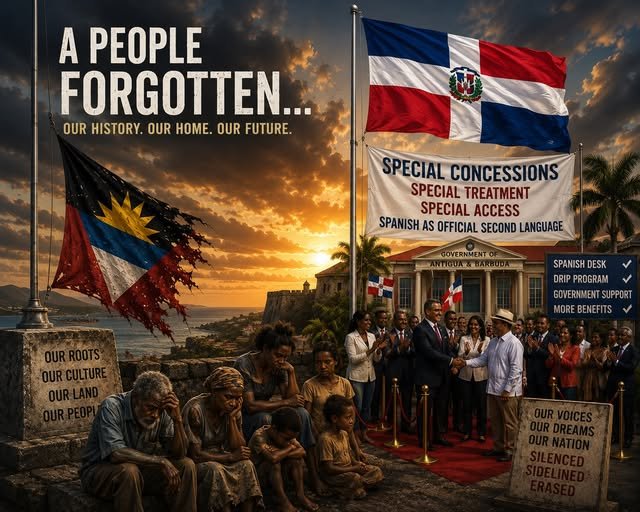
The piece also takes direct aim at the government's move to introduce a second official language. The author warns that within twenty years, the change will be transformative — likening it to the linguistic shift seen in Miami — and further cautions that under existing labour law, employers could face discrimination claims if they reject Spanish-speaking-only applicants who otherwise meet job requirements.
Beyond language, the author laments the decline of Antiguan and Barbudan folklore, music, and history, citing the near-total disappearance of cultural touchstones and arguing that books such as "To Shoot Hard Labour" should be required reading in schools. He traces the roots of cultural self-erasure to colonialism — a system that taught locals to view their dialect, hair, skin, and history as inferior — but reserves particular criticism for what he calls "neo-colonialists" who "look and sound like us" yet perpetuate the same conditions.
The author calls the current moment a watershed in the nation's history and urges citizens to shed their apathy, warning that prioritising foreign political dramas and international sports leagues over local affairs leaves Antiguans and Barbudans with little standing to claim their homeland when circumstances abroad — he references both the Windrush scandal and recent deportation policies — force them to return.
"If you continue to ignore what is very evident and choose to remain apathetic," he concludes, "then you must accept that we have lost the battle to keep the Antiguan and Barbudan way of life, forever."
The piece ends with a firm call to action: reject the adoption of any second official language beyond the nation's own dialect, and speak up before, in the author's words, it is too late.