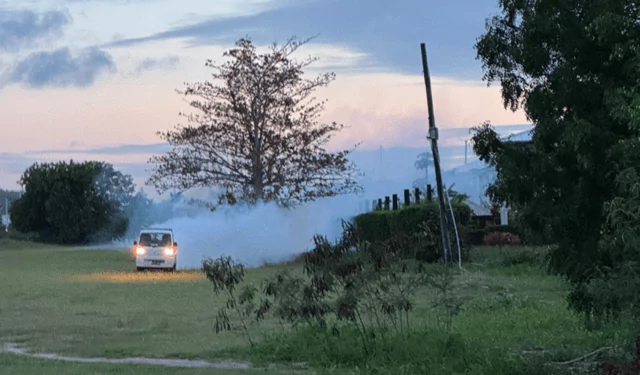
A Jolly Harbour property owner has filed a judicial review application asking the High Court to compel the Pesticides and Toxic Chemicals Control Board (PTCCB) to fulfill its statutory obligations regarding a chemical fogging programme operated by Caribbean Developments (Antigua) Limited (CDAL). According to Antigua.news, CDAL has admitted the fogging operations are conducted at more than four times the manufacturer's stated maximum annual frequency.
The case, brought by Mr. Cyprian Kowalczyk, places the Board's conduct toward a regulated entity under judicial scrutiny. Central to the application is why the High Court was required to issue an emergency stop order in early May — in the regulator's place — when the Board holds extensive statutory powers, including registration cancellation, operator licensing, personnel certification and the authority to issue notices of non-compliance, and when the underlying complaint had been before it since March.
Three letters, one reply — after a court order
The stop order was granted by the Honourable Madame Justice Stephenson in Mr. Kowalczyk's parallel civil claim against CDAL. It restrains the chemical fogging operations until early June. Prior to that order, Mr. Kowalczyk had hand-delivered three written communications to the Board over a period exceeding sixty days: a Freedom of Information request and complaint in March, a formal request for intervention co-signed by fourteen freeholders in April, and a Pre-Action Protocol Final Notice later that same month. The Board provided no substantive response to any of them.
The Board's first written engagement came only after Mr. Kowalczyk notified it that the High Court had granted the stop order. That letter declines to confirm whether CDAL holds the operator licence required under section 6(1) of the Pesticides and Toxic Chemicals Act, 2008, and commits to neither action nor a specific timeframe.
"Non-commercial" — and $163,200 a year
The judicial review argues that the Board's position, as reflected on the Court's file in the parallel civil proceedings, is internally inconsistent. CDAL contends that no operator licence is required because its fogging operations are "non-commercial" — a position its Defence and supporting Affidavit attributes to verbal advice from the Board itself. The Board has neither confirmed nor denied that attribution.
However, CDAL's own pleaded admissions record that the cost of the fogging operations is "built into the community fee" charged to approximately 850 freeholders at Jolly Harbour at $16.00 per property per month — amounting to up to $163,200 per annum if all freeholders pay. The judicial review argues that a "non-commercial" classification cannot be sustained alongside the collection of $163,200 annually from 850 freeholders. The Board's silence in the face of that contradiction is itself pleaded as the operative regulatory failure.
A regulator's other channel
The case draws a sharp contrast between the Board's engagement with CDAL and its treatment of the complainant. While Mr. Kowalczyk received no substantive response, CDAL's own sworn evidence indicates that the Board wrote to CDAL the day after the Court's stop order, inspected CDAL's storage facilities and personnel within the following week, has stamped each importation of Zenivex E4 RTU by CDAL, and has previously certified personnel said to be conducting the fogging. None of those communications, inspections or determinations has been disclosed to Mr. Kowalczyk.
Mr. Spencer's report
Several weeks before the Board's inspection of CDAL, a sitting Board member — Mr. F. Daryl Spencer, Deputy Chief Health Inspector — wrote a report on his personal letterhead addressed to CDAL's Director, Mrs. Jamie Tarter, endorsing the substance of CDAL's defensive position in the parallel civil proceedings. CDAL annexed the report to both its Defence and its Affidavit in Opposition.
Under section 4(3) of the Act, Board members hold the powers of an inspector — placing enforcement authority directly in their hands. The judicial review pleads that the Board has provided no information indicating that any conflict of interest disclosed by the report has been recognised as disqualifying, that Mr. Spencer has been recused from any determination of the freeholder's complaint, or that a panel free from his pre-published position has been constituted.
The air we breathe
Among the proprietary rights underpinning the case is one expressly preserved by the Registered Land Act, Cap. 374. Section 98 of that Act provides that nothing in the legislation shall be construed as derogating from "the natural right to support, light, air or access to a highway appertaining to any land."
Mr. Kowalczyk relies on both the natural right of access to a highway — the access route from his property to the nearest public road runs over CDAL's land, a right of way CDAL has admitted — and the natural right to air over and around it.
CDAL's own pleaded mitigation — that residents should "remain indoors during these periods to minimize exposure to the pesticide" — is characterised in the freeholder's case as an admission in itself. The outdoor air is being contaminated; residents must withdraw indoors to avoid it. That, the application argues, constitutes interference with the natural right to air preserved by the Registered Land Act.
What the order seeks
The judicial review does not ask the Court to determine the licensing question on its merits. Following the Padfield line of cases — and the Caribbean Court of Justice's decision in Commissioner of the Guyana Geology and Mines Commission v Diamond Quarry Inc [2022] CCJ 11 (AJ) GY — Mr. Kowalczyk seeks an order of mandamus compelling the Board to consider and decide, in writing and with reasons, the operator-licensing, product-registration, personnel-certification and section 20 enforcement questions.
Declarations are also sought that no oral representation by the Board can disapply the section 6(1) operator-licensing requirement, and that the statutory threshold for a section 20 notice is the test Parliament prescribed — "believes" — not the higher "sufficient evidence" standard the Board's letter has applied.
The Pesticides and Toxic Chemicals Act, 2008 has been in force for sixteen years. The statute has not changed. What the case asks the High Court to address is whether the regulator has applied it.