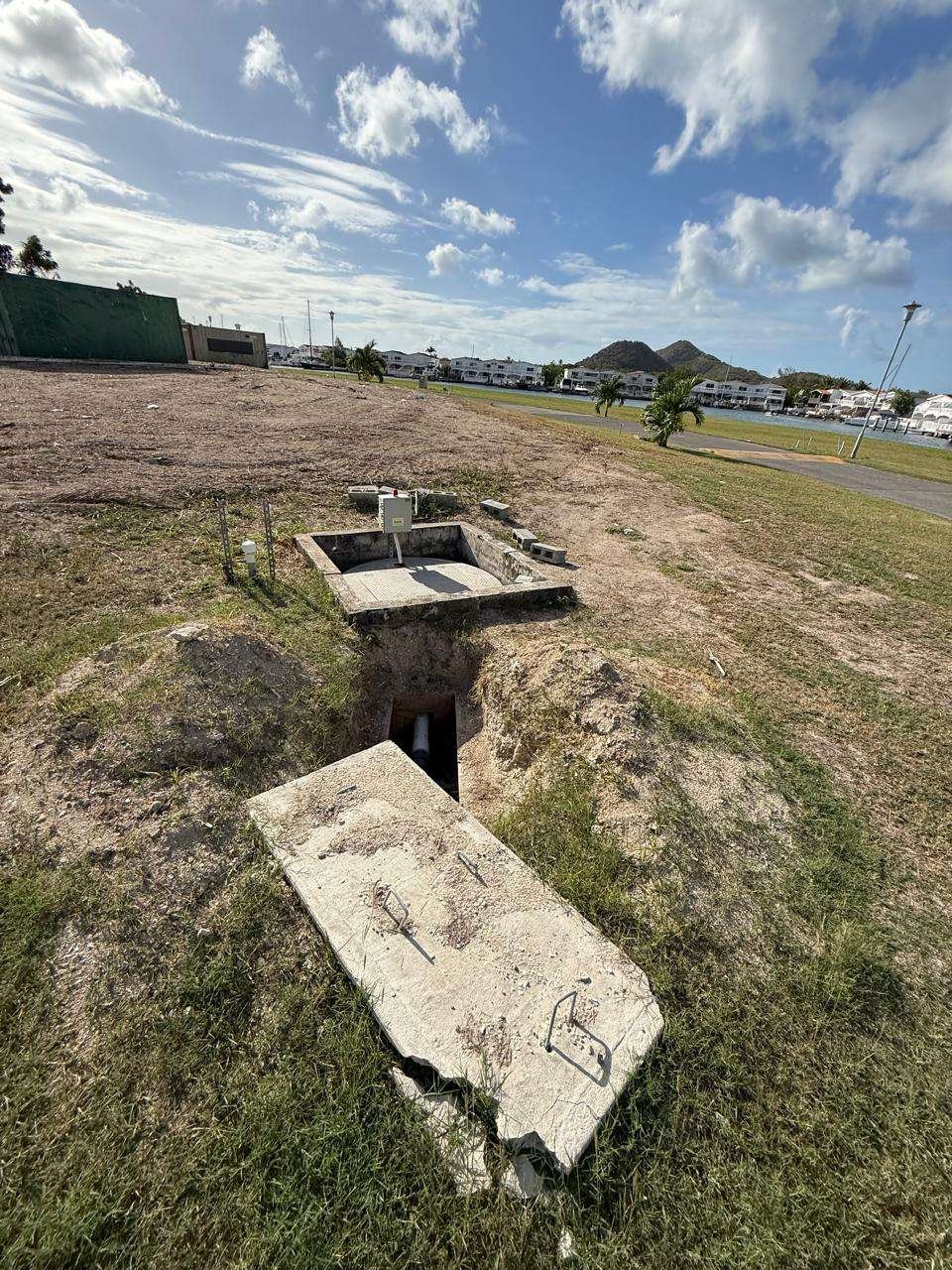
A sewage lift station was constructed eleven feet from a family home in Jolly Harbour earlier this year — without a development permit, without an Environmental Impact Assessment, and without notifying the adjacent property owner. The land on which it was built is registered under a covenant restricting it to residential use only. According to Antigua.news, the freeholder has now brought a judicial review against the Development Control Authority (DCA), the body charged by Parliament with overseeing such development.
The DCA has stated, on oath, that none of those regulatory requirements applied — because the works were already authorised under a development plan. The Authority then admitted it cannot locate that plan.
The station was built by Caribbean Developments (Antigua) Limited (CDAL) on a neighbouring residential parcel. A parallel private claim against CDAL and the adjacent landowners is also before the courts.
The judicial review was brought by freeholder Cyprian Kowalczyk. His claim alleges a pattern of regulatory deference to the developer that has left the statute book unapplied.
The original Harbour Island scheme, registered in 2006, placed the nearest sewage lift station approximately seventy-five feet from Mr Kowalczyk's home, with the neighbouring parcel serving as a residential buffer. The new station stands eleven feet away. The High Court, in the parallel private claim, has accepted there are "serious issues to be tried", including whether the new station is inconsistent with residential use restrictions and whether it constitutes actionable interference with the freeholder's use and enjoyment of his property.
Mr Kowalczyk formally requested that the DCA disclose what permits and approvals had been issued for the sewage works. A hand-delivered letter invoking the public-inspection provisions of the Act was delivered in October 2025, the day after construction began.
What he received in response was a DCA Inspection Report which, the regulator's own affidavit now concedes, contains "imprecisions". Rather than addressing his question, the Report suggested that his residence — not the new sewage station — had been built too close to a property boundary. The DCA's affidavit acknowledges the finding was made without requesting the building plans the DCA itself had stamped four years earlier, describing the omission on oath as "not best practice". The Report did not identify which setback rule was said to have been breached. Mr Kowalczyk contends no such published rule exists.
The Report had been sent to the developer before reaching Mr Kowalczyk. Two days prior to his receiving it, it had already been filed against him in the High Court in opposition to his injunction application.
In December 2025, the DCA's Acting Chief Town and Country Planner telephoned Mr Kowalczyk. According to his sworn evidence, the officer stated: "I am fully ready to retract that letter" and confirmed that the developer had not submitted any documentation for the construction. Days later, the same officer attended the site and indicated a stop order would be issued.
A verbal stop was communicated. Seventeen days later, the DCA authorised the works to resume. The connection was completed two days before the High Court rose for the Christmas vacation. The DCA's affidavit characterises the officer's earlier statements as "provisional and exploratory".
The DCA's legal position rests on the claim that the new station was a repositioning of pre-approved wastewater infrastructure under a section 10 development plan, exempting it from permit, EIA and notification requirements. Its affidavit then states: "the original development plan governing the Jolly Harbour development could not be located within the records of the Defendant."
The affidavit further notes that the broader Jolly Harbour development was commenced in or around the 1990s — predating the Physical Planning Act 2003, under which a section 10 plan can only have been made.
A 2012 letter on DCA letterhead, copied to the Prime Minister's Office, the Attorney General's Chambers and the Minister, described a regulator with a numbered application register, a defined approval process, and discretionary Environmental Impact Statement powers. It stated that new development plans "would have to go through a full approval process".
As reported by Antigua.news, none of those features appear to have operated in this instance. No application was made; no plan has been located; no records were taken at three undocumented site visits; no formal stop or enforcement notice was issued. A parallel system of developer-issued permits — which the Act does not authorise — runs alongside the statutory regime. Mr Kowalczyk paid CDAL $2,760 in 2022 for a "CDAL Building Permit"; for the 2025 sewage station, no permit was sought from the DCA at all.
The sworn evidence also contains apparent internal contradictions. The DCA states there is "no scenario" in which one application would be formally compared with an unrelated site, yet the same affidavit defends the new station by reference to other Harbour Island lift stations positioned approximately eleven feet from adjacent parcel boundaries. For a separate CDAL project — the proposed North Beach Resort — the DCA confirmed an EIA was required. No explanation has been offered for the difference in treatment.
The human impact on the family has also been placed before the Court. Mr Kowalczyk's wife has sworn an affidavit stating that a large sewage vacuum truck was parked directly in front of the family home over the Christmas holidays, its diesel engine running continuously, with exhaust fumes and sewage gas entering the house. The family was unable to ventilate. Their children were home from school. Days later, all three experienced what they describe as toxic gas inside their sealed home. Neighbours attended and have since provided sworn affidavits. A consultant dermatologist's letter records a diagnosis of atopic dermatitis in the couple's daughter and identifies hydrogen sulphide as a recognised trigger. Video footage of the station's hatch left open during servicing, and of overflows at other Jolly Harbour stations, has been placed before the Court.
Mr Kowalczyk's case is that construction was rushed to present the Court with a fait accompli — a tactic English courts have treated for over a century as build-at-your-own-risk, not a legal defence.
The judicial review seeks declarations that the DCA failed to discharge its duties under sections 17, 22 and 23 of the Physical Planning Act 2003; an order quashing the setback finding; and a direction compelling the DCA to determine, according to law, whether the new station required a permit, an EIA and adjacent-owner notification. Damages are sought for misfeasance in public office, breach of statutory duty, and losses flowing from the use of the Inspection Report against the freeholder.
The Physical Planning Act 2003 has been in force throughout the events in question. The matter is now before the High Court.