When ballots were counted in St. John's last week, the result was unambiguous. The Antigua and Barbuda Labour Party secured a commanding landslide victory, returning Prime Minister Gaston Browne to office for a fourth consecutive term. According to Antigua News Room, the outcome signals continuity at the highest level of government — and sustains an existing diplomatic trajectory between Antigua and Barbuda and the United Arab Emirates.
Ongoing discussions tied to investment, aviation, renewable energy, and technology cooperation are expected to continue under the returning administration. For Gulf partners, long-term political continuity provides greater certainty for bilateral projects requiring sustained coordination.
A Relationship Built on Patient Diplomacy
Relations between the UAE and Antigua and Barbuda have expanded steadily through diplomatic engagement, investment discussions, and broader cooperation surrounding climate resilience, tourism, and financial services. Antigua has increasingly positioned itself as a regional voice on sustainability and economic diversification within CARICOM, while the UAE continues strengthening ties across emerging international markets.
Connectivity Discussions Continue
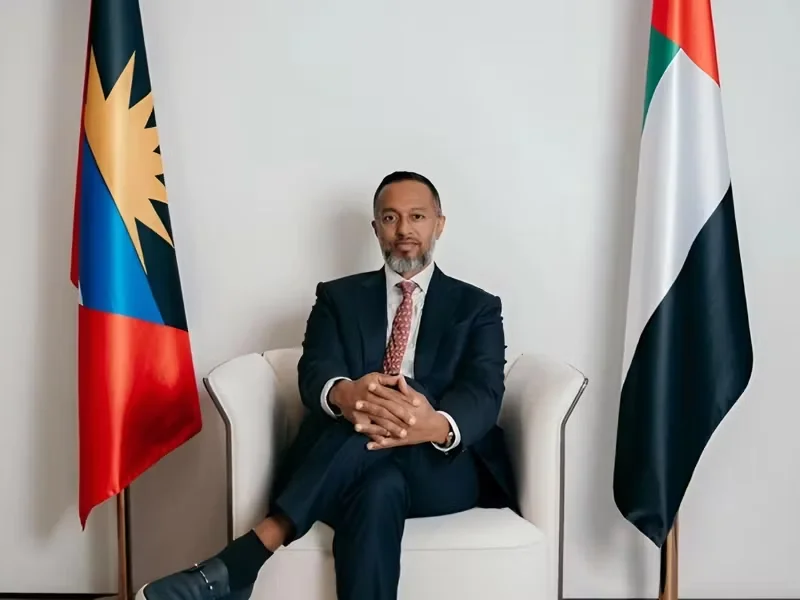
Among the active bilateral priorities is the long-discussed question of direct air links. Ambassador Theon Ali addressed the matter directly. "The UAE and Antigua have long been working on establishing direct air links between our two countries," he said. "This is not a new ambition or a hopeful paragraph in a feasibility study. It is an active file, one that has required navigating complex air service agreements, route economics, and the operational realities of long-haul travel to a small island market. This is the invisible infrastructure of international partnership — unglamorous, slow, and essential."
Direct flights could strengthen tourism flows between the two regions while also supporting business travel, educational exchanges, and broader economic engagement. Antigua continues attracting luxury tourism interest through its beaches, yachting sector, and hospitality industry — areas that align with growing outbound travel demand from Gulf travellers.
Technology and AI Cooperation Expands
Antigua and Barbuda has also increased its focus on digital transformation initiatives, including e-governance systems, AI-assisted logistics programmes, and data-driven tourism infrastructure. Regional policymakers continue exploring partnerships capable of supporting technical implementation and digital capacity-building.
The UAE's rapid expansion in artificial intelligence infrastructure and smart government services has positioned the country as a potential technical partner for Caribbean states seeking digital modernisation. Developments tied to Masdar City, government AI deployment initiatives, and partnerships involving firms such as G42 have drawn growing international attention in recent years. Caribbean markets may offer Gulf firms opportunities to test and adapt digital governance systems in smaller regulatory environments, expanding regional influence in sectors historically dominated by North American and European companies.
Climate and Energy Cooperation
Climate vulnerability remains one of the defining issues for Caribbean nations, particularly following increasingly destructive hurricane seasons across the region. Barbuda experienced severe devastation during Hurricane Irma in 2017, when approximately 95 percent of the island sustained damage.
In March 2024, the Green Barbuda project was inaugurated through the UAE-Caribbean Renewable Energy Fund. The hybrid solar facility combines 720 kilowatts of solar PV capacity with battery storage and diesel backup systems engineered to withstand hurricane-force winds reaching 265 kilometres per hour.
According to project data, the facility reduces annual diesel consumption by approximately 406,000 litres while lowering carbon dioxide emissions by more than one million kilograms annually. The UAE-Caribbean Renewable Energy Fund, launched in 2017, now supports projects across 16 Caribbean countries. The Green Barbuda project may serve as a model for future renewable energy expansion across Antigua and the wider Caribbean region as governments continue seeking alternatives to diesel dependency.