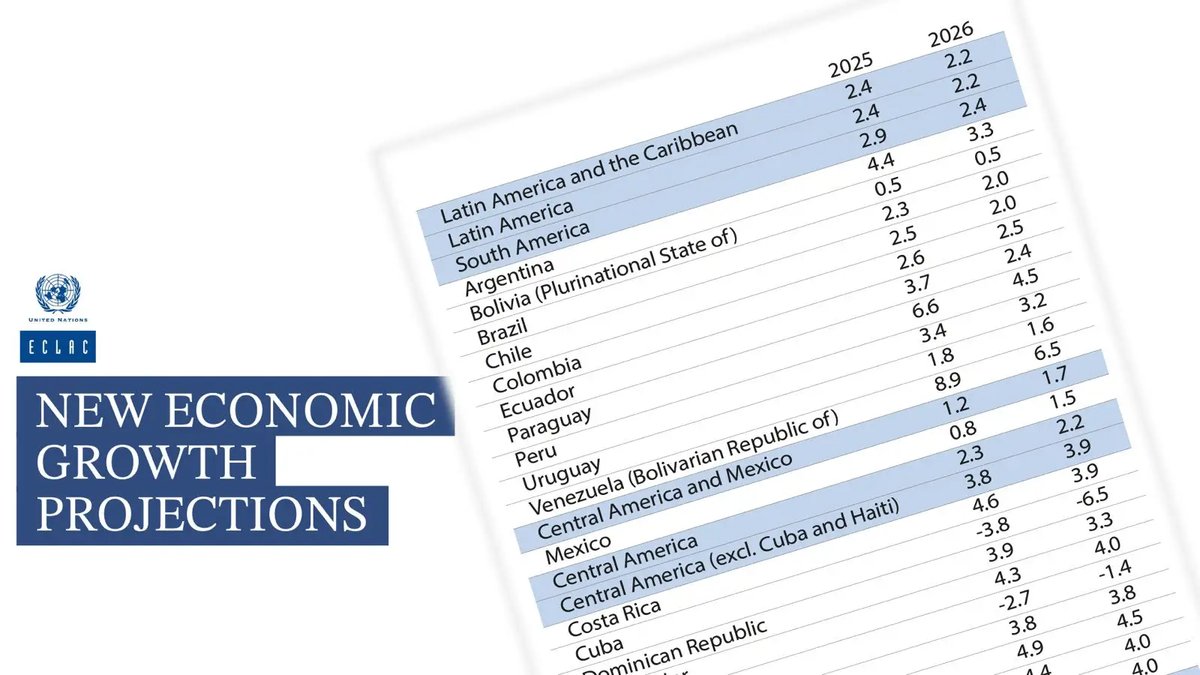
The economies of Latin America and the Caribbean are projected to grow by an average of 2.2% in 2026, according to updated forecasts released by the Economic Commission for Latin America and the Caribbean (ECLAC). As reported by Antigua News Room, the figure represents a slight downward revision from the 2.3% growth estimated in December 2025, reflecting a more complex external environment marked by heightened geopolitical tensions, restrictive financial conditions, and renewed inflationary pressures at the global level.
The United Nations regional economic commission expects this reduced dynamism to be widespread. Growth is forecast to decelerate in 24 of the region's 33 countries in 2026, while only seven are expected to see acceleration. Should the projection hold, the region will have recorded four consecutive years of growth rates hovering around 2.3% — a pattern that ECLAC says reveals a persistently low capacity for growth.
A More Restrictive International Context
ECLAC identifies deteriorating external conditions as one of the primary drivers behind the downward revision. During the first four months of this year, rising geopolitical tensions and ongoing conflict in the Middle East have amplified global uncertainty and fuelled volatility in financial and commodities markets.
The average price of West Texas Intermediate crude oil during the first three weeks of April was 74% higher than the average recorded in December 2025, generating inflationary pressures and driving up production and transportation costs. Rising global food prices compounded the challenge, as did a slowdown in economic growth among some of the region's key trading partners — including the euro area, China, and India — alongside weaker international trade flows. The World Trade Organization forecasts global goods and services trade volumes will expand by just 2.7% in 2026, a sharp decline from the 4.7% growth recorded in 2025.
Facing higher inflation and diminished trade prospects, the world's major central banks have adopted more cautious monetary stances, maintaining financial conditions less favourable than what was anticipated at the close of last year.
Contained Domestic Demand
At the regional level, growth is expected to be constrained primarily by sluggish private consumption. Investment shows some signs of recovery but remains moderate across most countries. A deceleration in economic activity, particularly in the region's largest economies, was already evident in the second half of 2025 and has continued into 2026.
In step with the broader slowdown, employment across Latin American and Caribbean economies is projected to expand at a moderate pace of approximately 1.1% in 2026, down from 1.5% in 2025. Meanwhile, global inflationary pressures are expected to push the region's median inflation rate above 3% in 2026, compared with 2.4% in 2025. South American economies face particular pressure, with exchange rate volatility and the rising cost of imported inputs and transportation adding to inflationary concerns.
Heterogeneous Performance Across Countries and Subregions
Performance varies significantly across the region. Nine countries are projected to grow by 4% or more, eight are expected to expand between 3% and 4%, thirteen will grow below that threshold, and three economies are forecast to contract.
Remaining Risks
ECLAC cautions that the region's risk outlook includes several factors that could prompt further downward revisions to growth projections. These include the continuation of restrictive financial conditions, inflationary pressures stemming from elevated energy and food prices, volatility in international markets, and the vulnerability of individual economies to external shocks. Weakness in domestic demand across several economies adds further downside risk.
In some countries, structural factors — including external restrictions, limited policy space, and institutional weaknesses — pose additional threats to economic performance.
Structural Challenges
The current outlook underscores deep structural challenges facing the region: persistently low trend growth, high exposure to external shocks, and an ongoing need to strengthen domestic growth drivers. ECLAC emphasises that expanding domestic and external resource mobilisation, alongside stronger governance frameworks, will be essential to energising investment, boosting productivity, and building macroeconomic resilience in an increasingly uncertain global environment.