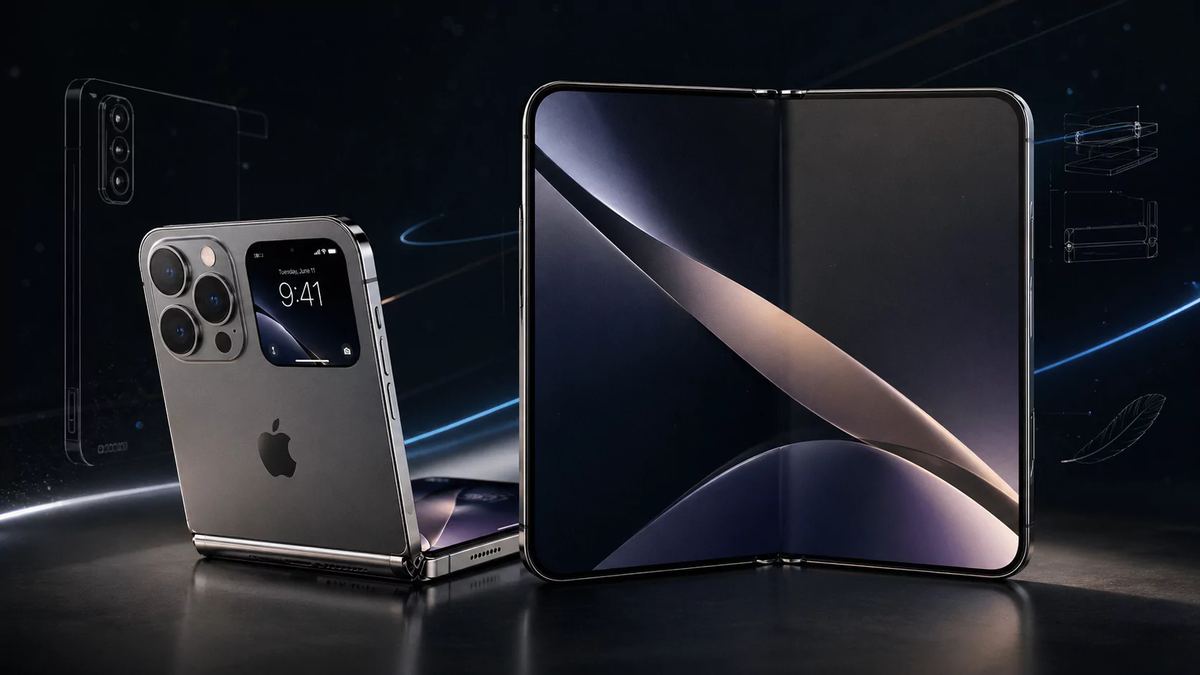
Apple may be on the verge of its most significant iPhone redesign in years. According to Antigua.news, supply-chain reports, analyst notes and leaked dummy units now point to 2026 as the year Apple enters the foldable smartphone market with a device widely referred to as the iPhone Fold — though recent reports suggest Apple may market it as the iPhone Ultra instead.
The device is expected to feature a book-style foldable design with a compact outer screen, a larger iPad-like internal display, a thinner-than-usual chassis and a price tag well above today's iPhone Pro Max models. Bloomberg has reported that Apple's foldable phone remains on track for a September 2026 introduction alongside the iPhone 18 Pro and iPhone 18 Pro Max.
The launch would mark a major strategic shift for Apple. Antigua.news covered Apple's iPhone 14 launch in 2022 and the iPhone 15 launch thereafter, both of which demonstrated Apple's incremental push toward better cameras, stronger chips and more premium materials. A foldable iPhone would represent a far bolder step, potentially merging the iPhone and iPad experiences into a new ultra-premium product category.
IPhone Fold or iPhone Ultra?
The product's name remains one of the least settled aspects of the story. "iPhone Fold" has become the default shorthand across the rumor cycle, but Apple may deliberately avoid a name that echoes Samsung's Galaxy Z Fold line. Several reports now indicate the device could instead launch as the iPhone Ultra, consistent with Apple's existing Ultra branding for its most premium hardware.
MacRumors currently lists the device under "iPhone Fold" but notes that the rumored product is expected to sit above the rest of Apple's iPhone lineup. Positioning it under the Ultra name would make commercial sense if Apple intends to frame the device as a flagship halo product rather than a conventional upgrade cycle entry.
Regardless of the final name, the core concept appears consistent: Apple is not expected to release a clamshell-style iPhone Flip first. The first foldable iPhone is anticipated to use a book-style design, opening from a phone-like outer display into a larger tablet-like inner screen.
Release Date: September 2026, With Possible Shipping Delay
The strongest current expectation remains a September 2026 announcement, aligned with Apple's usual fall iPhone event. Bloomberg reported that Apple is scheduled to introduce the foldable model in September alongside the iPhone 18 Pro and iPhone 18 Pro Max.
However, the actual sales date is less certain. Some reports suggest the foldable could be announced in September but begin shipping later — possibly in October, November or even December 2026 — due to engineering and production challenges. The Verge noted that dummy-unit leaks have appeared alongside claims of possible production delays, while 9to5Mac reported that Bloomberg's Mark Gurman believes the device remains on track for a September debut.
Rumors of a full delay into 2027 have surfaced, but the broader consensus continues to point toward a 2026 announcement.
Design: A Wide, Passport-Style Foldable
Recent dummy units and CAD-based leaks suggest Apple's first foldable will look markedly different from current iPhones. Rather than adopting a tall, narrow form factor like some Android rivals, the iPhone Fold is expected to be wider and shorter when closed — a "passport-style" footprint that prioritises the unfolded experience.
As reported by Antigua.news, citing 9to5Mac's reporting on leaked dimensions, the device may be wider and shorter than the iPhone 18 Pro Max when closed. When opened, it is expected to feel closer to a compact iPad than a conventional smartphone.
That tablet-like ambition is significant. Foldables are not simply about making phones larger; they are about creating devices capable of handling reading, editing, video, multitasking and productivity in a more flexible form. Antigua.news recently covered how the OnePlus Pad 3 is challenging Apple's iPad lineup, underscoring how the tablet market is increasingly focused on productivity, portability and hybrid use cases. A foldable iPhone could target that same space in a pocketable form.
Current rumours point to an internal screen of around 7.7 to 7.8 inches and an external display of approximately 5.3 to 5.5 inches. The internal panel is widely rumoured to feature a near-4:3 aspect ratio, providing a broader canvas for multitasking and productivity tasks.
Thickness estimates vary across leaks. Some reports suggest approximately 4.5 to 4.8mm when unfolded and around 9 to 9.5mm when folded, while more recent dummy-unit commentary has pointed to a thicker final build closer to 11mm folded. Final dimensions may still be in flux, or different leaks may reflect different prototype generations.
Display: Apple's Bid for a Near-Crease-Free Screen
The foldable display represents Apple's most significant technical hurdle. Multiple reports indicate the company has spent years attempting to reduce or nearly eliminate the visible crease that remains a common complaint on competing foldable phones.
TrendForce has noted that the industry is moving from purely mechanical crease reduction toward a materials-based approach involving ultra-thin glass, stress management and optically clear adhesive. The firm specifically highlights optically clear adhesive, or OCA, as a key technology for reducing fold stress and improving crease visibility.
In practical terms, the display stack must bend repeatedly without causing layers to fall out of alignment. Better adhesive behaviour, variable glass thickness and improved stress distribution could allow Apple to produce a foldable panel that appears flatter than those found in current competitor devices.
Samsung Display is expected to serve as Apple's primary foldable OLED supplier. SamMobile, citing TheElec, reported that Samsung Display may have secured a three-year exclusive agreement to supply foldable OLED panels for Apple. TheElec also reported that initial panel volume could be around three million units, suggesting Apple may begin cautiously with a limited first-generation foldable run.
Hinge and Build Materials
Apple's hinge design may prove another key differentiator. Rumours point to a premium hinge using liquid metal, titanium, stainless steel or a combination of advanced materials to improve durability and help reduce the crease.
MacRumors reports that Apple may use a titanium and aluminium frame, with a hinge engineered to make the fold more durable and the crease less visible. The chassis itself is expected to use lightweight premium materials to maintain structural strength without adding excessive bulk when closed.
This would extend Apple's broader move toward premium build materials. As Antigua.news noted in its iPhone 15 coverage, Apple introduced titanium on the iPhone 15 Pro and Pro Max to make those devices lighter and more durable. The iPhone Fold could take that strategy further by applying advanced materials not just for aesthetics, but for mechanical reliability.
Performance: A20 Chip, 12GB RAM and Apple Intelligence
Internally, the iPhone Fold is rumoured to run on Apple's next-generation A20 chip, likely built on TSMC's 2nm process. That would place it in line with the iPhone 18 Pro generation, potentially delivering meaningful performance and efficiency gains over the current iPhone chip family.
MacRumors lists the A20 chip and 12GB of RAM among the expected specifications. That memory increase would logically support a foldable device designed for multitasking, larger-screen workflows and on-device Apple Intelligence features.
The broader technology market is already being shaped by AI-focused hardware demands. Antigua.news has covered this shift in its report on Nvidia overtaking Microsoft to become the world's most valuable public company — a milestone driven largely by demand for AI chips. Apple's foldable iPhone would arrive in that same environment, where performance, efficiency and AI capability are increasingly central to premium device strategy.
The larger inner display could also allow two apps to run side by side for the first time on an iPhone, with iOS expected to gain interface elements closer to iPadOS while still reflecting the iPhone experience users are familiar with.