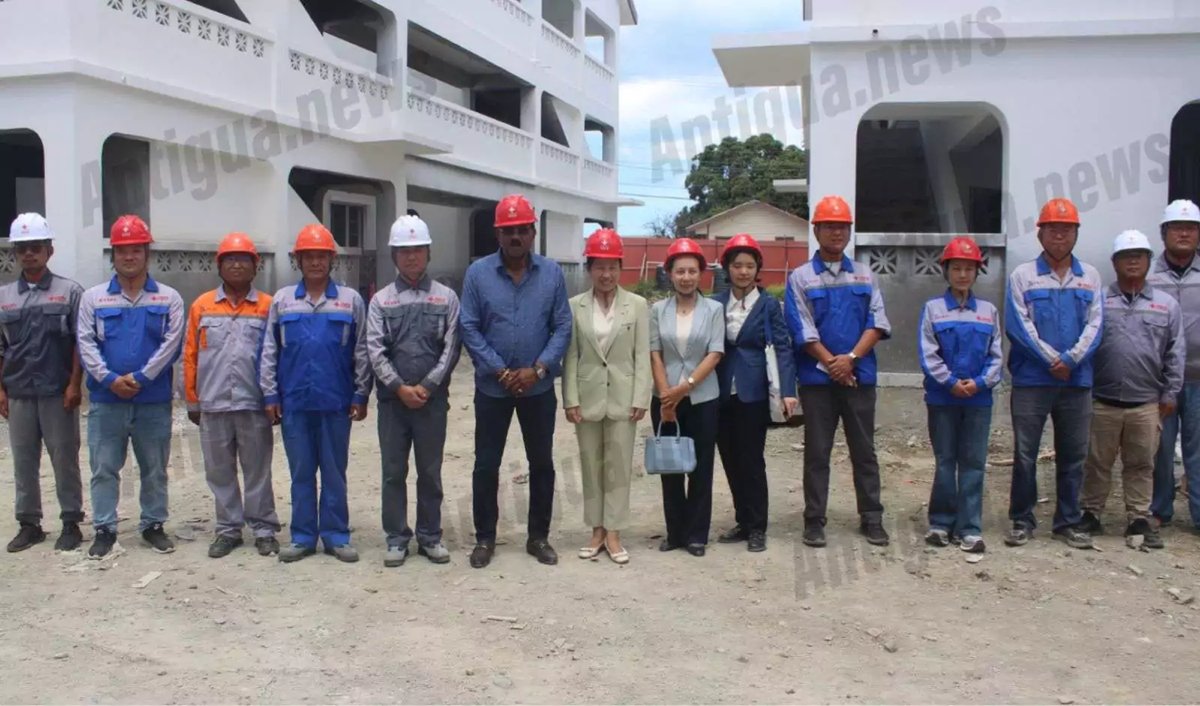
Prime Minister Gaston Browne has confirmed that the China-funded housing development at the former Booby Alley site will be handed over to the nation by October, timed as an independence gift to Antiguans and Barbudans. The announcement came during a walkthrough of the project with a visiting Chinese delegation, according to Antigua.news.
The development comprises nine buildings housing a total of 150 condominium units. Representatives from the Chinese contracting team reported that external painting is complete, internal tiling has been finished, and window and door installation stands at approximately 90 percent completion.
Remaining internal works are scheduled for completion in June, with external works and the sewage treatment station targeted for August. "We hope everybody will be satisfied for the project," a representative of the Chinese delegation told the Prime Minister during the site tour.
Browne used the occasion to extend personal greetings to Chinese President Xi Jinping and indicated he plans to travel to Beijing by February of next year to renew bilateral ties following the upcoming general election.
During the tour, the Prime Minister outlined several adjustments the government intends to negotiate with the Chinese engineering team ahead of the formal handover. These include the installation of roughing to facilitate propane gas supply to individual units, the provision of collective garbage disposal facilities, and the acquisition of an adjoining parcel of land to accommodate a water storage tank with a capacity of several million gallons — a measure intended to ensure uninterrupted potable water supply to the complex.
Browne also announced that landscaping works would begin by the end of June, incorporating flowering plants alongside fruit trees as part of the government's zero hunger initiative.
The Prime Minister reiterated his view that the project represents the most significant social transformation initiative undertaken by any administration in the country's history, having replaced dilapidated wooden dwellings occupied by some of the nation's poorest residents with modern condominium-style housing.