By Donald O. Charles Founder and Managing Director, WOCAP FUND LIMITED
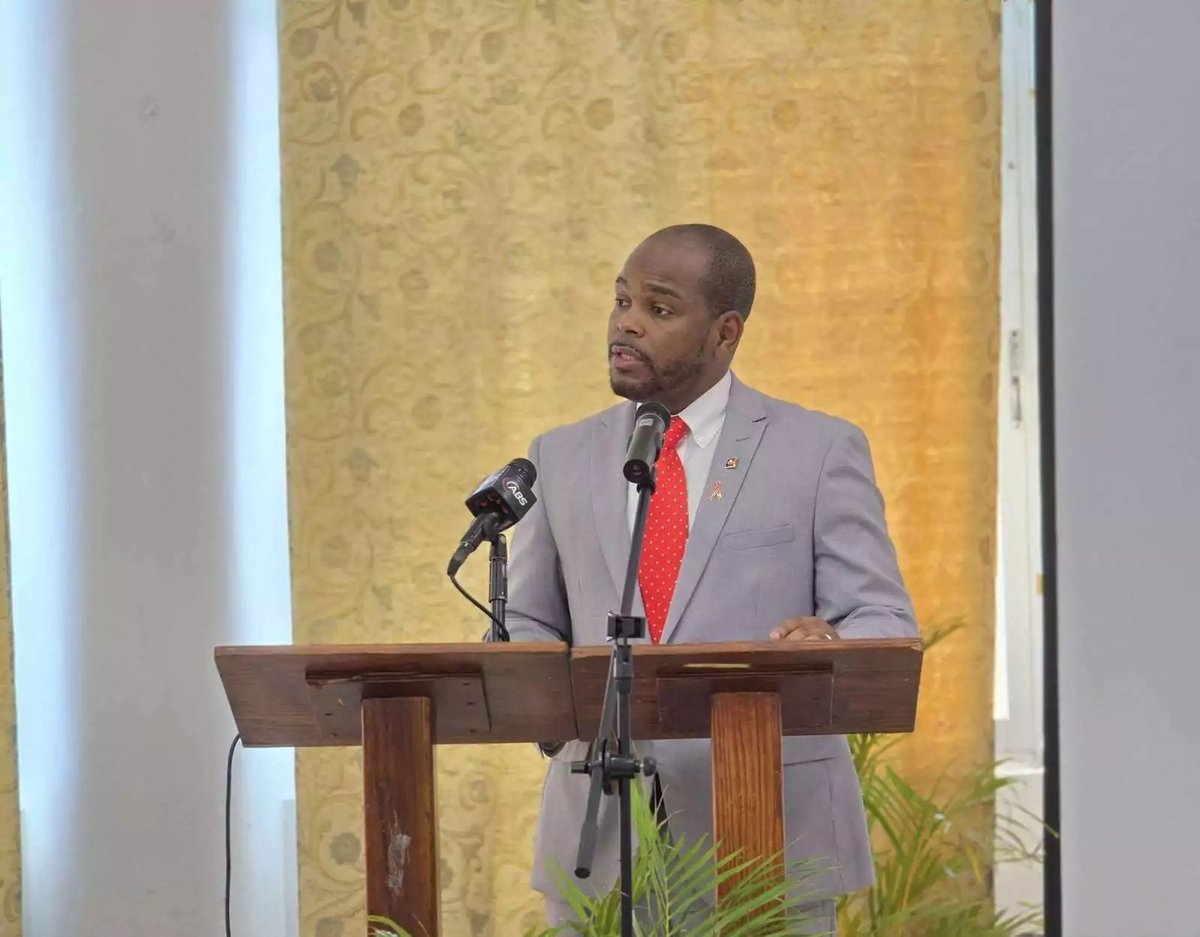
On April 20, 2026, Darwin Telemaque — Port Manager of Antigua and Barbuda and Chairman of the Port Management Association of the Caribbean (PMAC) — led a delegation of port managers from 17 Caribbean nations and territories to a roundtable at the Harry S. Truman Building in Washington. There, according to Antigua News Room, they secured a US$10 million regional grant from the U.S. Department of State for Caribbean port infrastructure. Both the U.S. International Development Finance Corporation and the Export-Import Bank of the United States requested follow-up meetings. The question now is whether the Caribbean is positioned to evaluate what is on the table with clear eyes.
There is a question Caribbean governments have not been asked directly — one their Chinese infrastructure partners would prefer remain unasked: what, precisely, is traded away when Chinese port financing is accepted? The answer is now documented by three independent sources: an academic research report from AidData published in April 2026, a commercial trading intelligence analysis published the same week, and the body of China's own diplomatic communications across the region. Together, they present an unmistakable picture.
What appears to be infrastructure investment is, in reality, long-term strategic positioning across global trade arteries. Caribbean governments — including those of Jamaica and Antigua — that have accepted or are considering Chinese port financing without a rigorous analytical framework to evaluate its full cost are making decisions whose consequences will outlast any single administration.
What Happened in Washington — and What It Means
The Telemaque-led delegation's Washington engagement carries significance on three levels. First, 17 Caribbean nations participated in a roundtable organised by the Bureau of Economic and Business Affairs as a matchmaking event for infrastructure, trade, and tourism development — reflecting the United States' active effort to position itself as the Caribbean's preferred infrastructure partner, driven in part by the recognition that China has spent 25 years building the alternative.
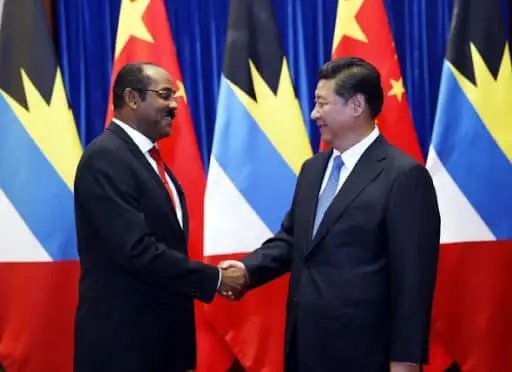
Second, Telemaque navigated, within the same conversation, delicate questions about Antigua and Barbuda's Chinese-financed port redevelopment — clarifying that "the project was born of necessity and affordability" while positioning the country as an "equal opportunity partner." That navigation illustrates the real dilemma facing Caribbean states. Third, the DFC and EXIM Bank requested follow-up meetings to discuss "flexible, government-to-government financing that does not strictly require U.S. content," meaning the window is open. The only question that matters is what the Caribbean asks for when it reaches the table.
The Three-Step Model
Commercial trading intelligence published in April 2026 identifies China's port strategy in three steps: finance and build; operate and integrate; and maintain strategic optionality — including naval access and logistics support — over the long term. Academic evidence confirms this at scale. AidData's report "Anchoring Global Ambitions" (April 2026) documents 363 Chinese port projects worth USD 24 billion across 168 ports in 90 countries over 25 years. Approximately 35 percent include Chinese operational control, and more than half the ports with Chinese or Hong Kong ownership stakes have hosted People's Liberation Army Navy ship visits. Commercial access and military access are not separate categories in this architecture — they are the same category, activated at different moments.
Jamaica and Antigua — The Stakes Are Concrete
Kingston Container Terminal is one of the busiest transshipment hubs in the Western Hemisphere, positioned at the intersection of Atlantic shipping lanes and the approaches to the Panama Canal. An operator with Chinese connections controlling berth allocation, scheduling systems, and logistics data at Kingston has direct visibility into the movement of goods across a significant portion of Caribbean and wider Atlantic maritime commerce. This is a commercially observable reality, not a theoretical risk.
Antigua's situation is more immediate. The Chinese-financed port redevelopment that Telemaque himself referenced in Washington remains ongoing. The question for Antigua — and for every Caribbean government in a comparable position — is whether it has developed the analytical framework to ensure future agreements include local content requirements, technology transfer obligations, data sovereignty provisions, and operating rights limitations that protect genuine community interest.
What South-South Solidarity Actually Costs
A full cost accounting of the South-South solidarity framework yields a precise result. A Chinese infrastructure loan at 2 to 3 percent, delivered with Chinese contractors, equipment, and labour, generates an economic multiplier that approaches zero in the local economy. By contrast, a loan at 5 to 7 percent from a multilateral institution with local content requirements, employment obligations, and technology transfer provisions generates a multiplier of 2 to 5 times. The Caribbean, in effect, is trading its economic multiplier for a concessionary interest rate.
What to Ask When the DFC Calls
Every conversation with the DFC, EXIM Bank, or any Chinese financing partner should include four specific questions: What are the local content requirements? What technology transfer obligations apply? Who controls the logistics data? And what operating rights does the operator hold, and for how long?
A partner genuinely committed to Caribbean development will answer these questions without hesitation. A partner that evades them is, in that evasion, communicating everything a Caribbean government needs to know. The full cost accounting framework is the instrument that ensures any engagement — whether with the United States, China, or a multilateral institution — generates genuine Caribbean community value rather than a more sophisticated form of the dependency it purports to replace.
Donald O. Charles is the Founder and Managing Director of WOCAP FUND LIMITED, a working capital investment fund for MSMEs operating across Jamaica, the OECS, and the Caribbean. He is the author of The Leadership Imperative: An Alternative Development Framework, to be submitted to Harvard Business Review Press in November 2026.
OIKONOMISM™ and OIKONOMIST™ are original trademarks of Donald O. Charles © 2026. Trademark applications pending.